How we ranked these
The certification clause, and who printed it.EN 13594 is the European standard for motorcycle gloves. The test house SATRA describes its two levels plainly: “Level 1 for gloves designed to give protection while having low ergonomic penalties, and level 2 for gloves providing greater protection than level 1.” The standard covers tear strength, seam strength, cut resistance and impact abrasion. Knuckle impact protection is, per SATRA, “an optional feature for level 1 gloves” and mandatory at level 2 — a glove that passes the knuckle test carries the KP mark. Our CE armor and gear ratings guide walks through the whole label system, including why EN 13594 and EN 17092 are not interchangeable.
That last point matters more on this page than on any other gear page we have built, because one of these gloves gets it wrong in public. We rank a maker’s own printed clause above a retailer’s, a clause with the year above one without, and any clause at all above none.
The palm slider.In a slide your hand goes down flat and the heel of the palm takes the first contact. Leather grips asphalt. A hard TPU plate on the palm does not — it lets the hand skid, which is the difference between sliding and your wrist stopping while the rest of you keeps going. Five of the six gloves here have one. The sixth does not, and that single omission is most of why it ranks last.
The finger bridge.Alpinestars describes it exactly: “linking the third and fourth fingers to prevent finger roll and separation during a slide.” It is a small piece of leather that costs almost nothing and is almost never fitted below the race tier. Three of these six have it. If you are looking at a glove for actual track use, this is the feature to check for first, because it is the cheapest one to leave out and the easiest to miss in a photograph.
The palm material. Kangaroo leather is the race standard because it reaches the same abrasion performance as cowhide at a much thinner section, so you feel the lever and the throttle instead of feeling the glove. Goatskin is the next step down and is genuinely good. The two gloves here with kangaroo palms are the two at the top. On the GP Pro R4, Alpinestars also builds the palm with the seams on the inside, which removes the ridge that sits under your fingers on an outseam glove.
What “track legal” actually means
There is no single rule. Track-day organizations and club racing bodies each publish their own gear requirements, and they are not the same from one paddock to the next. What they have in common is a floor: full-gauntlet leather gloves that overlap the suit sleeve, with no exposed skin at the wrist. Some groups also look for external hard knuckles or a palm slider at tech inspection, and some are stricter for race licensing than for a novice track day.
Check your organization’s published tech sheet before you buy. We are not going to tell you a glove passes an inspection we have not stood in, and any page that does is guessing. What we can tell you is which gloves on this page carry the features those sheets usually name: all six are full-gauntlet leather, five have a palm slider, three have a finger bridge, and four carry a published CE clause.
Race glove, sport glove, street glove
These three terms get used interchangeably in listings and they describe different products.
A race glove is built for a crash at racing speed and accepts every ergonomic penalty that buys: a tight pre-curved fit that is uncomfortable standing still, a thick gauntlet over the suit, no ventilation worth mentioning in traffic, and a price that reflects kangaroo leather and a lot of hand assembly. The GP Pro R4, the Jerez 4 and the GP Plus R V3 are race gloves.
A sport glove borrows the hardware and relaxes the fit. The Alpinestars SP-8 V3 on this page is the clearest example: a gauntlet cuff, a dual-density hard knuckle, a printed EN 13594:2015 Level 1 KP clause and touchscreen fingertips, in a glove you can wear to work. It is the pick for a rider who wants race hardware on a glove that lives on a road bike, and it is also the top pick on our general motorcycle glove ranking.
A street glove is everything else, including most of what is sold with a checkered-flag graphic. It is not what this page is about, and if you want a short-cuff glove for commuting our beginner glove rankingis the better page. If you ride in the cold or the wet, a race glove is actively the wrong tool — none of these has a membrane or insulation — and our winter glove ranking and touring glove ranking cover those jobs properly.
The picks in full
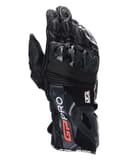
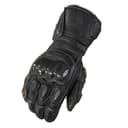
Buy the Alpinestars GP Pro R4 if you want the complete race specification without going to the top of the catalog.It is the only glove on this page whose maker prints the whole clause itself — “Category II EN 13594:2015, Level 1 KP” — and it has all four of our criteria: the clause, palm and finger sliders, the finger bridge and a kangaroo palm. Alpinestars also builds the palm with inner seams and adds aramid reinforcement on the backhand and landing zones, a ventilated knuckle gusset and a dual closure at the wrist and the gauntlet. The honest limits: it is Level 1 KP like everything else here, it has no membrane and no insulation, sizes stop at 3XL, and the race fit runs tight — if you are between sizes in a street glove you will probably be a size up in this one.
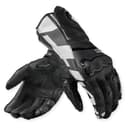
Buy the REV’IT! Jerez 4 if you want the maximum published hardware and the budget is not the constraint.The US listing counts TPU protection at six separate points — knuckles, finger knuckles, thumb, little finger, palm and cuff — with REV’IT!’s SEESOFT 3D|FIT construction putting a soft layer underneath the hard knuckle shell. The chassis is cowhide and kangaroo with an aramid liner, and the size range is the widest here at XS to 4XL. REV’IT! also runs a crash replacement program covering the glove for five years, which is a real part of the value at this price. The honest limits: it is the most expensive glove on the page by a wide margin for the same certified Level 1 KP as the cheapest certified one; the listing describes a “regular cuff” rather than an extended race gauntlet, which is worth checking against your organization’s tech sheet; and the tri-fleece liner makes it warm for anything other than track use.
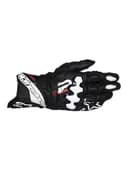
Buy the Alpinestars GP Plus R V3 if you want a real race glove without flagship money.It keeps the race-derived finger bridge, which is the feature that disappears first as prices fall, and it keeps the TPU dual-density knuckle, the palm slider, the finger sliders and a TPR wrist reinforcement. The palm and top hand are full leather with aramid reinforcement, and the gauntlet closes with a sublimated leather hook-and-loop upper plus a lower retention strap overlapped by palm leather. The honest limits: the listing prints “CE certified Level 1 knuckle protection” without the EN 13594 number or the year, which is weaker wording than Alpinestars uses one model up; the palm is goatskin rather than kangaroo, so it is thicker on the grips; and sizes stop at 2XL, the narrowest range here.
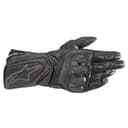
Buy the Alpinestars SP-8 V3 if you ride on the road and want race hardware you can live with. It is the odd one out on this page on purpose. Full-grain goat leather, a MotoGP-derived dual-density knuckle, a gauntlet cuff that covers the wrist a short glove leaves bare, a printed CE Level 1 KP certification to EN 13594:2015, and touchscreen fingertips. It is the glove most riders on this page should actually buy, because most riders are not going to a track day. The honest limits: no palm slider and no finger bridge, so it is not a race glove and we have not ranked it as one; no membrane, so it is not a wet-weather glove; and the gauntlet takes a moment longer on and off than the short gloves it competes with on the street.
Buy the ScorpionEXO SG3 MK III if you want the most hardware per dollar and you have read the caveat.On features alone it punches far above its price: a carbon-fiber-reinforced TPU knuckle guard, a custom palm slider, hard TPU finger armor over impact foam, perforated goat leather front and side, a dual-closure gauntlet, accordion stretch zones and touchscreen thumb, index and middle fingers — the only touchscreen gauntlet here. The caveat is the reason it sits fifth rather than second: the listing publishes no EN 13594 certification at all. Not a level, not a year, not a KP mark. That is not evidence the glove is uncertified, but on a page ranked on published protection it is the single most important thing a listing can omit. It also has no finger bridge, and the perforation that makes it the coolest glove here makes it the wrong one for a cold morning.
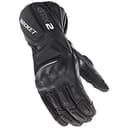
Buy the Joe Rocket GPX 2.0 only if the budget is the whole decision.It is the cheapest full-gauntlet goatskin glove we found from a brand that publishes a spec sheet, it has a full leather palm with a padded overlay, internal injection-molded knuckle armor, a reflective panel over the knuckle, a double hook-and-loop cuff closure and sizes to 3XL. For a first gauntlet or a spare pair in the tail bag, that is a reasonable thing to exist. It is not a race glove and we will not call it one. Joe Rocket’s own page states “EN 17092-A CERTIFIED” — EN 17092 is the standard for riding garments such as jackets and pants, not for gloves, which are covered by EN 13594 — and we could find no EN 13594 statement for this glove anywhere. The knuckle armor is internal rather than an external hard shell, there is no palm slider, and there is no finger bridge.
What we left out, and why
The Alpinestars GP Tech V2 S.Alpinestars’ top race glove, above the GP Pro R4, and a genuinely better piece of equipment. We ranked the R4 instead because the GP Tech sits at a price where a buyer reading a roundup is almost certainly not the customer, and because on the day we checked the available listings were down to single-digit stock in a handful of sizes. If you race seriously and the money is not the issue, buy that one.
The Dainese Full Metal 7 and Druid 4.Two of the most respected race gloves made, and both were listed on our check date at “usually ships within 2 to 3 weeks.” We do not rank a glove a reader cannot have before their next track day, and a three-week lead time on a size-critical item is a worse buying experience than anything we would save you in money.
The RST Tractech Evo 4 CE. A certified race glove at a fair price and an easy recommendation on paper. Every listing we found was down to three or four units in a single size and color, which is what the end of a product run looks like. We would rather say that than send you to a page that is empty by the time you read this.
Held, Furygan, Spidi and the other European race names. They make superb gloves and riders ask about them constantly. Our searches on the check date returned no US listing a reader could buy from in their size. We would rather name the gap than rank something you cannot actually get.
Anything claiming “CE Level 1” only in the listing title.Search any of these terms and the results fill with cheaper gauntlets whose titles claim EN 13594 or Level 1 KP. Some may well be certified. A listing title is not a maker’s certification statement, and we could not find one to check for any of them, so the rule we use on every gear page applied here too.