How we ranked these
Certification is the gate, and it is a low one here. Every helmet on this page is DOT FMVSS 218 certified and none of them claims anything else. Not one manufacturer page or US retailer listing we read stated ECE 22.06 or a Snell rating for an open-face or half helmet, including the $600 Shoei. That is worth sitting with for a second, because in our full-face roundup the picks stack DOT plus ECE 22.06 plus Snell M2025 at half the money. It is also why we did not rank this page on certification: with every entry on the same single standard, the certification column tells you nothing about which one to buy. Our safety-ratings guide explains what each standard actually tests and who verifies it.
So shell material became the first real differentiator.Below the certification line, construction is the thing that varies most in this category and the thing that gets buried deepest in the listings. Six of these seven use a fiberglass or aramid composite layup — Shoei’s AIM, Bell’s TriMatrix Kevlar/carbon/fiberglass blend on the Pit Boss and fiberglass on the Custom 500, Scorpion’s Ultra-TCT, Sena’s composite fiberglass and LS2’s HPFC — and only the HJC is injected polycarbonate. Composite is not automatically safer for you in a given crash, but it is the more expensive and more controllable way to build a shell, and at the same money it is the better indicator of where a maker spent.
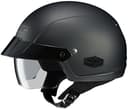
Then the sun shield, which matters more here than anywhere else. A full-face rider can swap to a tinted shield. An open-face rider with no internal sun shield is riding into low sun in sunglasses, taking them off in tunnels, and putting them back on at the next bend. Four of these seven have a drop-down shade — the Shoei’s QSV-2, Bell’s sun shade on the Pit Boss, Scorpion’s SpeedView on the Covert X, and HJC’s HJ-V4 on the IS-Cruiser. It is the single feature most worth paying for on this page, and it is why the cheapest helmet here is not the best value.
Then the fit system, because open-face helmets lift.The complaint every three-quarter helmet owner eventually has is aerodynamic: with no chin bar to anchor the front of the shell, wind gets under the leading edge and tries to peel the helmet up off your head at highway speed. Bell built an actual mechanism for this — the Speed Dial ratchet at the back of the Pit Boss — and it is the reason that helmet outranks better-looking lids here. Everything else on this page relies on you having ordered the right size, which our sizing and head-shape guide covers properly.
Then weight, as the tiebreaker.The spread on this page is enormous: 950 g for the Sena Cavalry 2, 1,615 g for the Shoei J-Cruise II. That is a 665 g gap between the lightest and heaviest, and it is bigger than the gap between most full-face helmets, because the heavy open-face helmets are carrying a big shield and a sun visor while the light ones are carrying almost nothing. Both ends are defensible — you are simply choosing between features and neck fatigue.
Open-face, three-quarter, half helmet: what actually differs
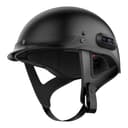
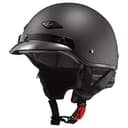
The words get used loosely, so here is the practical version. Open-face and three-quarter mean the same thing: a shell that covers the top, back and sides of your head down past your ears, with your face exposed from the brow down. The Shoei J-Cruise II, the Bell Pit Boss and the Bell Custom 500 are all this shape. A half helmet(or shorty) covers less — the crown and the back of the skull, typically stopping above or at the ears. The LS2 Bagger and the Sena Cavalry 2 are half helmets, and the HJC IS-Cruiser sits in the same group with more coverage at the rear than most.
The difference is not academic, and it is not just about impact area. A three-quarter shell puts material between the wind and your ears, which makes it quieter and makes an intercom speaker usable. A half helmet leaves your ears in open air, which is why every half helmet here either has speaker pockets with a wire channel or, in the Cavalry 2’s case, builds the speakers into the shell. If comms are a priority, the shape decides more than the brand does — and our intercom roundup covers the units that clamp on to whatever you already own.
The Scorpion EXO Covert Xis the odd one out, and deliberately so. Its front mask and ear covers come off on neodymium magnets, so one helmet gives you a full-coverage shape, a three-quarter shape and a half shell. Read that as a styling and wind-management feature, not as a certified chin bar — a magnetic mask is not tested or homologated as impact protection, and we would not want anyone buying it on the belief that it converts into a full-face helmet.
The coverage you give up, stated plainly
DOT FMVSS 218 tests the helmet it is given. An open-face helmet goes through the same impact-attenuation, penetration and retention-system tests as a full-face helmet — over the area it covers. It is not a weaker test; it is the same test applied to less helmet. That distinction matters because a “DOT approved” sticker on a half helmet is often read as a safety equivalence claim, and it is not one. A certified half helmet is a certified half helmet, with everything below your brow line uncovered.
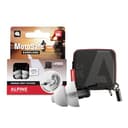
Two practical consequences follow. First, eye protection is a separate purchase on most of this page. Only the Shoei J-Cruise II and the Scorpion Covert X supply a clear visor you can ride behind after dark. The Pit Boss and the IS-Cruiser have a tinted drop-down sun shade and no clear shield; the Custom 500 has a 5-snap pattern waiting for an aftermarket one; and the Bagger and the Cavalry 2 leave it to your sunglasses or goggles. Second, wind noise is worse, in some cases dramatically. That is a hearing-damage issue on a long ride rather than a comfort quibble, and it is the reason earplugs sit in the essentials block below. If quiet is what you are actually after, our quietest-helmets ranking and our wind-noise guide are the honest places to go, and both will point you back toward a full-face.
If you have not actually settled the question yet, our open-face vs full-face comparison is the decision page: what each type covers, the certification gap between them, and the published weights that contradict the usual assumption that an open-face is the lighter helmet.
Match the pick to your riding
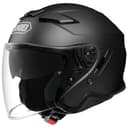
The Shoei J-Cruise IIis the best helmet here by a clear margin, and it is also the least logical purchase on paper. You are paying premium full-face money for an AIM composite shell in four shell sizes, a Pinlock-ready CJ-2 shield with tool-less removal, a QSV-2 internal sun shield, and a shell tooled to take Shoei’s SRL headset flush. Nothing else in this category has that shield or that comms integration. The catches are real: it is the heaviest helmet on the page at about 1,615 g, the Pinlock insert costs extra, and Shoei’s own US distributor lists the standard as DOT alone. Buy it if you have decided you want an open-face helmet and now want the best-built one.
One update worth knowing before you spend that money: Shoei now sells the J-Cruise 3in the US above the II, on a revised shell and reworked ventilation, and it is listed at roughly two hundred dollars more. We have kept the II ranked because it is still widely stocked, distinctly cheaper, and — the part that matters for this page — the US listing for the 3 states DOT FMVSS 218 alone as well. If you have read a European review crediting the J-Cruise 3 with ECE 22.06, that is the EU-market version of the helmet, not the one a US buyer receives. It is the same market split we record on the Neotec 3 and Schuberth C5. So the 3 buys you a newer helmet, not a better certification.
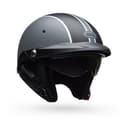
The Bell Pit Bossis the one we would point most riders at first. It has the Speed Dial fit system that directly addresses the lift problem, an internal drop-down sun shade, speaker pockets, a removable neck curtain, and a Kevlar/carbon/fiberglass TriMatrix shell — all at a price that sits well below the Custom 500. Its weaknesses are that it is heavy for a helmet with no chin bar and no shield, and that two shell sizes have to stretch across an XS/SM to 3XL run.
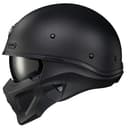
The Scorpion EXO Covert X earns its place for riders who genuinely cannot pick a shape. Composite Ultra-TCT shell, dark-smoke SpeedView sun visor with anti-fog fitted, a clear visor supplied for nights, and ear covers with speaker pockets in the box. At about 1,501 g it is the second heaviest here, which is the arithmetic of a convertible: you carry the hardware for all three configurations no matter which one you are riding in.
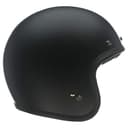
The Bell Custom 500 is a styling purchase and we have ranked it as one. What justifies it on the spec sheet is unusual though: five shell and EPS sizes, which is more than most full-face helmets offer and the reason a size Small looks like a size Small rather than a bowling ball. It has no shield, no sun visor, and Bell notes it runs small. Buy it because you want that silhouette on a classic bike, not because you want features.
The HJC IS-Cruiser is the best of the true half helmets, and the reason is one feature: a drop-down HJ-V4 sun shield at a budget price. It is the heaviest half helmet here at about 1,197 g and the only polycarbonate shell on the page, but nothing else this cheap solves glare. The LS2 Baggerundercuts it and answers a different question: lightest, cheapest, fiberglass composite, zip-off neck skirt for cold mornings, speaker pockets with a hidden wire channel — and no sun visor at all.
The Sena Cavalry 2is the specialist. It is a 950 g composite half helmet with Sena’s Mesh Intercom 3.0 built into the shell, quoted at up to 0.8 miles bike-to-bike in open terrain with Group Mesh for up to 24 riders and 18 hours of talk time. On a half helmet, where there is no good place to clamp a unit and no shell to shield the speakers, building it in is a genuinely better answer than bolting it on. You pay for the electronics, they are not removable, and Sena does not state a sun visor. If group riding on a cruiser is your use case, nothing else here is close — and if you would rather keep the helmet and the comms separate, the cruiser helmet roundup covers the full-face and modular route to the same result.
What we left out, and why
We left out the whole category of unbranded “DOT approved” novelty shorties sold on the big marketplaces for less than the cost of a tank of fuel. The problem is not that they are cheap; it is that the certification claim is the only claim they make, and there is nothing published behind it — no shell material, no weight, no size chart worth reading, often no importer to hold accountable. We do not rank gear whose central protection claim cannot be checked against something a manufacturer put in writing, so none of them appear.
We also left out the Scorpion EXO-C110, which would otherwise have been a natural budget pick with a sun visor. It has aged out: it is gone from the major US retailers’ current lineups and the remaining listings are single-unit closeouts, which is not something to send a reader at. And we did not include modular helmets, even though a flip-up gives you an open-face experience at a stoplight, because a modular is a full-face helmet by certification and coverage — that comparison is its own page in full-face vs modular, and the ranked modular picks live in the modular roundup.