The Lid Test

The Best Motorcycle Helmet Speakers

Almost nobody buys motorcycle helmet speakers on their own — they arrive as part of a comms kit, wired to the control unit that drives them. So this page ranks the kits by what actually comes out of the speakers, and explains why a helmet is a genuinely hostile place to put audio.

By Stephen V.Last verified How we compare

Search for “motorcycle helmet speakers” and you will find two very different things: cheap generic drivers on a wire, and the speaker sets that come packaged with a comms system. The second is what nearly everyone ends up buying, and for a good reason. A speaker on its own has no amplifier, no Bluetooth radio, no noise-canceling microphone and no waterproof control you can operate with a glove. The speakers are the output stage of a system, and the system is what determines whether they sound like anything at all.

So this ranks comms kits by their audio hardware— whose drivers are in the box, and what the maker publishes about them. Two brands actually put a named audio partner on the spec sheet: Cardo with JBL and Sena with Harman Kardon on its premium units. Where a maker does not name an audio partner, we say so rather than invent one. We do not have a listening room and we do not run measurements, so this is a comparison of published hardware and system design, not a subjective sound test we did not perform.

How this is funded:we earn a commission if you buy through our links, at no extra cost to you. It never changes which helmet we recommend, and we’ll tell you plainly when a cheaper or lighter one is the better buy. Full disclosure.

Quick picks

Ranked on our spec score — certification, weight, features and value. Select a row to jump to the full write-up. We have not tested these helmets; here is exactly how we compare them instead.

#HelmetBest forOur scorePrice
1
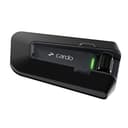
Cardo Packtalk Edge

Cardo Packtalk Edge

The mesh intercom most groups converge on. Second-generation DMC mesh keeps a 15-rider group connected without re-pairing, JBL speakers handle audio, and the Air Mount magnetic bracket is the best mounting system in the category. IP67 and voice-operated.

Best sound overall9.2
$393.95 · View on Amazon

$439.9510% off

Price as of August 31, 2026. #ad How we’re funded

2
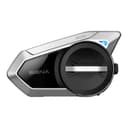
Sena 50S

Sena 50S

Sena's flagship mesh unit and the main rival to Cardo's Edge. Harman Kardon speakers, a headline 5-mile Open Mesh range, and 24-rider group mesh. If your riding buddies run Sena, this is the one that talks to them natively.

Best Sena audio8.8
$303.20 · View on Amazon

$379.0020% off

Price as of August 31, 2026. #ad How we’re funded

3
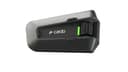
Cardo Packtalk Neo

Cardo Packtalk Neo

The Edge's mesh brain in a slightly cheaper package: the same 2nd-gen DMC mesh, JBL sound, 15-rider groups and IP67 rating, on a traditional clamp mount instead of the magnetic Air Mount. If you don't need the magnet, it's the value mesh pick.

Best value JBL8.9
$251.95 · View on Amazon

$359.9530% off

Price as of August 31, 2026. #ad How we’re funded

4
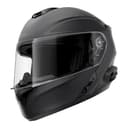
Sena Outrush R

Sena Outrush R

The shortcut to a helmet-and-comms setup: the Outrush R builds Bluetooth speakers, a mic and a 4-way intercom into the shell, so there is no external unit to buy, clamp on or charge separately. DOT-certified, with a sun visor, at a single sensible price.

Best built-in8.1
$287.20 · View on Amazon

$359.0020% off

Price as of August 31, 2026. #ad How we’re funded

5
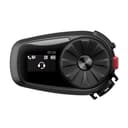
Sena 5S

Sena 5S

The sensible starter comm. It skips mesh entirely — a simple, reliable two-way Bluetooth intercom, HD speakers, a backlit setup screen and a class-leading 18 hours of talk time. If you ride solo or two-up and want music and phone calls, this is plenty.

Best budget8.0
$135.20 · View on Amazon

$152.1011% off

Price as of August 31, 2026. #ad How we’re funded

The picks in full

#1Best sound overallOur score9.2

Cardo Packtalk Edge

The mesh intercom most groups converge on. Second-generation DMC mesh keeps a 15-rider group connected without re-pairing, JBL speakers handle audio, and the Air Mount magnetic bracket is the best mounting system in the category. IP67 and voice-operated.

Strengths

  • 2nd-gen DMC mesh auto-manages a group of up to 15 riders — no manual re-pairing
  • 40 mm JBL speakers and 'Hey Cardo' natural-voice control
  • Air Mount magnetic bracket and IP67 water resistance

Trade-offs

  • Premium price for the top-tier mesh
  • ~13 hours battery is fine for a day but not multi-day without charging
ConnectivityMesh + Bluetooth
Range (bike to bike)1 mile (bike to bike)
Max riders (intercom)15
Talk time13 hours
Water resistanceIP67
SpeakersJBL

Notable. Air Mount magnetic mount; 2nd-gen DMC mesh; 'Hey Cardo' natural voice

Specs read from the manufacturer / retailer listing, on July 19, 2026. “Not published” means the maker does not state that figure.

#2Best Sena audioOur score8.8

Sena 50S

Sena's flagship mesh unit and the main rival to Cardo's Edge. Harman Kardon speakers, a headline 5-mile Open Mesh range, and 24-rider group mesh. If your riding buddies run Sena, this is the one that talks to them natively.

Strengths

  • SOUND BY Harman Kardon speakers and microphone
  • Multi-channel Open Mesh with a headline 5-mile bike-to-bike range
  • Group Mesh supports up to 24 riders; Advanced Noise Control

Trade-offs

  • Cross-brand mesh with Cardo requires universal-mode Bluetooth, which is more limited
  • Premium price; no IP water rating stated on the pages we verified
ConnectivityMesh + Bluetooth
Range (bike to bike)5 miles (Open Mesh)
Max riders (intercom)24
Talk time16 hours
Water resistanceNot published
SpeakersHarman Kardon

Notable. Harman Kardon audio; multi-channel Open Mesh; Advanced Noise Control

Specs read from the manufacturer / retailer listing, on July 19, 2026. “Not published” means the maker does not state that figure.

#3Best value JBLOur score8.9

Cardo Packtalk Neo

The Edge's mesh brain in a slightly cheaper package: the same 2nd-gen DMC mesh, JBL sound, 15-rider groups and IP67 rating, on a traditional clamp mount instead of the magnetic Air Mount. If you don't need the magnet, it's the value mesh pick.

Strengths

  • Identical 2nd-gen DMC mesh and JBL speakers to the Edge
  • 15-rider groups, 1-mile range, IP67, natural-voice control
  • Costs less than the Edge by skipping the Air Mount magnet

Trade-offs

  • Traditional clamp mount, not the magnetic Air Mount
  • Still premium money versus a simple Bluetooth headset
ConnectivityMesh + Bluetooth
Range (bike to bike)1 mile (bike to bike)
Max riders (intercom)15
Talk time13 hours
Water resistanceIP67
SpeakersJBL

Notable. 2nd-gen DMC mesh; JBL speakers; clamp mount; IP67

Specs read from the manufacturer / retailer listing, on July 19, 2026. “Not published” means the maker does not state that figure.

#4Best built-inOur score8.1

Sena Outrush R

The shortcut to a helmet-and-comms setup: the Outrush R builds Bluetooth speakers, a mic and a 4-way intercom into the shell, so there is no external unit to buy, clamp on or charge separately. DOT-certified, with a sun visor, at a single sensible price.

Strengths

  • Bluetooth 5.1 comms are built in — speakers, mic and a 4-way ~900 m intercom, up to 18 hours talk
  • One purchase covers helmet plus comms; nothing to clamp to the side
  • Includes a drop-down sun visor

Trade-offs

  • Polycarbonate shell; DOT listed but no ECE/Snell on the pages we verified
  • Built-in comms means you can't swap to a Cardo mesh system later
CertificationsDOT
Weight1730 g
ShellPolycarbonate ABS with multi-density EPS
Head shapeIntermediate oval
SizesS-2XL
Internal sun visorYes
Pinlock-readyNo

Notable. Integrated Bluetooth 5.1 comms (4-way intercom, ~900 m, 18 h talk); sun visor

Specs read from the manufacturer / retailer listing, on July 19, 2026. “Not published” means the maker does not state that figure.

#5Best budgetOur score8.0

Sena 5S

The sensible starter comm. It skips mesh entirely — a simple, reliable two-way Bluetooth intercom, HD speakers, a backlit setup screen and a class-leading 18 hours of talk time. If you ride solo or two-up and want music and phone calls, this is plenty.

Strengths

  • HD two-way Bluetooth intercom that's simple and reliable
  • Redesigned HD speakers and a helpful backlit LCD for pre-ride setup
  • 18-hour talk time — among the longest here

Trade-offs

  • Bluetooth only — no mesh, so big groups drop out as riders spread apart
  • Two-rider intercom cap; 0.4-mile range is short
ConnectivityBluetooth
Range (bike to bike)0.4 miles
Max riders (intercom)2
Talk time18 hours
Water resistanceWater resistant
SpeakersNot published

Notable. HD two-way intercom; HD speakers; backlit LCD; 18 h talk

Specs read from the manufacturer / retailer listing, on July 19, 2026. “Not published” means the maker does not state that figure.

Why a helmet is a terrible place for a speaker

Understanding this makes the ranking make sense. A helmet speaker fires into a sealed pocket in the cheek pad, sitting a centimeter or two from your ear rather than in it, with no seal and no way to control where the sound goes. Around it, wind noise at highway speed sits in the range where a helmet interior is loudest — and it is concentrated in exactly the low and low-mid frequencies where music has its body. That is why helmet audio so often sounds thin: the bass is not missing from the speaker, it is being buried by the wind.

Two consequences follow. First, driver quality and tuning matter more than raw volume— the good systems boost the frequencies that survive the wind rather than simply playing louder, which is why a JBL or Harman Kardon set sounds clearer at the same volume rather than just bigger. Second, earplugs improve helmet audio, which sounds wrong and is not. Cut the wind floor with a filtered plug and you can run the speakers quieter and still hear more detail, and you protect your hearing while you do it. Our wind-noise guide covers this properly.

How we ranked these

Named audio hardware first.A maker that partners with JBL or Harman Kardon is making a checkable claim and staking a third party’s reputation on it. A maker that says “HD speakers” is making a claim about nothing in particular. We weight the first far more heavily than the second.

Then the system around them.Noise-canceling microphones, sound profiles you can switch, and audio multitasking — hearing intercom and music or navigation simultaneously rather than having one cut the other — are all part of whether the audio is usable in practice. So is the ability to update firmware, because these systems genuinely improve over their life.

Then price and fit.The best-sounding kit is no use if it does not fit your helmet, so speaker pocket depth matters — and it is the one thing to check on your own lid before ordering anything on this page. Our setup guide walks through mounting and pairing.

Match the pick to how you listen

The Cardo Packtalk Edge is our best-sounding kit. The JBLspeakers are the standout — a named audio partnership rather than an unattributed claim — and Cardo pairs them with a natural-voice-operated system so you can change track or volume without taking a hand off the bar. It is also the best-mounted unit here thanks to the magnetic Air Mount, and the flagship price reflects all of it. The Cardo Packtalk Neois the value route to exactly the same JBL speakers and the same second-generation DMC mesh — you swap the magnetic Air Mount for a conventional clamp mount and keep the audio. If sound is what you are buying and the mount is not, it is the smarter purchase.

The Sena 50Sis the Harman Kardon alternative, and it is a genuinely different tuning philosophy rather than a worse one — along with a Harman Kardon microphone, Advanced Noise Control and Sena’s Open Mesh, which scales to more riders than Cardo’s. If your riding group already runs Sena, this is your kit; the Packtalk Edge against the 50S is the comparison to read. The Sena 5S is the honest budget answer: Sena does not name an audio partner for it, so we do not pretend it has one, but it has HD speakers, an 18-hour battery and a two-way intercom for a fraction of flagship money. For a solo rider who wants music and navigation, it is enough.

The Sena Outrush Ris on this list for a different reason: it is a helmet with the speakers, microphone and Bluetooth already built into the shell. No clamp, no wires to route, no speaker pockets to fight — and no compatibility question, because the helmet and the audio were designed together. It will not out-sing a JBL-equipped Packtalk, but it is the tidiest audio installation you can buy, and it appears in our Bluetooth helmet roundup for the same reason.

Getting the best out of whatever you buy

Position the speakers over your ear canal, not over your ear. This is the single biggest free improvement available, and almost everyone gets it wrong on the first install. Put the helmet on, find where the canal actually sits, and move the speaker pocket padding to match. A centimeter of misalignment costs more clarity than the difference between two brands.

Use the speaker spacers if your helmet has deep pockets. Most kits ship with foam spacers precisely because pocket depth varies. Closer to the ear is louder and clearer at lower volume, which is better for both audio quality and your hearing.

Protect your hearing anyway. Sustained highway wind noise is loud enough to cause permanent damage over a riding career, and turning music up to compete with it makes that worse rather than better. Filtered riding earplugs plus correctly-positioned speakers at moderate volume is the setup that lets you hear music, your intercom and the traffic around you.

Update the firmware before you judge the sound.Both Cardo and Sena ship meaningful audio and connectivity improvements through firmware, and a unit that has sat in a warehouse can be a year behind. Connect it to the maker’s desktop app before your first ride.
Frequently asked questions

Can you buy motorcycle helmet speakers on their own?

You can, but it is rarely the right purchase. Standalone speakers are passive drivers on a wire — they need something to amplify and feed them, which in practice means a comms unit anyway. The speakers sold with Cardo and Sena kits are matched to that unit's amplifier and tuned for a helmet's acoustics. If you already own a comms unit, most makers sell an upgraded speaker set for it, and that is the one situation where buying speakers alone makes sense.

Which motorcycle helmet speakers sound best?

On published hardware, the JBL-equipped Cardo units are the strongest — the Packtalk Edge and Packtalk Neo both use JBL speakers. Sena's answer is the Harman Kardon audio on the 50S, which is a different tuning rather than a worse one. Both are named third-party audio partners, which is a checkable claim. We rank on that published hardware and system design; we do not run listening tests and will not pretend to.

Will helmet speakers fit any helmet?

Almost, but check the speaker pocket depth on your helmet first. Most modern full-face and modular helmets have recessed pockets in the cheek pads sized for standard comms speakers, and kits ship with foam spacers to take up slack in deep pockets. Shallow-pocket helmets can press the speaker against your ear uncomfortably. If your helmet has no pockets at all, the speakers sit between the liner and your ear, which works but is less comfortable on a long ride.

How loud do helmet speakers need to be?

Loud enough to hear clearly over wind noise at your normal cruising speed, and no louder. The mistake is treating volume as the fix for wind noise — competing with a 95 dB wind floor by turning music up is how riders damage their hearing. Filtered earplugs lower the floor so you can run the speakers quieter and hear more, and correct speaker positioning over the ear canal does more for clarity than another notch of volume.

Can I listen to music and use the intercom at the same time?

On most current units, yes. Cardo and Sena both support hearing intercom audio and music or navigation prompts together rather than having one cut the other — Sena calls it Audio Multitasking. Behavior differs between models and firmware versions, so check the specific unit's manual. Budget single-channel units are more likely to interrupt music for an intercom call than to mix them.

Is a helmet with built-in speakers better than a clamp-on kit?

It is tidier, not better-sounding. A helmet like the Sena Outrush R has the speakers, microphone and Bluetooth designed into the shell, so there is nothing to clamp on, no wires to route and no compatibility question — a genuine convenience. But a top clamp-on kit with JBL or Harman Kardon drivers will out-perform it on audio, and it can move to your next helmet. Built-in is the right answer if you value simplicity; a separate kit is the right answer if you value sound.

Sources

  • Cardo SystemsCardo's official site — Packtalk mesh intercom specifications (accessed July 19, 2026)
  • SenaSena's official site — mesh and Bluetooth intercom specifications (accessed July 19, 2026)

Keep reading