How we ranked these
EN 17092 is the gate, and most riders have never heard of it. It is the European standard that rates a whole riding garment — not the armor inside it — for abrasion, tear and seam strength. It splits into classes: AAA is the highest and is where one-piece leather suits and heavy touring gear live, AA is the class most serious riding jeans and sport leather now target, and A is the entry street rating. The classes are not marketing tiers; they correspond to different test speeds and pass thresholds. When you see two pants at similar money and one says AA while the other says A, that is a real difference and it is the first thing we sort on.
Then the armor, because the class does not cover it.A garment’s EN 17092 class tells you nothing about impact protection. That is EN 1621-1, a separate standard, rated Level 1 or Level 2 — Level 2 transmits less force through to the joint. Two things are worth checking and almost nobody does: whether the armor is included or the pockets are simply there, and whether the maker publishes the levelor just says “CE armor.” Hip armor is where pants quietly diverge. Both riding jeans here ship with hip pads; all three textile and leather pants do not. Our CE armor guide works through the levels and what the difference actually means in a fall.
Then construction, matched to weather. Denim with an abrasion-resistant weave and a Kevlar or aramid lining is the everyday answer. A laminate textile pant with a waterproof membrane and a removable thermal liner is the all-season answer. Leather remains the abrasion answer when speeds go up. Mesh is a summer-only answer that trades weather protection for airflow. None of these is better than the others in the abstract; each is better for a specific set of rides.
Then fit, which decides whether the pant gets worn. Riding pants have a sizing problem the rest of the gear category does not. Inseam options are frequently a single length regardless of waist size, size runs stop early, and boot compatibility is an afterthought. We flag every one of these in the write-ups, because a pant with a great abrasion class that does not fit over your boots is a pant you leave at home.
Riding jeans, textile, leather or mesh — which type do you need?
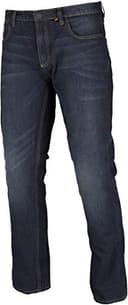
Riding jeansare the right default for most street riders, and the reason is behavioral rather than technical: they are the only riding pant you will wear on a short ride to a friend’s house. The modern versions are not the flimsy “Kevlar-lined” jeans of a decade ago. The Klim K Fifty 2 and the ScorpionEXO Covert Pro IIare both certified CE AA under EN 17092-3, which means they are tested a full class above the entry street rating — and both ship with knee and hip armor already fitted. That combination did not exist at this price a few years ago.
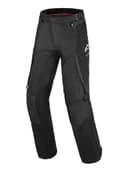
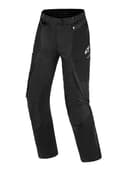
Textile touring pants are what you buy when weather is the problem rather than pace. The Alpinestars Andes V4 Drystar carries a fixed waterproof membrane, so rain protection is built in rather than packed in a tail bag, and a removable full-length thermal liner stretches it across three to four seasons. The honest trade is the abrasion class: it is a Class A garment, below both jeans on this page. If you commute year-round in real weather, that trade is usually the right one; if you ride fast on dry roads, it is not.
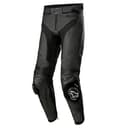
Leather is still the abrasion benchmark, and the Alpinestars Missile V3 Airflowis the modern version of it: 1.3 mm bovine leather certified to EN 17092 AA class, with perforated thigh panels and accordion stretch zones so it is wearable in heat and in a riding tuck. It also zips to an Alpinestars jacket at the waist and is rated to run with the Tech-Air 10 airbag system, which is the direction fast road and track gear has gone — our airbag vest roundup ranks the wearable systems on the certification each maker publishes.
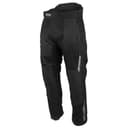
Mesh overpants solve a different problem entirely. The Tourmaster Draft Air 2.0 pulls on over what you are already wearing and flows air through Armor-Link mesh panels, with 1000 denier ripstop backing the knees and seat and CE Level 1 Armanox knee armor fitted. It is the cheapest pant here and the only one that will not cook you in July traffic. The same logic applies one layer up in our jackets roundup, where the mesh pick exists for exactly the same reason.
Match the pick to your riding
The Klim K Fifty 2is our best overall because it is the most complete riding jean on the list: CE AA to EN 17092-3, D3O Evo knee and hip armor included, a Poron XRD tailbone pad that essentially no other jean bothers with, and Cordura denim partially lined with 100% Kevlar panels. It also has the only genuine tall inseam run here. It is the most expensive jean on the page, and Klim does not publish the CE level of the D3O Evo pads — only that Rogue Level 1 and Level 2 armor is offered as an upgrade. Those are real limitations, and they are why the gap to second place is narrow.
The ScorpionEXO Covert Pro II is the value answer and the one we would point most riders at first. It hits the same AA class as the Klim for noticeably less, and it publishes the number the Klim does not: its Rheon knee and hip armor is stated as CE Level 1, with Level 2 available as an upgrade. The 13.5-14 oz high-stretch Nyco denim with a perforated Coolmax lining is the more comfortable spec sheet of the two jeans. Its weakness is specific and worth knowing before you order: one 32-inch inseam across every waist size.
The Alpinestars Andes V4 Drystaris the pant for riders whose enemy is weather. Waterproof Drystar membrane, removable thermal liner, adjustable thigh vents, Nucleon Flex Plus CE Level 1 knee armor in three-position pockets, and a size run to 6XL — the widest here by a distance. Class A abrasion and no hip armor in the box are the honest costs. The Stella Andes V4 Drystaris the same pant on a women’s-specific pattern rather than a men’s pant relabeled in smaller sizes, which is exactly why it earns its own place on this list rather than a footnote. It carries the same Class A rating and the same missing hip armor, and a narrower XS-3XL size run.
The Missile V3 Airflowis for the rider whose pace has outgrown denim — track days, canyon days, fast road miles. AA class in 1.3 mm leather is the strongest abrasion spec on this page. It is also the most expensive by a wide margin, the hip protectors cost extra, and it is not a pant you wear off the bike. The Draft Air 2.0 is at the other end: the summer overpant that gets a rider out of unarmored jeans for the least money. It is mesh, so there is no rain and no cold-weather use, and no hip armor is published.
One note we owe you on the Tourmaster: its own certification line reads “CE certified A EN 17092-2,” which is internally inconsistent — in EN 17092, class A is clause -4 and clause -2 is class AAA. We treat it as the class A it names rather than the AAA the clause number would imply, because that is the conservative reading and because Tourmaster prices and builds it as an entry mesh pant. We would rather flag a maker’s own typo than quietly round it in the product’s favor.
What we left out, and why
There is a floor on credible protection in this category, and it sits higher than most riders expect. There are plenty of sub-$100 “motorcycle pants” on the major marketplaces with armor claims in the title, but most of them do not publish an EN 17092 class at all, and several do not name the EN 1621-1 level of the armor they include either. We do not rank gear whose central protection claim cannot be checked against a published standard, so none of them are here. If the budget is tight, the honest advice is to buy the mesh overpant above rather than an uncertified pant with a lower sticker price — and our budget gear setup guide works through where the money is best spent across a whole kit.
We also left out full one-piece suits and dedicated off-road pants. A race suit is a different purchase with a different fit process, and off-road pants are built to work with knee braces and boots rather than to be street-rated garments. If you are assembling a first set of gear rather than filling one gap, start with the ATGATT first-gear checklist, which puts pants in the right order relative to a pair of gloves and a set of boots— both of which protect joints that heal slowly and are cheaper to get right.
Pants are also the zone riders drop first when the weather gets extreme, in both directions. Our guides to riding in summer and staying warm explain why a mesh overpant and a thermal-lined touring pant are two different purchases rather than one compromise.