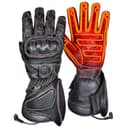
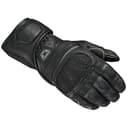
How we ranked these
Certification first, because a winter glove is still a riding glove.EN 13594 is the European standard for motorcycle gloves, and the test house SATRA describes its two levels plainly: “Level 1 for gloves designed to give protection while having low ergonomic penalties, and level 2 for gloves providing greater protection than level 1.” The standard tests tear strength, seam strength, cut resistance and impact abrasion. Knuckle impact protection, per SATRA, “is an optional feature for level 1 gloves” and mandatory at level 2, and a glove that passes the knuckle test carries the KP mark. Every certified glove on this page is Level 1 KP. None is Level 2, which is normal for insulated touring gloves and worth knowing before you assume a thicker glove is a more protective one. Our CE armor and gear ratings guide covers the whole label system.
Then how the membrane is built.All six gloves put a membrane between you and the weather, but they do it three different ways, and the difference is the most useful thing on this page. It gets its own section below. The short version: the Klim bonds its GORE-TEX to the shell, both REV’IT! gloves and the Alpinestars hang theirs inside as a liner, the Cortech uses a liner from a different membrane maker, and the Gerbing uses a membrane its maker calls water-resistant rather than waterproof.
Then the insulation the maker publishes.Insulation is sold by weight per square meter, and the useful comparison is not just how much but where. REV’IT! prints the most on the Stratos 3 (Thinsulate G in 300 g and 80 g weights, plus a fur liner). Alpinestars prints Thinsulate on both the top of the hand and the palm of the Tourer W-7 V2. Cortech prints PrimaLoft on both sides of the Scarab V3. Klim and REV’IT!’s Fusion 3 insulate the backhand only and leave the palm thin on purpose. And Gerbing prints “150 grams of insulation” without naming what it is. Where a maker prints two numbers that do not agree — Alpinestars does — we show both rather than choose.
Then the cuff, the wipers and the small stuff.A gauntlet that goes over the jacket sleeve seals out wind and rain in a way a short cuff cannot, and four of the six are gauntlets; REV’IT! calls the cuff on both of its gloves “regular,” meaning it sits under the sleeve. Visor wipers matter more in winter than at any other time of year. Every glove here has touchscreen fingertips, so that did not separate them.
The picks side by side
Here is what each maker publishes on the three things this ranking turns on. “Not published” means we could not find the figure on the maker’s page, not that we assume the worst.
| Glove | EN 13594 | Membrane | Insulation published | Cuff |
|---|
| Klim Badlands GTX Long | Level 1 KP (year not printed) | GORE-TEX, bonded (GORE Grip) | 60 g Thinsulate, backhand only | Gauntlet with neoprene gasket |
|---|
| REV’IT! Stratos 3 GTX | Level 1 KP, EN 13594:2015 | GORE-TEX Z-liner | Thinsulate G 300 g and 80 g, plus fur liner | Regular |
|---|
| REV’IT! Fusion 3 GTX | Level 1 KP, EN 13594:2015 | GORE-TEX Z-liner | Thinsulate G 100 g + Exkin Platinum, backhand only | Regular |
|---|
| Alpinestars Tourer W-7 V2 Drystar | Level 1 KP, EN 13594:2015 | Drystar, 5,000 mm | Thinsulate 150 g top / 100 g palm (description says 120 g) | Long touring cuff |
|---|
| Gerbing 12V Extreme Hard Knuckle | Not published | Aquatex, water-resistant | 150 g, type not named; 12 V heating to every fingertip | Full-length gauntlet |
|---|
| Cortech Scarab V3 | Not published | Hipora liner | PrimaLoft 120 g backhand / 60 g palm | Gauntlet |
|---|
Bonded, Z-liner or water-resistant: how the membrane is built
A glove is a harder thing to waterproof than a jacket because every layer in it has to bend around four knuckles a few thousand times a ride. The usual construction is a Z-liner: a waterproof membrane sewn as a separate glove-shaped bag between the outer leather and the inner lining. It works, and both REV’IT! gloves and the Alpinestars use it. Its known weaknesses are feel and wet hands. A loose membrane can shift a little on the bars, and if the lining ever gets damp — sweat, or water sneaking in at the cuff — it can grab and pull when you take the glove off.
Gore’s answer is the construction Klim uses on the Badlands GTX Long, which Klim calls “GORE-TEX + GORE Grip Technology.” In Gore’s words, “the usual loose layers within gloves are tightly bonded together for a layered construction that eliminates friction and movement between layers.” The practical result is that the membrane cannot slide against the leather, so the glove feels more like an unlined leather glove on the grips. It is the single biggest reason the Klim tops this list despite carrying the least insulation of the certified picks.
Two of the six do not use GORE-TEX at all. Alpinestars uses its own Drystarmembrane, which it rates at 5,000 mm of water column and 5,000 g/m² of breathability — useful because it is one of the few makers to put a number on the membrane at all. Cortech uses a Hiporaliner, a membrane widely used in mid-priced gloves, with no rating printed. And the Gerbing uses what Gerbing calls an “AQUATEX breathable water-resistant membrane.” We take the maker at its word: water-resistant is not waterproof, and the Gerbing’s waterproof row reads “No” on its card for that reason.
Insulation, or heated grips? Why the palm matters
There are two ways to keep a hand warm on a motorcycle, and they pull a glove in opposite directions. Insulation traps the heat your hand makes, and the more of it you put in the palm, the less you feel of the bars. Heated grips push heat in from the outside, and they only work if the palm is thin enough to let it through. That is why the two most expensive gloves here have the thinnest palms. Klim puts its 60 g of Thinsulate “on backhand” and leaves the inside of the hand unlined. REV’IT! goes further with the Fusion 3 and says it outright: the glove is “designed specifically to work in conjunction with heated grip systems, the inside of the gloves is made to conduct the warmth from your grips.”
If your bike has heated grips, those two are the right shape and the Stratos 3, the Alpinestars and the Cortech — all with insulation in the palm — will partly waste them. If your bike does not, the equation flips: the Klim and the Fusion 3 become the least warm gloves on the page, and the Stratos 3 with its 300 g Thinsulate G becomes the obvious buy. Decide this before you decide anything else.
Which one should you buy?
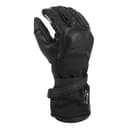
Buy the Klim Badlands GTX Long if you want the best-built glove here and you have heated grips. It is our top pick because it gets the three things we rank on right in the order we rank them: a Level 1 KP certification to EN 13594, a GORE-TEX membrane bonded to the shell instead of floating inside it, and a full gauntlet with a neoprene gasket inside the cuff and two visor wipers (Klim assigns the left to water and the right to ice). The honest limits are the price, which is the highest on this page, and the insulation, which at 60 g on the backhand only is the least of any certified glove here. Klim also prints the CE level without the EN 13594 year and publishes no weight.
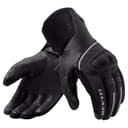
Buy the REV’IT! Stratos 3 GTX if warmth is the whole question.No other maker on this page publishes anything close to its insulation figures, and it pairs them with a GORE-TEX Z-liner, a goatskin shell, a Temperfoam palm slider and the same EN 13594:2015 Level 1 KP certification as the Fusion 3, for less money than either the Klim or the Fusion. The trades are a “regular” cuff that tucks under the sleeve rather than over it, a maker page that lists both Thinsulate weights without saying which panel gets which, and stock that was down to a unit or two in several sizes at the retailer we link on the day we checked.
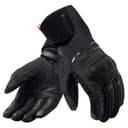
Buy the REV’IT! Fusion 3 GTX if you have heated grips and want more armor than the Klim.It is the most protective glove here on hardware: a hard-shell knuckle, PU-injected finger knuckles and a TPU palm slider, all inside the same certification and GORE-TEX Z-liner as the Stratos. It costs more than the Stratos while publishing a third of its Thinsulate, and the reason is the heated-grip design above. Without heated grips, buy the Stratos instead. Like the Stratos, it has a regular cuff, and REV’IT! names Exkin Platinum insulation without giving it a weight.
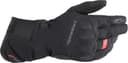
Buy the Alpinestars Tourer W-7 V2 Drystar if you want a certified winter gauntlet for the least money.Alpinestars prints the certification in full — “CE Certified Category II EN 13594:2015 LEVEL 1 KP” — and puts Thinsulate on both sides of the hand behind a Drystar membrane, with a long touring cuff whose single closure tightens the wrist strap and cuff flap together. Two things to know. The upper is stretch Nyspan and ripstop polyamide with a leather palm, so it is the least leather of the certified picks. And Alpinestars’ own page disagrees with itself on insulation: the spec list says 150 g on the top hand and 100 g on the palm, the description says “compact 120g.” Either way it is a palm full of insulation, so it is not a heated-grip glove. A Stella version is cut for women. Most sizes at the retailer we link showed only one or two units on the check date.
Buy the Gerbing 12V Extreme Hard Knuckle if you ride through real winter and would rather plug in.Gerbing publishes the numbers most heated-glove makers skip: 12 V DC, 1.1 A and 13 W per glove, a maximum of 135°F, and Microwire elements that run to every fingertip. Around that it builds a cowhide gauntlet with 150 g of insulation, a floating TPU hard knuckle and gel palm pads. It ranks fifth for three published reasons. Gerbing prints no EN 13594 certification anywhere. It calls the Aquatex membrane water-resistant, not waterproof. And the glove alone does not work: the battery harness, Y-harness and temperature controller are “required for stand-alone operation (sold separately),” so budget for them, or for one of Gerbing’s heated jacket liners that the gloves plug into directly.
Buy the Cortech Scarab V3 if the budget is firm. For the lowest price on this page it publishes a surprising amount: a goat leather chassis, a Hipora waterproof membrane, PrimaLoft on both the backhand (120 g Silver) and the palm (60 g Gold Eco), a TPU knuckle with Superfabric at the knuckle, fingers, thumb, outer wrist and heel of the palm, a shield wiper, and a four-year warranty. It ranks last because Cortech publishes no EN 13594 certification, which means nothing on that list has been tested to the glove standard. It is a well-specified glove with an unverified protection claim, and we would rather say that than dress it up.
Heated gloves: when they are the better answer
Every insulated glove has a floor. Below some temperature, at some speed, the heat your hand produces cannot keep up with the wind stripping it away, and no amount of Thinsulate changes that; it only slows it down. A heated glove moves the floor by adding heat, which is why riders who genuinely commute through winter tend to end up with one, or with heated grips and a thin-palmed glove like the Klim or the Fusion 3.
The trade-offs are real and none of the makers hide them. A 12 V glove like the Gerbing is tethered to the bike by a cable at each cuff and needs a harness and controller to run. Battery gloves are free of the bike but carry the batteries in the cuff and run for a limited time per charge. And heating hardware crowds out the other things a glove is for: of the heated gloves we checked, only Alpinestars’ HT-7 prints an EN 13594 certification, and it costs roughly three times what the Gerbing does — see the section below. If you go heated, go in knowing you are choosing warmth over a tested protection rating, unless you pay for the one that has both.
Whatever glove you pick, the rest of the setup decides whether it works. A winter glove under a summer jacket with the sleeves flapping is a wet glove by mile ten; our all-season jackets roundup ranks shells by where the waterproof membrane sits, and our helmets for rain page ranks lids on the fogging and sealing problems that arrive with the cold.
What we left out, and why
The Alpinestars HT-7 Heat Tech Drystar.It is the glove that answers the heated-glove problem properly: “Fully CE-certified riding garment to CE Level 1 KP,” a Drystar membrane, 80 g of PrimaLoft on the backhand and a 7.4 V battery system with three heat settings. We left it out because Alpinestars lists it at roughly three times the Gerbing’s price on its US site, and because on the day we checked the retailer we link showed a single unit in most sizes. If you want a heated glove with a certification behind it and the price does not stop you, it is the one to buy.
The Scorpion EXO Tempest II. A well-liked budget cold-weather glove with a Hypora lining, 100 g of Thinsulate everywhere but the palm and a double gauntlet. It publishes no CE certification, which would have put it level with the Cortech, and on our check several sizes at a major US retailer were marked closeout or out of stock. We do not rank a glove that looks to be on its way out.
The Alpinestars Andes V3 Drystar. It shows up in every search for a waterproof glove and it is a good one, but Alpinestars describes it as a mid-season glove and publishes no insulation for it. It is a three-season glove, not a winter one, and it would have been unfair to rank it against gloves carrying 100 to 300 g of Thinsulate.
The Dainese Tempest 2 D-Dry Long. A winter glove we would have liked to include. On our check, the listings we could find were either temporarily out of stock or quoting a two-to-three-week ship time, and we only rank gloves a reader can actually buy in their size.
Low-priced gloves with “CE” in the listing title. Search the phrase at the retailer we link and the results fill with lower-priced winter gloves whose titles claim “CE Level 1 KP” or “EN 13594.” Some of them may be certified. But a listing title is not a maker’s certification page, and we could not find one to check for any of them, so we applied the rule we use on every gear page: we do not rank a protection claim we cannot check against the maker’s own statement. The Cortech is the closest this page comes to an exception, and it earns its place on a maker page that publishes everything except the certification, not on a title.