How we ranked these
Certification first, even though it barely separates them. EN 13594 is the European standard for motorcycle gloves, and the test house SATRA describes its two levels plainly: “Level 1 for gloves designed to give protection while having low ergonomic penalties, and level 2 for gloves providing greater protection than level 1.” The standard covers tear strength, seam strength, cut resistance and impact abrasion. Knuckle impact protection, per SATRA, “is an optional feature for level 1 gloves” and mandatory at level 2 — a glove that passes the knuckle test carries the KP mark. All six gloves here are Level 1 KP. Our CE armor and gear ratings guide covers the whole label system.
What does separate them on certification is who printed it. Klim prints “CE CERTIFIED TO EN13594:2015, KP LEVEL 1” on its own site. REV’IT!’s two gloves carry “CE certified to EN 13594:2015 Level 1 Knuckle Protection” with the year. Alpinestars’ Corozal listing says “CE Level 1 KP certified” without the year. And for the Andes V3, Alpinestars’ own product page prints no certification at all— the clause we quote for it comes from the US retailer’s listing, not from the maker. That gap is a real ranking factor on this page, and it is why the Andes sits where it does rather than higher.
Then how the membrane is built. Five of the six put a waterproof membrane between you and the weather and they do it two different ways; the sixth has no membrane at all. The difference gets its own section below, because on a touring glove it is the single most useful thing on the spec sheet and almost nobody explains it.
Then the temperature band.This is where touring gloves quietly disagree with each other. Klim builds the Vanguard with neither vents nor insulation on purpose. REV’IT! perforates the Dominator 3 so it breathes, then keeps it waterproof with a bonded membrane. Klim perforates the Induction and skips the membrane entirely. REV’IT! adds a tri-fleece liner to the Sand 5 for the cool end. Alpinestars calls the Andes V3 a mid-season glove and publishes no insulation for it. Those are five different answers to one question and you should pick the one that matches your riding, not the one at the top of the list.
Then the cuff, the wiper and the small stuff. Here is the genuinely surprising finding: not one of these six is a long gauntlet. The Vanguard is explicitly an “under cuff short design.” The Sand 5 adjusts at the wrist and a tab. The other four publish no cuff description at all. If you want a gauntlet that goes over the jacket sleeve, that is a winter-glove feature on this evidence, and our winter glove ranking is where four of six are gauntlets.
The picks side by side
Here is what each maker publishes on the three things this ranking turns on. “Not published” means we could not find the figure on the page we read, not that we assume the worst.
| Glove | EN 13594, and who printed it | Membrane | Temperature design | Cuff |
|---|
| Klim Vanguard GTX Short | Level 1 KP, EN 13594:2015 — printed by Klim | GORE-TEX, bonded (GORE Grip) | “Temperature neutral”: no vents, no insulation | Short, under-cuff |
|---|
| REV’IT! Dominator 3 GTX | Level 1 KP, EN 13594:2015 | GORE-TEX, bonded (Gore Grip) | Perforated goatskin, waterproof | Not published |
|---|
| REV’IT! Sand 5 H2O | Level 1 KP, EN 13594:2015 | Hydratex Z-liner with McFit | Tri-fleece liner for the cool end | Wrist strap and tab |
|---|
| Klim Induction | Level 1 KP, EN 13594 (year not printed) | None published | Mesh backhand, mapped perforations | Not published |
|---|
| Alpinestars Andes V3 Drystar | Level 1 KP, EN 13594:2015 — per the retailer, not Alpinestars | Drystar, 5,000 mm / 5,000 g per m² | Mid-season; no insulation published | Not published |
|---|
| Alpinestars Corozal V3 Drystar | Level 1 KP (EN 13594 year not printed) | Drystar, no rating published | “All-weather”; no insulation published | Not published |
|---|
Bonded or Z-liner: the thing nobody explains
A glove is harder to waterproof than a jacket because every layer in it has to bend around four knuckles a few thousand times a ride. The ordinary solution is a Z-liner: the waterproof membrane is sewn in as a separate glove-shaped bag between the outer leather and the inner lining, free to move a little. REV’IT!’s Sand 5 uses one (Hydratex with McFit), and so, in a different form, do both Alpinestars gloves with their Drystar membranes. It works, it is cheaper to build, and it has two known costs: a loose membrane can shift against the leather so the glove feels slightly vague on the bars, and if the lining gets damp from sweat or from water sneaking in at the cuff, it can grab and drag when you pull the glove off.
The alternative is to glue the layers together. Gore calls it GORE Grip, and in Gore’s own words “the usual loose layers within gloves are tightly bonded together for a layered construction that eliminates friction and movement between layers.” Two gloves here use it: the Klim Vanguard GTX Short and the REV’IT! Dominator 3 GTX. The practical result is a waterproof glove that feels close to an unlined leather one on the grips, which is exactly what you want when you are going to be holding those grips until dark. It is the single biggest reason those two sit at the top.
The sixth glove, the Klim Induction, has no membrane at all and Klim does not claim one. That is not a failing, it is a different product: a certified, heavily vented summer glove. We rank it fourth because for a large part of the country it genuinely is the right touring glove from June to September, and because it is the only glove here with a carbon-fiber hard knuckle and an aramid-reinforced palm overlay. Just do not expect it to handle a storm.
Why there is no gauntlet on this page
We went in expecting the touring segment to be gauntlet territory, because a cuff that goes over the jacket sleeve is the obvious way to stop rain running down your arm and into the glove. It is not. Klim is explicit that the Vanguard GTX Short is an “under cuff short design,” and there is a Vanguard GTX Long for riders who want the other thing. REV’IT! lists wrist adjustment and a donning tab for the Sand 5 and nothing cuff-related at all for the Dominator 3. Neither Alpinestars listing describes a cuff.
The reason is that a touring glove is worn for hours at a stretch and taken off at every fuel stop, and a long gauntlet makes both of those worse. The trade is real, though, and it has a practical consequence: with a short-cuff glove, your jacket sleeve closure is now doing the waterproofing job the gauntlet would have done. If your jacket cuff does not cinch down tightly over the glove, you will get wet hands in a certified waterproof glove and blame the glove. Our all-season jacket ranking sorts shells by where the membrane sits and how the cuffs close, which is the other half of this problem.
Which one should you buy?
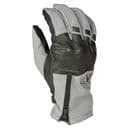
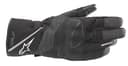
Buy the Klim Vanguard GTX Short if you want one glove for most of the year.It wins on all three ranking criteria at once: Klim prints the certification clause in full on its own site, the GORE-TEX is bonded to the shell with GORE Grip rather than floating inside it, and the temperature design is the most honest statement any maker here makes — “neither venting nor insulation”, which Klim calls temperature neutral and we would call the definition of a touring glove. It also has the index-finger visor wiper and Mult-E-Touch pads. The honest limits: it is a short under-cuff glove, so your jacket sleeve has to seal over it; it has no insulation whatsoever, so below freezing you want a winter glove instead; Klim publishes no weight; and it is premium money for a glove with no gadgets.
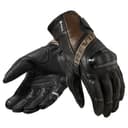
Buy the REV’IT! Dominator 3 GTX if one trip crosses three climates. It is the only glove here that is bonded GORE-TEX and perforated, which is a genuinely hard thing to build and the reason it costs what it does. The armor list is the longest on the page: a ventilated dual-comp knuckle, TPU hard-shell protectors, PU-injected finger knuckles, a TPU palm slider, Temperfoam at fingers, palm and thumb, and Pittards hairsheep WR100X leather in the palm. The honest limits: it is by far the most expensive glove here and carries the same printed EN 13594 level as picks costing a third as much; the listing publishes no cuff description, no insulation figure, no visor wiper and no touchscreen claim; and perforated leather is a hot-weather feature you cannot switch off, so in real cold this is not the warm choice.
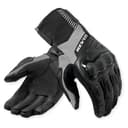
Buy the REV’IT! Sand 5 H2O if you want the most armor per dollar.It carries the same printed certification as the two GORE-TEX gloves above it with harder protection than either Alpinestars pick: a TPU hard-shell knuckle, TPR finger knuckles, a TPU palm slider and a thumb protector, with Temperfoam under the knuckle and at the cuff. It adds a visor wiper, a tri-fleece liner for cool mornings, and sizes from XS to 4XL — the widest range on this page by two sizes. The honest limits: it is a Z-liner, so the membrane is a separate bag between layers and does not feel as direct on the bars as the bonded gloves; the US listing does not state touchscreen compatibility even though European listings for the same glove do, so treat that as unconfirmed; and adjustment is at the wrist and a tab rather than a long cuff.
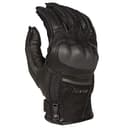
Buy the Klim Induction if your touring season is the hot one.A mesh backhand and mapped perforations over a premium goat leather chassis, with the best-documented abrasion story here — an aramid-reinforced Schoeller fabric palm pad overlay — and the only carbon-fiber hard knuckle on the page, plus 5 mm XRD impact foam in the palm and knuckle pads. And Klim still prints the EN 13594 clause, which a lot of vented gloves do not. The honest limits: there is no membrane at all, so this is a dry-weather glove; the perforations are not reversible, so it is cold at highway speed once the temperature drops into the fifties; the listing publishes no cuff description and no visor wiper; and it costs within a few dollars of the waterproof picks here while doing one job instead of two.
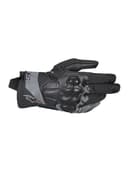
Buy the Alpinestars Andes V3 Drystar if you want a soft, light waterproof glove.It is the one glove here whose maker puts actual numbers on the membrane rather than just a brand name: 5,000 mm of water column and 5,000 g per square meter of breathability. A micro ripstop nylon backhand over a full goat leather palm keeps it light and unfussy for all-day wear, and the touchscreen fingertips work. The honest limits are significant and we rank it accordingly: Alpinestars’ own product page prints no EN 13594 certification anywhere, so the clause we quote comes from the retailer; the knuckle is a flexible viscoelastic guard rather than a hard shell, the softest protection on this page; Alpinestars calls it a mid-season glove and publishes no insulation; and on our check date the Amazon listing quoted a multi-day handling time rather than immediate dispatch.
Buy the Alpinestars Corozal V3 Drystar if you want waterproof leather for the least money.It is the cheapest certified glove here and the most leather-forward: a leather and textile top hand with stretch panels, leather palm and side walls, a Drystar membrane, a leather-covered SP knuckle instead of an exposed hard shell, conductive thumb and index fingertips, and sizes to 4XL. If you ride something where a race-looking glove would be out of place, this is the one. The honest limits: the certification is printed without the EN 13594 year, which is less specific than Klim’s or REV’IT!’s wording; the covered SP knuckle is less impact hardware than either REV’IT!; and the listing publishes no Drystar rating, no cuff description, no visor wiper and no insulation figure.
What we left out, and why
The Alpinestars Tourer W-7 V2 Drystar.A certified, insulated Drystar gauntlet and a genuinely good glove — it is the value pick on our winter glove ranking. We left it off here because Alpinestars puts Thinsulate on both the top of the hand and the palm, which makes it a cold-weather glove rather than a three-season one. Ranking it against gloves with no insulation at all would have compared two different products.
The Klim Vanguard GTX Long.The gauntlet version of our top pick, and the obvious answer for anyone who wants a cuff over the jacket sleeve. We ranked the Short because the whole argument for this glove is all-day comfort and quick on-and-off at fuel stops, and because the Long costs more for the same certification and the same membrane. If the gauntlet matters more to you than the convenience, buy that one instead — it is the same glove with a longer cuff.
The Tourmaster Storm Chaser.A waterproof glove at a fraction of the price of anything here, which is exactly why we checked it. Tourmaster’s own product page publishes no materials, no construction, no certification and no description of what kind of glove it is, and on our check date it was listed at half price. We do not rank a protection claim we cannot check against the maker’s own statement, and we do not rank a glove that looks to be on its way out.
Held, Rukka and the other European touring names. They make some of the best touring gloves in the world and riders ask about them constantly. They sell in the US almost entirely through their own dealer networks, and we could not find a listing a US reader could buy from in their size on the day we checked. We would rather say that than rank something you cannot actually get.
Anything claiming “CE Level 1” only in the listing title.Search any of these terms at a major retailer and the results fill with cheaper gloves whose titles claim EN 13594 or Level 1 KP. Some may well be certified. But a listing title is not a maker’s certification statement, and we could not find one to check for any of them, so the rule we use on every gear page applied here too.