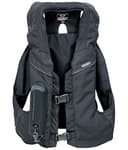
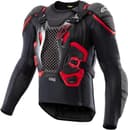
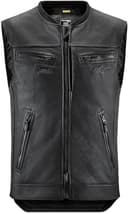
The Lid Test

The Best Motorcycle Airbag Vests

An airbag vest is the biggest single protection upgrade available to a road rider, and the category where makers publish the least. Five vests ranked on the EN 1621-4 certification each one actually states, then on what the bag covers, then on the weight and the real cost of a deployment.

By Stephen V.Last verified How we compare

Everything else you wear is passive. A jacket, a pair of riding pants and a set of CE armor sit there being tough, and how much they help depends on where you land. An airbag vest is the only piece of road gear that does something at the moment of the crash: it fires a bag around your chest, back and neck in roughly a tenth of a second, before you hit anything. That is why it is the most expensive layer in the kit and the one most riders put off buying.

It is also the category with the thinnest published data on the whole site. Helmets have DOT, ECE and Snell. Jackets and pants have EN 17092 classes printed on the label. Airbags have exactly one standard, EN 1621-4, and makers are inconsistent about publishing their result against it — one of the five vests below is certified to it but never states its Level, and another prints the standard’s number wrong on its own product page. So this ranking is built on four criteria, in this order. First, what the maker publishes about EN 1621-4, because a vest with an unreadable protection claim is not comparable to one with a number. Second, which body zones the inflated bag covers — the gap between “chest and back” and “chest, ribs, back and shoulders” is the difference riders feel in a real fall. Third, how it fires: electronic sensors versus a mechanical tether to the bike, which are genuinely different products with different failure modes. Fourth, weight, wearability and what a deployment costs you, because the airbag you leave at home protects nothing.

We have not crash-tested any of these and we own none of them — here is exactly how we compare gear instead. Every spec below was read from the manufacturer’s own page on the date recorded with each product. Prices in the text stay qualitative; the live number sits on each buy button.

How this is funded: we earn a commission if you buy through our links, at no extra cost to you. It never changes which helmet we recommend, and we’ll tell you plainly when a cheaper or lighter one is the better buy. Full disclosure.

Quick picks

Ranked on our spec score — certification, weight, features and value. Select a row to jump to the full write-up. We have not tested these helmets; here is exactly how we compare them instead.

#HelmetBest forOur scorePrice
1
Alpinestars Tech-Air 5 Plasma

Alpinestars Tech-Air 5 Plasma

The airbag that answers the reason most riders never buy one: bulk. At a published 1,530 g it is more than 25% lighter than the Tech-Air 5 it replaces, it wears under a normal jacket, it arms itself when you zip it, and it covers chest, ribs, back and shoulders — the widest zone list of any electronic vest here. You also reset it yourself instead of booking a dealer visit.

Best overall9.2
$869.95 · View on Amazon

Price as of September 19, 2026. #ad How we’re funded

2
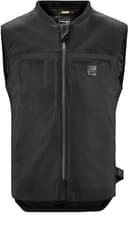
Alpinestars Tech-Air 3 V2 Canvas

Alpinestars Tech-Air 3 V2 Canvas

The one number that beats the flagship: Alpinestars publishes Level 2 attenuation for chest and back here, against Level 1 on the Tech-Air 5 Plasma, and it costs less. The trade is bulk and coverage — it is a canvas vest worn over your jacket, it weighs two to three times as much, it protects chest and back only, and a deployment goes back to a Tech-Air dealer.

Best CE attenuation level8.9
$699.95 · View on Amazon

Price as of September 19, 2026. #ad How we’re funded

3
Hit-Air MLV2

Hit-Air MLV2

The airbag with no battery, no app and no subscription. A coiled lanyard clips to the bike and a CO2 cartridge fires when you and the machine part company, inflating a bag that runs up the neck, down the spine and around the hips. It is the least expensive certified vest here, it weighs 1.4-1.6 kg, and you re-arm it yourself with a new cartridge.

Best with no electronics8.6
$659.00 · View on Amazon

Price as of September 19, 2026. #ad How we’re funded

4
Alpinestars Tech-Air Off-Road

Alpinestars Tech-Air Off-Road

The only pick here built for dirt, and the only one that combines an airbag with passive armor in the same garment: a CE Level 2 chest protector and CE Level 1 back, elbow and shoulder protectors around a Level 1 bag covering chest, back, shoulders, collarbones and neck. It is FIM Cross-Country Rally homologated, which is a real gate rather than a marketing line.

Best for adventure and off-road8.4
$1,099.95 · View on Amazon

Price as of September 19, 2026. #ad How we’re funded

5
Alpinestars Tech-Air 3 V2 Leather

Alpinestars Tech-Air 3 V2 Leather

The same Level 2 electronics as the canvas Tech-Air 3 V2 in a softened-leather shell, for the rider who wants an airbag that reads as a vest rather than as safety equipment. That is a real reason to buy — a cruiser or urban rider who would leave a technical vest at home will wear this one — but you pay more and carry more weight for the material.

Best for cruiser and urban riding8.2

The picks in full

#1Best overallOur score9.2

Alpinestars Tech-Air 5 Plasma

The airbag that answers the reason most riders never buy one: bulk. At a published 1,530 g it is more than 25% lighter than the Tech-Air 5 it replaces, it wears under a normal jacket, it arms itself when you zip it, and it covers chest, ribs, back and shoulders — the widest zone list of any electronic vest here. You also reset it yourself instead of booking a dealer visit.

Strengths

  • Widest published coverage of the electronic vests here — chest, ribs, back and shoulders, not chest and back alone
  • 1,530 g published system weight, roughly half what the over-jacket Tech-Air 3 systems weigh
  • User-replaceable single gas inflator through a quick-release service cover (where legally permitted), so a deployment does not mean a dealer visit
  • Arms automatically when zipped via an internal magnetic sensor, with haptic confirmation — nothing to remember before pulling away
  • Eight sizes, XS-4XL, and no subscription: Alpinestars publishes no ongoing fee to keep the system working

Trade-offs

  • Alpinestars certifies the bag to EN 1621-4:2013 Level 1 — the Tech-Air 3 V2, which costs less, publishes Level 2 for chest and back
  • The airbag is certified for up to six deployments before it has to be replaced, which is a real long-term cost nobody quotes at the till
  • Under-jacket wear means the jacket has to have room for it — a close-fitting sport jacket may not
  • Alpinestars does not publish a charge time for the 30-hour battery on this page
DeploymentElectronic — self-contained sensors; arms automatically when the vest is zipped (internal magnetic sensor)
CoverageChest, ribs, back and shoulders
Airbag certificationEN 1621-4:2013 Level 1 (full back); passive back protector EN 1621-2:2014 Level 1; garment EN 17092-6:2020 Class C undergarment
Weight1530 g
PowerRechargeable — up to 30 hours of ride time per charge (charge time not published)
After a deploymentUser-replaceable gas inflator via a quick-release service cover, where legally permitted; certified for up to six deployments before replacement
WornUnder a jacket

Notable. 1,530 g under-jacket airbag; chest, rib, back and shoulder coverage; user-replaceable inflator; no subscription

Specs read from the manufacturer / retailer listing, on September 7, 2026. “Not published” means the maker does not state that figure.

#2Best CE attenuation levelOur score8.9

Alpinestars Tech-Air 3 V2 Canvas

The one number that beats the flagship: Alpinestars publishes Level 2 attenuation for chest and back here, against Level 1 on the Tech-Air 5 Plasma, and it costs less. The trade is bulk and coverage — it is a canvas vest worn over your jacket, it weighs two to three times as much, it protects chest and back only, and a deployment goes back to a Tech-Air dealer.

Strengths

  • Level 2 impact attenuation for chest and back — the highest airbag level published by any pick on this page
  • Six integrated sensors (three accelerometers, three gyroscopes), with full inflation Alpinestars states at approximately 50 milliseconds
  • Up to 40 hours of runtime and a stated four-hour full charge — the longest battery here
  • Works over any jacket, so it fits gear you already own instead of demanding a jacket with room underneath
  • XS-4XL size run and no subscription fee

Trade-offs

  • 2,660-3,040 g depending on size — nearly twice the Tech-Air 5 Plasma, and a vest over a jacket is something you feel
  • Chest and back only: no shoulder or rib coverage, both of which the flagship publishes
  • Gas cartridge replacement is handled by a certified Tech-Air dealer, not by you
  • Alpinestars' own page prints the standard as “EN1624-4:2013”, a typo for the airbag standard EN 1621-4:2013 — we record it as the latter
DeploymentElectronic — 6 integrated sensors (3 accelerometers, 3 gyroscopes)
CoverageFull chest and full back
Airbag certificationEN 1621-4:2013 Level 2, chest and back (printed “EN1624-4:2013” on Alpinestars' page); garment EN 17092-6 Class C outer garment; Category II PPE under (EU) 2016/425
Weight2,660-3,040 g (size dependent)
PowerRechargeable — up to 40 hours of runtime, four-hour full charge
After a deploymentReplacement gas cartridge fitted by a certified Tech-Air dealer
WornOver a jacket (Alpinestars states it can also be worn under one)

Notable. EN 1621-4 Level 2 chest and back; six sensors; 40-hour battery; over-jacket canvas vest

Specs read from the manufacturer / retailer listing, on September 7, 2026. “Not published” means the maker does not state that figure.

#3Best with no electronicsOur score8.6

Hit-Air MLV2

The airbag with no battery, no app and no subscription. A coiled lanyard clips to the bike and a CO2 cartridge fires when you and the machine part company, inflating a bag that runs up the neck, down the spine and around the hips. It is the least expensive certified vest here, it weighs 1.4-1.6 kg, and you re-arm it yourself with a new cartridge.

Strengths

  • No electronics at all — nothing to charge, nothing to update, nothing to subscribe to
  • Hip and lower-back coverage that neither Tech-Air street vest publishes, plus neck and spine
  • Hit-Air publishes a declaration of conformity to EN 1621-4:2013 covering every MLV2 variant
  • 1.4 kg (S), 1.5 kg (M), 1.6 kg (L) published weights — lighter than any over-jacket electronic vest here
  • You replace the CO2 cartridge and repack the bag yourself using Hit-Air's own re-assembly instructions

Trade-offs

  • Hit-Air does not publish the EN 1621-4 attenuation Level on the model page or the declaration of conformity — certified, but there is no number to compare
  • A tether only fires when you separate from the bike: it cannot protect you in a crash where you stay on it, which an electronic system can
  • You have to remember to clip in — and forgetting to unclip before you dismount is the classic tethered-vest embarrassment
  • Three sizes only (S, M, L), against eight on the Tech-Air systems
DeploymentMechanical — coiled lanyard tethered to the bike; a 50 cc (S) or 60 cc (M/L) CO2 cartridge fires on separation
CoverageNeck, back, hips and sides (declaration of conformity lists chest, back and neck)
Airbag certificationEN 1621-4:2013 per Hit-Air's declaration of conformity (all MLV2 variants); attenuation Level not published
Weight1.4 kg (S), 1.5 kg (M), 1.6 kg (L)
PowerNone — no battery and no electronics
After a deploymentFit a new CO2 cartridge and repack the bag yourself, per Hit-Air's re-assembly instructions
WornOver a jacket or riding gear

Notable. Tethered CO2 airbag with neck, spine and hip coverage; no battery; user re-armed

Specs read from the manufacturer / retailer listing, on September 7, 2026. “Not published” means the maker does not state that figure.

#4Best for adventure and off-roadOur score8.4

Alpinestars Tech-Air Off-Road

The only pick here built for dirt, and the only one that combines an airbag with passive armor in the same garment: a CE Level 2 chest protector and CE Level 1 back, elbow and shoulder protectors around a Level 1 bag covering chest, back, shoulders, collarbones and neck. It is FIM Cross-Country Rally homologated, which is a real gate rather than a marketing line.

Strengths

  • Airbag coverage includes collarbones and neck — zones no street vest on this page protects
  • Passive armor built in: CE Level 2 chest protector, CE Level 1 back, elbow and shoulder protectors
  • Homologated for FIM Cross-Country Rally and certified under Dolomiticert protocols for Enduro, Rally and Street
  • USB-C charging with up to 30 hours of runtime, a roughly four-hour full charge and about eight hours from a one-hour top-up
  • User-replaceable gas inflators where local law permits

Trade-offs

  • Approximately 3.9-4.22 kg depending on size — by far the heaviest system here, and the most expensive
  • The bag itself is CE Level 1, and Alpinestars does not print the EN 1621-4 clause on this page, only the level
  • Built to layer under an off-road jacket, so it is overkill and awkward for commuting or road touring
  • Sizes S-2XL only, a narrower run than the street Tech-Air systems
DeploymentElectronic — accelerometers and gyroscopes integrated in the ECU
CoverageChest, back, shoulders, collarbones and neck
Airbag certificationCE Level 1 airbag (EN 1621-4 clause not printed on this page); passive chest protector CE Level 2, back, elbow and shoulder protectors CE Level 1; Dolomiticert-certified for Enduro, Rally and Street; FIM Cross-Country Rally homologated
WeightApproximately 3.9-4.22 kg (size dependent)
PowerRechargeable — up to 30 hours of runtime, ~4-hour USB-C full charge, ~8 hours from a 1-hour top-up
After a deploymentUser-replaceable gas inflators, where local laws permit
WornUnder a properly fitting off-road jacket

Notable. Airbag plus integrated passive armor; collarbone and neck coverage; FIM Cross-Country Rally homologated

Specs read from the manufacturer / retailer listing, on September 7, 2026. “Not published” means the maker does not state that figure.

#5Best for cruiser and urban ridingOur score8.2

Alpinestars Tech-Air 3 V2 Leather

The same Level 2 electronics as the canvas Tech-Air 3 V2 in a softened-leather shell, for the rider who wants an airbag that reads as a vest rather than as safety equipment. That is a real reason to buy — a cruiser or urban rider who would leave a technical vest at home will wear this one — but you pay more and carry more weight for the material.

Strengths

  • Same six-sensor system and Level 2 chest and back attenuation as the canvas Tech-Air 3 V2
  • Up to 40 hours of ride time with roughly a four-hour full charge, or 8-10 hours from a one-hour top-up
  • Premium softened leather outer that wears as a vest over a jacket or a shirt
  • Alpinestars states over- or under-jacket wear, and XS-4XL sizing
  • Gas inflator separately CE certified to UNI EN 16263

Trade-offs

  • 3.34-3.43 kg across XS-L per Alpinestars' own figures — the heaviest street vest here, and heavier than the canvas version
  • Costs more than the canvas Tech-Air 3 V2 for the same protection specification
  • Chest and back coverage only — no shoulder, rib or hip protection
  • Alpinestars does not state the re-arming process on this page; the canvas system's page routes cartridge replacement through a certified dealer
DeploymentElectronic — 6 onboard sensors (triaxial accelerometer and gyroscope sets)
CoverageFull chest and full back
Airbag certificationEN 1621-4:2013 Level 2, chest and back (printed “EN1624-4:2013” on Alpinestars' page); gas inflator CE UNI EN 16263; Category II PPE under (EU) 2016/425
Weight3.34-3.43 kg (varies by size, XS-L)
PowerRechargeable — up to 40 hours of ride time, ~4-hour full charge
After a deploymentNot published on this page; the canvas Tech-Air 3 V2 page states dealer-fitted cartridge replacement
WornOver or under a jacket

Notable. Leather-shelled Tech-Air 3 V2; Level 2 chest and back; 40-hour battery

Specs read from the manufacturer / retailer listing, on September 7, 2026. “Not published” means the maker does not state that figure.

How we ranked these

EN 1621-4 is the only airbag standard, and it is a number, not a badge.It rates the whole inflatable system for how much force reaches your body in an impact, and it splits into two levels. As Dainese’s own certification explainer states it, under EN 1621-4 the force transmitted to the body cannot exceed 4.5 kN for Level 1 or 2.5 kN for Level 2. Level 2 is therefore the roughly twice-as-protective rating, and it is the first thing we look for. The catch is that publishing the level is voluntary in practice: Alpinestars states it plainly on the Tech-Air 3 V2, states Level 1 on the Tech-Air 5 Plasma, and on the Tech-Air Off-Road prints only “CE Level 1” without the clause number. Hit-Air publishes a declaration of conformity to EN 1621-4:2013 for every MLV2 variant and does not state a level anywhere we could fetch.

Then coverage, because a level tells you nothing about where the bag is.Two vests can both say Level 1 and protect completely different parts of you. The Tech-Air 5 Plasma inflates around chest, ribs, back and shoulders. Both Tech-Air 3 V2 systems cover full chest and full back and nothing else. The Hit-Air MLV2 runs up the neck, down the spine and around the hips — hip and lower-back coverage that neither Tech-Air street vest publishes. The Tech-Air Off-Road adds collarbones and neck, which is exactly what you want when the crash is a dirt get-off rather than a road slide. There is no single “most coverage” answer here; there is a best match for the crash you are most likely to have.

Then how it fires, which is the real fork in this category. An electronic vest carries accelerometers and gyroscopes, decides for itself that you are crashing, and fires whether or not you are still on the bike. A tetheredvest is mechanical: a coiled lanyard clips to the machine, and when you and the bike separate far enough the lanyard pulls a pin and a CO2 cartridge inflates the bag. The tether is simpler, cheaper, needs no charging and never runs out of battery. Its limitation is structural and worth being blunt about: it cannot fire in a crash where you stay on the bike, and it depends on you remembering to clip in. Neither approach is universally better — but they are different purchases, so we rank one of each rather than pretending they compete directly.

Then weight, wearability and the cost of firing it.A deployment is not free and almost nobody tells you that before you buy. Alpinestars states the Tech-Air 5 Plasma’s inflator is user-replaceable through a service cover where legally permitted, and that the airbag itself is certified for up to six deployments before it has to be replaced. The Tech-Air 3 V2 sends you to a certified dealer for a new cartridge. The Hit-Air is the cheapest to re-arm: you fit a new CO2 cartridge and repack the bag yourself. Weight matters for the same practical reason: at 1,530 g the Plasma disappears under a jacket, while the canvas Tech-Air 3 V2 is 2,660-3,040 g and the Off-Road system is approximately 3.9-4.22 kg.

Electronic or tethered — which type do you need?

Buy electronic if you ride on the road at speed.The scenarios a street rider most fears — being hit at a junction, a high-side, a car turning across you — do not reliably start with you being thrown clear of the bike. An electronic system does not care; it reads the crash and fires. The Tech-Air 5 Plasma is our top pick because it makes that protection wearable: the widest coverage of the electronic vests here, roughly half the weight of the over-jacket systems, automatic arming when you zip it, and no subscription. The honest cost is that Alpinestars certifies it to Level 1 while the cheaper Tech-Air 3 V2 publishes Level 2.

Buy tethered if simplicity and price are the deciding factors. The Hit-Air MLV2 is the least expensive certified vest on this page, weighs 1.4-1.6 kg depending on size, needs no charging and no app, and covers zones the Tech-Air street vests do not. Riders who have watched a battery-powered device die at the wrong moment tend to like this, and so do riders who want to hand the vest to a pillion or move it between bikes. Its limits are the tether logic and the missing Level.

If you ride dirt, the answer is a different product entirely. The Tech-Air Off-Roadis the only pick here that wraps passive armor around the airbag — a CE Level 2 chest protector and CE Level 1 back, elbow and shoulder protectors — because off-road crashes involve roost, bars and rocks as well as impact. It is FIM Cross-Country Rally homologated. It is also the heaviest and priciest system here, and it is the wrong buy for a commuter. If adventure riding is your use case, our adventure helmet roundup covers the other end of the same kit.

If the vest has to look like clothing, buy the leather one. The Tech-Air 3 V2 Leatheris the same six-sensor, Level 2 system as the canvas version wrapped in softened leather. On specification alone that is a worse deal — more money, more weight, identical protection. Judged as a piece of gear a cruiser or urban rider will actually put on instead of leaving in the garage, it earns its place, because an unworn airbag has a protection level of zero.

What an airbag vest really costs

The sticker price is not the system price, and this is the single most useful thing to understand before you shop. Every vest on this page is a complete system: you buy it, charge it or clip it in, and ride. Some rival systems are not. KLIM’s Ai-1 vest lists at $299.99, but the In&box detection module that makes it an airbag is sold separately on a $12 per month or $120 per year subscription, or a $399 one-time purchase — so the real entry price lands in the same bracket as the vests here, and one version of it never stops costing money. Neither Alpinestars system nor the Hit-Air carries any subscription.

Then there is the cost of actually using it. A deployment consumes a gas cartridge, and on the Tech-Air 5 Plasma the airbag is certified for up to six deployments in its life before replacement. On the Tech-Air 3 V2 the cartridge is a dealer job. On the Hit-Air it is a part you fit yourself. If you ride in a group or off-road where a low-speed get-off is a normal Sunday, that difference adds up quickly, and it is worth weighing before you choose between the two mechanisms.

What we left out, and why

Vests whose maker publishes no airbag certification we can read.Hit-Air’s own declaration of conformity lists the MLV2 and ST series as certified to EN 1621-4:2013; its VHR and older MLV harnesses are still on sale but do not appear on that declaration, so they are not ranked here. The same rule removes the large group of sub-$200 “motorcycle airbag vests” that dominate marketplace search results: we could not find a published EN 1621-4 declaration for any of them, and we do not rank a protection claim we cannot check against a standard. It is the same line we draw on uncertified riding pants in our riding pants roundup.

Good vests that are not sold through the retailer we link. Helite’s Turtle 2 is a serious tethered vest sold direct in the US, with a stated 100 ms inflation and coverage across cervical, back, pelvis, sacrum and thorax, certified by the CRITT Sport Loisirs laboratory. Dainese’s Smart Jacket and KLIM’s Ai-1 are likewise real products sold through their own dealer networks. None of them has a stocked listing at the retailer our buy links point to, so featuring them would mean sending you to a search page rather than a product. They are named here on purpose: if one of them fits you better, buy it.

Airbag-ready jackets, which are a different purchase.A jacket described as “airbag-ready” — like the Alpinestars T-GP Plus R V4 in our jackets roundup — is cut with the room to wear one of these systems, but it contains no airbag itself. Buying one now and the vest later is a sensible order of operations, and it is why we flag airbag compatibility on jackets at all. If you are still assembling a first set of gear, the airbag is not step one: start with the ATGATT first-gear checklist, which puts a helmet, gloves and a certified jacket ahead of it for good reason. And if the budget will not stretch to an airbag this year, the cheaper passive answer to the same gap is an armored base layer— a shirt or vest with a certified back and chest protector fitted, ranked on the EN 1621 clause each maker publishes.
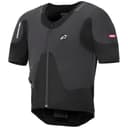
Frequently asked questions

Are motorcycle airbag vests actually worth it?

An airbag is the only piece of road gear that acts during the crash rather than after you land, and it protects the torso — chest, ribs, spine and neck — which is where the injuries that end riding careers happen. The honest counterweight is cost: these are the most expensive items in a gear kit, a deployment consumes a gas cartridge, and one system on this page is certified for a limited number of deployments before the airbag has to be replaced. If your budget is finite and your helmet, gloves or jacket are old or uncertified, fix those first. If they are sorted, this is the biggest single upgrade left.

What does EN 1621-4 Level 1 and Level 2 mean on an airbag vest?

EN 1621-4 is the European standard for inflatable motorcycle protectors, and it measures how much force reaches your body in an impact. As Dainese's certification explainer puts it, the transmitted force cannot exceed 4.5 kN for Level 1 or 2.5 kN for Level 2, so Level 2 is the roughly twice-as-protective rating. It is worth knowing that the level says nothing about coverage: a Level 2 vest that only protects chest and back can leave zones exposed that a Level 1 vest with wider coverage protects.

Is an electronic airbag vest better than a tethered one?

They fail differently rather than one being universally better. An electronic vest reads the crash with its own accelerometers and gyroscopes and fires whether or not you leave the bike, which covers scenarios a tether cannot — but it needs charging and it costs more. A tethered vest is mechanical, needs no battery, is cheaper to buy and cheaper to re-arm, and only fires when you and the bike separate. If most of your riding is road riding at speed, the electronic system covers more of what can happen to you.

Do airbag vests require a subscription?

Some do and some do not, and it is worth checking before you buy. Neither Alpinestars Tech-Air system on this page nor the Hit-Air MLV2 carries an ongoing fee. KLIM's Ai-1 is the well-known counter-example: the vest itself lists at $299.99, but the In&box detection module is offered on a $12 per month or $120 per year subscription, or a $399 one-time purchase. Read the listing for what is included, because the vest price and the system price are frequently not the same number.

Can you reuse an airbag vest after it deploys?

Yes, but the process and the cost differ. The Hit-Air MLV2 is user-serviceable: you fit a new CO2 cartridge and repack the bag using the maker's own instructions. Alpinestars states that the Tech-Air 5 Plasma has a user-replaceable inflator through a quick-release service cover where legally permitted, and that its airbag is certified for up to six deployments before it needs replacing. The Tech-Air 3 V2 routes cartridge replacement through a certified Tech-Air dealer.

Do you wear an airbag vest over or under your jacket?

It depends on the system, and each maker states it. The Tech-Air 5 Plasma is designed as an under-jacket layer, which is why its 1,530 g weight and slim profile matter — but it needs a jacket with room for it. The canvas and leather Tech-Air 3 V2 systems are designed primarily to go over a jacket, so they work with gear you already own, at the cost of extra bulk. The Hit-Air MLV2 is worn over a jacket or riding gear, and the Tech-Air Off-Road layers under a properly fitting off-road jacket.

Does an airbag vest replace a back protector or CE armor?

Not in the way most riders assume. Some systems include a passive protector as well — the Tech-Air 5 Plasma carries a back protector certified to EN 1621-2:2014 Level 1, and the Tech-Air Off-Road adds a CE Level 2 chest protector plus Level 1 back, elbow and shoulder protectors. Others are airbag only, so the armor in your jacket is still doing the shoulder and elbow work. Our CE armor guide explains which standard covers which piece of gear.

Sources

  • Alpinestars — Tech-Air 5 Plasma SystemThe maker's own spec page: EN 1621-4:2013 Level 1, chest/rib/back/shoulder coverage, 1,530 g, 30-hour battery and six certified deployments (accessed September 7, 2026)
  • Hit-Air — EN 1621-4 declaration of conformityMugen Denko's published declaration: which Hit-Air models are certified to EN 1621-4:2013 and which body zones they cover (accessed September 7, 2026)
  • Dainese — How do protection certifications work?A maker's explainer of the CE levels: under EN 1621-4 the force transmitted to the body cannot exceed 4.5 kN for Level 1 or 2.5 kN for Level 2 (accessed September 7, 2026)
  • Helite Moto (US) — Turtle 2 airbag vestA tethered airbag sold direct in the US rather than through Amazon: 100 ms inflation and cervical, back, pelvis, sacrum and thorax coverage (accessed September 7, 2026)
  • KLIM — Ai-1 Airbag VestThe vest that shows the subscription model: $299.99 for the vest, with the In&box detection module on a $12/month or $120/year subscription or a $399 one-time purchase (accessed September 7, 2026)

Keep reading