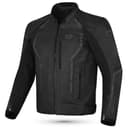
What EN 17092 actually measures, and why it ends the old argument
EN 17092 certifies a complete motorcycle garment rather than a swatch of material, and its classes run AAA, AA, A, B and C. The clause number is the fastest way to check a claim: -2 is Class AAA, -3 is AA, -4 is A. The test house SATRA states the armor requirement plainly: “Elbow, shoulder, knee and hip impact protectors are to be present in Class AAA and AA garments as a mandatory requirement, with the hip protectors being optional in Class A garments.” On a jacket, that means shoulder and elbow protectors are required either way and the class letter is mostly telling you how demanding the abrasion, tear and seam tests were.
The reason this matters for the leather-versus-textile question is that the standard is material-blind. It does not ask what the garment is made of; it asks whether the garment as sold survives the test. A laminate textile with high-tenacity yarns can clear the same clause as 1.3 mm cowhide, and in this comparison it does — three times over. Our CE armor and garment ratings guide walks the whole scale in plain English.
Here is what the five jackets on this page publish, side by side.
| Jacket | Material | Published class | Back protector included? |
|---|
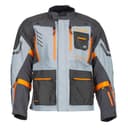
| Klim Carlsbad | Textile (GORE-TEX shell, FPL400 + 630D CORDURA) | AA (EN 17092-3) | Yes — Rogue CE Level 2 |
|---|
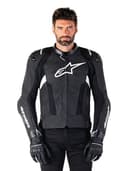
| Alpinestars Missile V3 Leather | Leather (premium bovine, perforated panels) | AA (EN 17092-3) | No — optional insert |
|---|
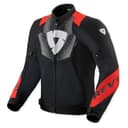
| REV’IT! Hyperspeed 3 GT Air | Textile (PWR|Weave chest, PWR|Shell mesh) | AA (EN 17092-3:2020) | No — “prepared for” Level 2 insert |
|---|
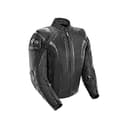
| Joe Rocket Atomic 5.0 | Textile (waterproof-treated Rock Tex / Hitena) | Class A (as published) | Yes — removable spine pad |
|---|
| Cortech Chicane 2.0 | Leather (1.1–1.3 mm drum-dyed cowhide) | None published | Yes — Armanox back pad |
|---|
Read the last two columns together and the conventional wisdom inverts completely. The only jacket here with no published garment class at all is one of the two leather jackets, and the two jackets that include a back protector at Level 2 or as standard are both textile or the cheapest leather— the premium AA leather ships with an empty back pocket.
What leather still does that the class does not measure
None of the above means leather is obsolete, and it would be dishonest to read it that way. The EN 17092 test is a defined protocol: a specified abrasion sequence, tear and seam-burst requirements, on new material. There is real-world behaviour it does not capture, and that is where leather keeps its reputation.
A thick hide has mass and body. On a long slide across coarse asphalt it tends to keep working after the point at which a thin fabric would have gone through, and it resists a second contact — a cartwheel, a kerb, a slide that catches and tumbles — better than most textiles of equivalent class. It is also what the paddock wears, under conditions where the people choosing have the most to lose and the most data. None of that is a certified claim and we are not going to dress it up as one. It is a well-established material property, and if your riding involves the speeds where it applies, it is the right reason to buy leather.
What leather asks in return is specific and non-negotiable. It is not waterproof and it never will be. Neither leather jacket on this page carries a waterproof rating; both textile three-season jackets do. Leather is heavier, hotter even perforated, needs breaking in, and takes a long time to dry once wet. A race-fit leather jacket is also cut for a rider folded over the bars, which is why the premium Alpinestars jackets are sold in European race sizing and feel wrong standing up.
Perforation: how leather became wearable in summer
Both leather jackets here are perforated rather than solid, and that is the only way leather is usable in heat. The important detail is where: perforation is drilled into chosen panels, and the impact and slide zones stay solid. Alpinestars perforates the lower front, back and sleeves of the Missile V3 and the jacket is still certified to Class AA with the perforation in place— the whole garment as sold was tested, holes included. That is the point worth holding on to, because a fully perforated budget jacket with no published class, like the Cortech, is a different proposition entirely.
Textile answers heat differently and more completely: with mesh. The REV’IT! Hyperspeed 3 GT Air is mostly air by construction — PWR|Shell mesh and 3D air mesh panels around a PWR|Weave chest — and still holds the AA clause. There is no leather equivalent of a mesh jacket. If your problem is August traffic, the textile wins without an argument, and our main jacket roundup splits the whole category by climate.
The back protector tells you more than the material does
Look again at that table. EN 17092 does notrequire a back protector at any class, and the sport category is the worst offender for leaving the pocket empty. Of the five jackets here, three include back armor — the Klim Carlsbad (Rogue CE Level 2), the Joe Rocket Atomic 5.0 (a removable spine pad) and the Cortech Chicane 2.0 (an Armanox back pad) — and the two that do not are the REV’IT! and the most expensive jacket on the page.
REV’IT! at least tells you exactly what to buy: the Hyperspeed 3 GT Air is “prepared for” a SEESOFT CE-level 2 back insert and a divided CE-level 1 chest insert. Alpinestars sells Nucleon inserts for the Missile V3. Budget for one on day one, or put the protector on your body instead of in the jacket — our armored base layer roundup ranks back and chest protectors on the EN 1621 clause each maker publishes, and they work under a jacket of either material.
One honesty note on the Cortech. Its page states that the Armanox “shoulder, elbow, and back armor is impact tested and CE certified to EN 1621.1, Level 1”. EN 1621-1 is the clause for limb protectors; back protectors are certified under EN 1621-2, a different test with a different threshold. So the shoulder and elbow claim is checkable and the back claim cites a clause that does not apply to a back protector. We print what the page says and flag it rather than quietly upgrading or downgrading the pad.
What about pants and gloves?
The same logic carries, with one adjustment. On pants, the certified-denim category has done to leather what mesh did on jackets: the Klim K Fifty 2 and ScorpionEXO Covert Pro II are both CE AA under EN 17092-3 in Cordura and Nyco denim, and the Alpinestars Missile V3 Airflow reaches the same AA class in 1.3 mm leather. Three pants, one class, two materials — and the denim is the one you can walk into a restaurant wearing. Our riding pants roundup ranks the whole category on abrasion class first, and whether kevlar jeans are actually protective answers the question underneath it.
On gloves, leather still wins more clearly than anywhere else, and the reason is simple: a glove is small, the palm takes the first contact in almost every fall, and there is not enough area to engineer a textile equivalent of goat or kangaroo hide. Every glove in our glove rankinguses leather at least on the palm. A textile-backed glove with a leather palm — the commuter pattern — is a reasonable compromise; an all-textile glove is not. The relevant standard there is EN 13594 rather than EN 17092.
Who should buy which, in one paragraph each
Buy textileif you commute, tour, ride in weather you do not get to choose, ride in heat, or want the most protection per dollar. The Klim Carlsbad is the most complete jacket on this page by a clear margin: AA class, GORE-TEX in the shell rather than hung behind it, and Level 2 armor at all three zones in the box. The REV’IT! Hyperspeed 3 GT Air is the sport-riding answer at AA for roughly half of leather money. The Joe Rocket Atomic 5.0 is the one to buy if the budget is around two hundred dollars and you need one jacket that handles rain.
Buy leather if you do track days or sustained fast road riding, if you want the material behaviour the class test does not measure, or if you want the highest published armor level in a jacket you will also wear on the street. The Missile V3 Leather is the only jacket here whose maker publishes both an AA garment class and an EN 1621-1:2012 Level 2 clause for the limb armor in the box. Expect to add a back protector and expect it not to work in the rain. Our sport-jacket roundup goes deeper on the race-fit leather options, including the one jacket we would not rank.
Buy the budget leather only with your eyes open. The Cortech Chicane 2.0 is real perforated cowhide with shoulder, elbow and back pads included at well under half the price of the premium picks, and it is the cheapest route to a leather jacket with any armor at all. But Cortech publishes no EN 17092 class, which means there is no certified statement anywhere about how the leather itself performs in a slide. That is not the same as the jacket being unsafe. It does mean you are buying on material thickness and reputation rather than on a test result, and it is why it ranks last here.
And if you take one sentence from this page: the material is no longer the protection decision. The class on the label, the armor in the box and the back protector you remember to buy are — and a mid-price AA textile with Level 2 armor at all three zones protects you better than a premium leather jacket with an empty back pocket, in any weather, for less money.