Why weight matters (and why it doesn’t)
What weight does: less mass on your head means less strain on your neck against airflow, which is most noticeable at sustained highway speed and over a long day. If you tour, commute long distances, or notice neck ache after a ride, a lighter helmet is one of the few upgrades you feel every single time. What it doesn’t do:weight is not a protection metric. A heavier, well-fitted, well-certified helmet protects better than a lighter one that fits poorly. So treat low weight as a comfort tie-breaker between helmets you’d already trust — get the fit and certification right first, then chase grams.
What makes a helmet light: the shell material, mostly. Our shell-materials guidecovers this in full, but the short version is that carbon fiber is the lightest and priciest, fiberglass composites (Shoei’s AIM, HJC’s PIM) sit in the middle, and polycarbonate is the heaviest and cheapest. Every helmet on this list uses a carbon or premium composite shell — which is exactly why none of them is cheap.
The ranking, and what each weighs
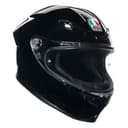
The AGV K6 S is the lightest full-face we cover, with a carbon-aramid shell AGV publishes at 1,255 g— class-leading for a DOT-and-ECE-22.06 helmet, and paired with a 190-degree field of view. If outright low weight is the goal, this is the one. The HJC RPHA 11 Pro is the value lightweight: a PIM+ carbon-fiberglass-aramid shell that Rider Magazine measured at ~1,417 g in medium, at roughly half a flagship’s price — the sensible way to get a genuinely light sport lid without flagship money.
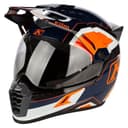
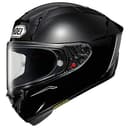
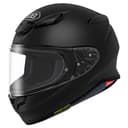
The Klim Krios Pro is remarkable in context: a full-carbon adventurehelmet — a category that’s usually heavy because of the peak — at a published 1,450 g in Large, which is lighter than many pure street helmets. For ADV riders, nothing else combines that weight with the versatility. The Shoei X-Fifteen is the lightest race flagship here at ~1,624 g(RevZilla’s figure), with wind-tunnel aero for the track; and the Shoei RF-1400 rounds out the list at ~1,651 g— not the lightest number, but the best all-round helmet on the list and our full-face benchmark, proof that “lightest” and “best for you” aren’t always the same helmet.
Cheaper ways to feel a lighter helmet
If a carbon or premium-composite lid is out of budget, two things get you much of the benefit for less. First, fit: a correctly sized helmet distributes its weight evenly and feels lighter than a too-big one that flops around, so nailing the size and head shapeis the cheapest “weight” upgrade there is. Second, a proper fit reduces buffeting, and a helmet that isn’t getting pushed around in the wind feels less tiring regardless of its grams. Beyond that, the honest truth is that low weight is a premium feature — the shells that deliver it cost money, and that’s reflected in every pick above.