How we ranked these
EN 1621 is three standards, not one, and the clause tells you which body part was tested.EN 1621-1 covers limb protectors — shoulders, elbows, knees, hips. EN 1621-2 covers back protectors. EN 1621-3 covers chest protectors. Each one has a Level 1 and a Level 2, where Level 2 transmits less force in the test and is the higher rating. The useful consequence is that a complete claim always names a clause and a level for each zone: “EN 1621-2:2014 Level 2 back” is a claim you can check, and “CE Level 2 armor” on its own is not. Alpinestars, Klim and Leatt all publish the full string for every pad. Our CE armor and garment ratings guide walks through what the levels mean in plain English if this is new to you.
Then the zone list, because the level says nothing about where the pads are.This is where the five products separate hardest. The Alpinestars Bionic Plus V2 and the Leatt 3DF AirFit Evo both cover four zones — chest, back, shoulders and elbows. The Klim Tactical Pro covers three, dropping the elbow because it is a short-sleeve shirt. The Alpinestars Nucleon Flex Pro covers two, back and chest, and nothing on the arms at all. The Wicked Stock covers shoulders, elbows and back but has no chest protector. There is no single “most coverage” winner that is right for everyone: if your jacket already has shoulder and elbow pads, buying them a second time is money spent on bulk, and the two-zone vest is the smarter purchase.
Then the garment class, which is the finding on this page.Only the Klim publishes one: it states a “CE CU rating certified to EN 17092-6”, which is Class C. That is worth understanding precisely, because it cuts both ways. It is a real certification, tested and marked, and it is more than any other product here can show. It also carries no abrasion requirement whatsoever. A Class C garment is defined as one intended to be worn with and supplement a Class AAA, AA, A or B garment — in other words, alongside a jacket, not instead of one. The other four publish no class at all, which for the three pure protectors is not a criticism (a protector is not a garment and has nothing to certify), but for the Wicked Stock shirt, which is sold as clothing, is a real gap.
Then ventilation, weight and fit.Almost nobody in this category publishes a weight: Leatt states “from 1.53 kg” and the other four state nothing, which is why the weight row on four of the five spec tables below reads “Not published.” What makers do publish is airflow, and it matters more here than on any other piece of gear, because this layer sits directly against your skin under everything else. Klim’s cooling stretch fabric, Alpinestars’ perforated Cell protectors and Leatt’s ventilated 3DF foam are all attempts at the same problem. Size range is the other practical filter and it varies wildly: the Wicked Stock runs XS to 5XL, the Klim starts at medium, and the Leatt is sold in three brackets keyed to rider height rather than chest measurement.
Shirt, protection jacket or vest — which one do you need?
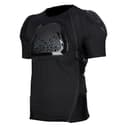
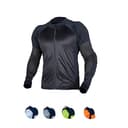
Buy the armored shirt if heat is the reason you are shopping. The Klim Tactical Pro is our top pick because it is the only product here that is genuinely both things at once: a certified set of protectors and a certified garment you can wear as your outer layer on a hot day. Level 2 at the chest and back, Level 1 at the shoulder, all with the clause published, in a four-way-stretch cooling fabric that Klim designed to sit against skin. The honest costs are that the short sleeve means no elbow armor, that it starts at medium, and that it is the most expensive shirt on this page by a wide margin. Klim does make a long-sleeve version that adds a Level 1 elbow pad, but it is not stocked at the retailer our buy links point to, so we have not ranked it.
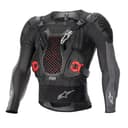
Buy the protection jacket if you want the most certified zones for the least money. The Alpinestars Bionic Plus V2puts a published protector on four zones — Level 1 elbow and shoulder, Level 2 back, Level 2 chest — for less than the Leatt and less than the Klim shirt. It is not clothing and does not pretend to be: it is a padded chassis with protectors strapped to it, worn under a jacket or a jersey. It is cut for off-road use, so it is bulkier under a close road jacket than a vest, and Alpinestars publishes no weight for it. If your existing jacket is a mesh summer shell with token pads, this is the cheapest way to fix all four upper-body zones at once.
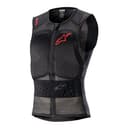
Buy the vest if your jacket already has arm armor. This is the most common real situation and the most commonly over-bought. Almost every certified jacket ships with shoulder and elbow protectors and leaves the back and chest empty. The Alpinestars Nucleon Flex Pro fills exactly that gap and nothing else, and it is the only pick here where every certified zone is Level 2. It also publishes something none of the others do: both protectors are marked T+ and T-, meaning they met their level when tested hot and cold rather than only at room temperature, which is the difference between armor that works in August traffic and armor that was only ever measured in a lab at 23 degrees. Its chest protectors come out, so it can be run as a back-protector vest alone.
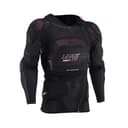
Buy the off-road protector if the hazard is roost as well as impact. The Leatt 3DF AirFit Evo is the most thoroughly documented product on this page: four zones with the clause and level printed for each, a separate French Motorcycle Federation certification, a BraceOn fitting system so a neck brace sits correctly over it, and the only published weight in the category. It also has a solid chest plate, which is protection against flying rocks that a road rider has no use for and will notice as heat and bulk. It is the priciest pick here and it is sized in three brackets by rider height. If adventure riding is the use case, our adventure helmet roundup covers the other end of the same kit.
Buy the budget shirt with your eyes open. The Wicked Stock Potomacputs removable pads on shoulders, elbows and back for roughly a quarter of the Klim’s price, in a size run from XS to 5XL that nothing else here approaches. We rank it last and we will say why rather than bury it in a footnote: Wicked Stock states “CE Level 2” for those pads but never names the EN clause behind the number, publishes no EN 17092 garment class, and prints the level inconsistently on its own site — the product URL says Level 1 while the title and body copy say Level 2. It is still armor where you previously had none, which is a real improvement over a t-shirt. It is not a certified equivalent to the four above it, and pretending otherwise would be the easiest way for this page to be wrong.
What an armored base layer does not do
The single most expensive mistake in this category is treating an armored shirt as a jacket replacement. Impact protection and abrasion protection are two different jobs tested by two different standards, and armor does nothing for the second one. In a slide, the fabric between you and the asphalt is what matters, and Class C fabric has no minimum requirement to meet — it only has to hold the protectors in place. That is why EN 17092 defines Class C as a garment to be worn with a Class AAA, AA, A or B garment. It is a supplement by design.
There is a version of this that is fine and a version that is not. Wearing an armored shirt under a mesh jacket, or under a leather jacket that has no armor pockets, is exactly what the product is for. Wearing an armored shirt and jeans on a summer ride because the armor makes it feel covered is the mistake — you have upgraded the impact protection on three or four zones and left your skin completely unprotected. If that is the ride you actually take, the honest fix is a Class A mesh jacket, which is certified for abrasion and flows nearly as much air; our jackets roundup ranks those. The lower half has the same problem and the same answer in our riding pants and Kevlar jeans roundup.
The second thing a base layer does not do is fire. If you are here because you want the biggest possible upgrade to torso protection, the honest answer is that a passive back and chest protector is not it — an airbag vest is, because it acts during the crash rather than after you land. It also costs three to five times as much. The two are not mutually exclusive, and several airbag systems include a passive back protector as well, but if the budget only covers one, buy the one that matches your riding.
Armored hoodies, flannels and “armor-ready” shirts
Search for an armored base layer and you will land on a large number of armored hoodies and riding flannels, and they are a genuinely different purchase for two reasons. First, they are outer garments, not base layers: a hoodie with aramid lining is trying to be a light jacket, and it should be judged on the same EN 17092 abrasion class as a jacket, not on Class C. Second, and more importantly — a great many of them are sold as “armored” when what they actually have is empty pockets for optional armorthat is not in the box. Read the listing carefully. If the phrase is “pockets for CE-rated armor,” you are buying a shirt and then buying pads separately, which can still be a sensible purchase — but it is not the same product as a shirt with certified protectors already fitted, and the price difference usually reflects exactly that.
The same caution applies to the phrase “CE approved.” There is no such thing as a CE-approved motorcycle garment in the sense the phrase implies. There are protectors certified to a clause of EN 1621 at a stated level, and there are garments certified to a class of EN 17092. Anything vaguer than that is a claim nobody has to stand behind, and we mark it “Not published” in the spec tables above rather than assume the best case.
What we left out, and why
Excellent protectors that are not sold at the retailer we link.Forcefield Body Armour’s Pro Shirt and Knox’s Urbane Pro are the two products most often recommended in this category by riders, and neither has a stocked listing at the retailer our buy links point to — a search for either returns unrelated products. Klim’s own long-sleeve Tactical Pro, which adds the Level 1 elbow pad the short-sleeve version lacks, is in the same position: it exists, it is better specified than our top pick, and you would have to buy it direct. They are named here on purpose. If one of them fits you better, buy it.
Roost deflectors sold as body armor.A large slice of the off-road “chest protector” market is built to stop flying stones and is not certified as impact protection at all. Those products are good at the job they were designed for, and buying one expecting an EN 1621-3 chest protector is a straightforward mistake. We only ranked protectors whose makers publish a clause and a level.
The rest of the sub-$100 marketplace shirts.Wicked Stock is here as the one budget pick because it is at least specific about the zones and the level, and because its size run genuinely serves riders the premium brands do not. The wider category — a long tail of near-identical mesh shirts claiming “CE Level 2” with no standard named anywhere on the listing or the maker’s site — is left out on the same rule we applied to uncertified airbag vests and uncertified riding pants: we do not rank a protection claim we cannot check against a standard. If you are assembling gear from scratch, the ATGATT first-gear checklist puts a helmet, gloves and a certified jacket ahead of any of this, and it is right to.