Arai Contour-X Review
Arai's current flagship street full-face is one of the most expensive ways to buy DOT and Snell M2025, and it does not have a sun visor. Here is what the two US spec sheets actually publish, the one thing Arai's own website does not tell you, and the specific rider this helmet is worth the money to.
How this is funded: we earn a commission if you buy through our links, at no extra cost to you. It never changes which helmet we recommend, and we’ll tell you plainly when a cheaper or lighter one is the better buy. Full disclosure.
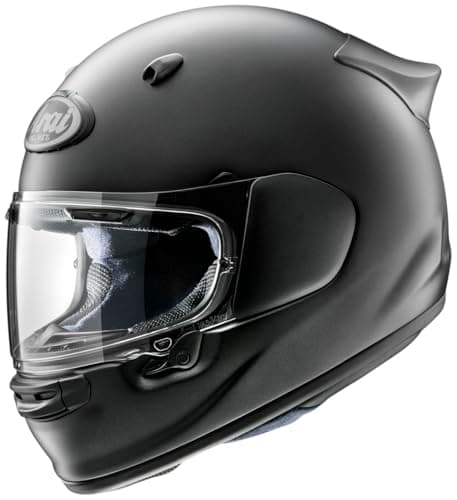
Product image supplied by Amazon
Arai's current street full-face, and the helmet most riders actually mean when they say “Arai.” DOT plus Snell M2025 in a hand-laid PB e-cLc shell built in four shell sizes, a Pinlock insert in the box, and Arai's R75 round-shell rule applied throughout. Lighter than Shoei's RF-1400 on the published figures, and noticeably more expensive.
Best for: Riders who want Arai's round-shell construction and four shell sizes in a street helmet, and will pay for it
Price as of October 14, 2026. #ad How we’re funded
Strengths
- DOT plus Snell M2025 — the same certification stack as Shoei's RF-1400 benchmark
- Four shell sizes (XS, SM, MD-LG, XL-2XL), so the shell scales with your head instead of the liner doing all the work
- VAS MAX Vision shield ships with a clear Pinlock insert included, not merely Pinlock-ready
- 13 ventilation ports (7 intake, 6 exhaust), with brow vents built into the shield rather than drilled through the shell
Trade-offs
- Consistently the most expensive way to buy this certification stack — the RF-1400 undercuts it by a wide margin
- No ECE 22.06 stated on the US listing, so no published rotational-impact testing
- No drop-down internal sun visor; you swap to a tinted shield instead
The spec sheet
| Certifications | DOT, Snell M2025 |
|---|---|
| Weight | 1515 g |
| Shell | PB e-cLc (Peripherally Belted e-Complex Laminate Construction, hand-laid) |
| Head shape | Intermediate oval |
| Sizes | XS-2XL |
| Internal sun visor | No |
| Pinlock-ready | Yes |
Specs read from the manufacturer / retailer listing, on October 14, 2026. “Not published” means the maker does not state that figure.
The Arai Contour-Xis the helmet most people mean when they say “an Arai.” It is the company’s current flagship road full-face, it is one of the most expensive helmets on any American shelf, and the list of features it does not have is long enough to be confusing: no internal sun visor, no ECE 22.06 rating on the US version, no electronics, no gimmicks.
So what is the money for? Two things, and both of them are structural. Here is what the published paperwork says, including the part where the maker publishes nothing at all.
The certification, which is the floor not the story
Both US listings we read state “Snell M2025 certified and DOT approved.” DOT is the US legal minimum, self-certified by the manufacturer under FMVSS 218. Snell is separate, voluntary and independently administered, with a stricter impact program, and a helmet carrying M2025 has been through the current revision of it. Our Snell guide covers what the test actually adds.
What neither listing states is ECE 22.06. That is normal for a Snell-rated helmet sold in America — certification varies by market version across every brand — but it is worth being precise about what it means: there is no published rotational-impact test result for the helmet you would buy here. Our ECE 22.06 guide explains what the newer European standard added and why a US-market helmet often does not carry it.
The important thing is that this certification stack is notwhat makes the Contour-X expensive. Shoei’s RF-1400 publishes the identical stack — DOT plus Snell M2025 — for considerably less money, and so does Arai’s own Regent-X. If a Snell rating is the whole reason you are looking at this helmet, you are about to overpay for it. Our certification-stack ranking lays the whole field out.
Four shell sizes, which is the actual argument
Both listings state four shell sizes— XS, SM, MD-LG and XL-2XL — built from a “PB e-cLc” shell, Arai’s Peripherally Belted e-Complex Laminate Construction. Cycle Gear’s listing adds a detail RevZilla’s does not: the construction substitutes an AR-mat middle layer specifically for weight reduction.
Shell count is the quietest important number on a helmet spec sheet, and it is the first thing the money buys here. A helmet built in one or two shells covers its entire size range by varying how thick the liner is. That works, but a small-headed rider ends up wearing a physically large helmet packed with extra padding — more frontal area, more leverage on the neck, more noise. Four shells means the outer shell itself steps up with the head, so the helmet stays proportionate at every size and the EPS liner stays the thickness it was designed to be.
The second structural thing is the shell’s shape. Arai’s design rule is a continuous curve with no radius tighter than 75 mm across the impact area, which is why an Arai has no hard edges, no shell-mounted spoilers and no bolted-on vent towers — the geometry is meant to glance off a surface rather than catch on it. That is also the direct reason there is no internal sun visor: a drop-down visor means a second cut-out in the shell and a mechanism inside it. You can disagree with the trade. It is at least a consistent one. Our shell materials guide covers what a hand-laid laminate is doing that a polycarbonate shell is not.
The thing Arai does not publish
Here is the honest frustration of writing about this helmet. We went to Arai Americas’ own Contour-X page to check the specs against the source, and on the day we read it the page is a color picker. Proto Yellow, Proto Red, Swirl White, Swirl Red, Star, Mark Yellow, Mark Red, Podium, Snake White, Hayes Jolly Roger. No shell construction. No certification statement. No weight. No size range. No ventilation count. Nothing.
Every specification on this page therefore comes from a US retailer listing, and we would rather say that plainly than imply we read it off a manufacturer spec sheet that does not exist. It is the same situation we ran into writing up the Regent-X, and on a helmet at this price it is a strange gap. The two retailer listings we used agree with each other on everything material, which is the best cross-check available here.
They do not agree on everything. RevZilla states a size range of XS (53–54 cm) through 2XL (63–64 cm). Cycle Gear states 51–66 cm across nine sizes, 2XS to 3XL. That is most likely the difference between the sizes a given retailer stocks and the sizes the model is made in, but nobody says so on either page, so we print the conflict instead of picking the number that sounds better. If you are at either end of the range, confirm your size is available before you commit.
Ventilation: 13 ports, and where they are
Both listings publish 13 ventilation ports — 7 intake, 6 exhaust, which is a high count for a road full-face and is worth unpacking because of where Arai puts them.
The intakes include 3D logo intakes, dual tear-duct top intakes that Arai describes as F1-derived, twin brow vents and a three-position sliding air-scoop chin vent with a replaceable filter. Exhaust runs through a one-piece rear exhaust and spoiler that doubles as airflow management, plus twin flush-fit side exhausts.
The brow vents are the detail that matters most day to day, and they are a consequence of the no-sun-visor decision. On a helmet with a drop-down visor, the brow area is occupied by the visor cassette. On the Contour-X it is free, so Arai routes air across the inside of the shield there — which is the part of the helmet that fogs first. Combined with the included Pinlock insert, that is a genuinely effective anti-fog setup rather than a spec-sheet line. Our fogging guide explains why airflow across the shield beats airflow anywhere else.
The flush-fit exhausts are part of the same R75 logic as everything else: nothing stands proud of the shell. The practical consequence for a rider is that the Contour-X does not have the big obvious scoops of a race-styled helmet, and the vent count is doing the work instead.
The shield system, and the part that is included
The Contour-X ships with the VAS MAX Vision shield and a clear anti-fog Pinlock insert in the box. That second point is worth stopping on, because it is not a given even at this price: Arai’s own Regent-X lists the same part as “available separately.” Pinlock is a second lens that seals against the shield and creates a double-glazed air gap, and it is the single most effective anti-fog measure available. Getting one in the box is roughly the cost of a tank of fuel that you are not spending later.
VAS stands for Variable Axis System: the shield pivots on a moving point rather than a fixed one, which lets Arai mount the whole shield mechanism lower on the shell and keep the critical impact zone around the temple clear of hardware. It is another example of the pattern on this helmet — a design decision made in the shell first, with the convenience feature arranged around it. The VAS shield latch system handles closing and the cracked-open de-mist position.
What you do not get is a tint. No Arai has an internal sun visor, so bright-sun riding means a tinted or photochromic shield bought separately and swapped over. Budget for it; on a helmet in this bracket it is a real additional purchase, not an accessory.
Fit and the liner
The published fit is intermediate oval, which is the shape most American heads are and the reason an Arai is workable for a mainstream buyer at all. If you have tried an Arai before and found it pressing hard on your forehead and crown with slack at the sides, your head is probably long oval and the problem is not this helmet — our head shapes guide walks through how to tell which one you are.
The interior is fully removable and made from an odor-resistant material, with adjustable temple padding— a small thing that solves a specific and common problem, because the temples are where a helmet that is otherwise the right size most often presses. The cheek pads use Arai’s Facial Contour System and are replaceable, so the fit can be tuned with thicker or thinner pads instead of by changing helmet size. The neck roll has an integrated wire pocket for routing a Bluetooth unit’s speaker wires, which is a considerate detail on a helmet that otherwise has no comms provision.
The cheek pads are also part of the Emergency Release System, which lets a first responder pull the pads out from the bottom of the helmet and get it off your head without levering it over your neck. Every serious road helmet should have this and not all of them do. Our helmet fit guide covers how tight the pads should actually be when the helmet is new.
Weight: 3.34 lb, with a caveat
Both listings publish 3.34 lb— about 1,515 g — and neither states what size that figure refers to. On a four-shell helmet that omission is bigger than it looks, because the spread between the smallest shell and the largest is genuinely material and nobody publishes the breakdown.
Taken at face value, the number is good: it undercuts the published figure for Shoei’s RF-1400, which is the benchmark this helmet is usually measured against, and it is light for a hand-laid laminate full-face. Treat it as a reference figure rather than the weight of the helmet that will arrive, and if weight is the deciding factor for you our lightweight helmet ranking sorts the field on exactly that, with the same caveat applied everywhere.
Who should buy it
Buy the Contour-X if the fit is the reason. If you have a head that four shell sizes serve better than two, or you have worn Arais for years and know the intermediate oval shape is yours, this is the helmet and there is no cheaper way to buy what it is selling. The vent count, the included Pinlock, the adjustable temple padding and the replaceable cheek pads are all in service of a helmet you keep for years and tune to your head rather than tolerate.
Do not buy it for the certification.DOT plus Snell M2025 is available for substantially less money from Shoei and from Arai’s own cheaper model. Our RF-1400 vs Contour-X comparison is the page to read next if that is the decision in front of you, and the Regent-X review is the one to read if you want the same construction philosophy for less.
And price in the shield.No sun visor means a tinted or photochromic shield if you ride in bright sun, on top of a helmet that is already at the top of the market. That is not a flaw — it is the direct cost of the shell shape the whole helmet is built around — but it should be in the number you compare, not discovered afterwards.
Frequently asked questions
Is the Arai Contour-X Snell certified?
Yes. Both US listings we read state 'Snell M2025 certified and DOT approved', the current Snell motorcycle standard plus the US legal minimum under FMVSS 218. Neither listing states ECE 22.06, which is normal for a Snell-rated helmet sold in America and means there is no published rotational-impact test result for the US version of this helmet.
How much does the Arai Contour-X weigh?
Both US listings publish 3.34 lb, which is about 1,515 g, and neither states which size that figure refers to. That matters more than usual on a helmet built in four shell sizes, because the spread between the smallest shell and the largest is real and nobody publishes the per-size breakdown. Treat 3.34 lb as a reference number. For scale, it is lighter than the published figure for Shoei's RF-1400.
Does the Arai Contour-X have a sun visor?
No, and no Arai does. Arai's position is that an internal drop-down sun visor means another cut-out in the shell and more hardware inside it. The alternative is a tinted or photochromic shield bought separately and swapped over using the VAS shield latch system. Price one in before you compare this helmet to a rival that includes a sun visor, because it is a real extra purchase.
Does the Contour-X come with a Pinlock insert?
Yes, and it is worth noting because Arai's own cheaper Regent-X does not. Both US listings state that the VAS MAX Vision shield ships with a clear anti-fog Pinlock insert included, not merely Pinlock-ready. On the Regent-X the same part is listed as 'available separately'.
What does PB e-cLc mean?
Peripherally Belted e-Complex Laminate Construction. 'Peripherally belted' means a reinforcing belt runs around the bottom opening of the shell, the area that would otherwise be the weak point of a laminate. 'Complex laminate construction' is Arai's hand-laid fiberglass-and-fiber layup. Cycle Gear's listing adds that the construction substitutes an AR-mat middle layer for weight reduction. Our shell materials guide explains what a laminate shell does differently from a polycarbonate one.
How many shell sizes does the Contour-X have?
Four: XS, SM, MD-LG and XL-2XL. Shell count is the quietest important number on a helmet spec sheet. A helmet built in one or two shells covers its whole size range by varying liner thickness, which leaves a small-headed rider wearing a physically large helmet full of padding. Four shells means the outer shell steps up with the head, so the helmet stays proportionate and the EPS liner stays the thickness it was engineered to be.
What is the difference between the Arai Contour-X and the Regent-X?
Price, hardware and finish, not the certification. Both carry DOT and Snell M2025, both use a peripherally belted laminate shell in four shell sizes, and both are intermediate oval. The Contour-X is the flagship: 13 vents, the VAS MAX Vision shield with a Pinlock insert in the box, adjustable temple padding. The Regent-X is the entry point into the same construction, costs substantially less, and ships Pinlock-ready rather than Pinlock-included.
Is the Arai Contour-X worth the money?
It depends entirely on whether you need the two things it is actually selling. If four shell sizes and a hand-laid laminate shell in the exact head shape that fits you are what you want, there is no cheap way to buy that and the Contour-X is a defensible purchase you will keep for years. If what you want is DOT plus Snell M2025, Shoei's RF-1400 publishes the same stack for meaningfully less money, and our comparison of the two walks through where the difference actually goes.
Sources
- RevZilla — Arai Contour-X Helmet (US) — One of the two US pages that publish a Contour-X spec sheet: "Snell M2025 certified and DOT approved", a "PB e-cLc" outer shell (Peripherally Belted e-Complex Laminate Construction) in "4 shell sizes: XS, SM, MD-LG, XL-2XL", "3.34 lbs." with no reference size stated, "Intermediate Oval" fit, a stated range of XS (53-54 cm) to 2XL (63-64 cm), "13 ventilation ports: 7 intake, 6 exhaust" including twin brow vents and a 3-position chin vent, the "VAS MAX Vision shield" with a clear anti-fog Pinlock insert included, a "variable axis (moving pivot point)" shield mount, a fully removable odor-resistant liner with adjustable temple padding, the Facial Contour System cheek pads, the "Emergency Release System (ERS)", and a neck roll with an integrated wire pocket for a Bluetooth unit (accessed October 14, 2026)
- Cycle Gear — Arai Contour-X Helmet (US) — The second US spec sheet, read the same day to cross-check: the same "Snell M2025 certified and DOT approved", "PB e-cLc outer shell design" using "Peripherally Belted e-Complex Laminate Construction for lightweight strength" with an AR-mat middle layer substituted for weight reduction, the same "4 Shell sizes: XS, SM, MD-LG, XL-2XL", the same 3.34 lb figure, "13 ventilation ports: 7 intake, 6 exhaust", a "3-position sliding air-scoop chin vent" with a replaceable filter, a "one-piece rear exhaust/spoiler", the "VAS MAX Vision shield" with a "clear anti-fog Pinlock insert" and the "VAS shield latch system". Cited alongside RevZilla because the two listings DISAGREE on the published size range - Cycle Gear states 51-66 cm across nine sizes (2XS-3XL) where RevZilla states XS-2XL (accessed October 14, 2026)
- Arai Americas — Contour-X — The manufacturer's own page for its flagship street helmet, cited for what is NOT on it: read on this date it is a color picker (Proto Yellow, Proto Red, Swirl White, Swirl Red, Star, Mark Yellow, Mark Red, Podium, Snake White, Hayes Jolly Roger) and publishes no specification sheet at all - no shell construction, no certification statement, no weight, no size range and no ventilation count. Every spec on this review therefore traces to a US retailer listing, and the review says so (accessed October 14, 2026)
- Snell Memorial Foundation — Standards — The current Snell motorcycle helmet standards and what each revision changed (accessed July 19, 2026)
- NHTSA — Motorcycle Safety — The US regulator behind the DOT FMVSS 218 helmet standard (accessed July 19, 2026)
- Pinlock — Anti-fog technology — The maker of the Pinlock anti-fog insert most premium shields are prepared for (accessed July 19, 2026)
Compare it against
Shoei RF-1400 vs Arai Contour-X
The purchase decision this review leads to — the same certification stack from two makers, at meaningfully different money.
Read the comparisonArai Regent-X review
The cheaper Arai with the same Snell M2025 and the same four-shell philosophy, and a bottom opening designed to be easier to get on.
Read the reviewArai vs Shoei
The brand argument underneath this helmet: head shapes, shell counts and what each company optimizes for.
Read the comparisonThe most thoroughly certified helmets
Where the Contour-X lands in a field ranked purely on the certification stack each helmet publishes.
See the rankingHelmet head shapes explained
Why an intermediate oval fits most American heads, and how to tell whether an Arai will fit yours before you spend flagship money.
Read the guideDo I need a Snell helmet?
What Snell M2025 tests that DOT does not, and whether the rating is worth paying for on a street helmet.
Read the guideBest full-face motorcycle helmets
The whole full-face field ranked on certification, weight and shell, from budget picks up to this one.
See the ranking