Arai Regent-X Review
Arai's cheapest road full-face carries the same Snell M2025 certification and the same four-shell-size philosophy as helmets costing twice as much — and it was designed to fix the one thing every Arai owner complains about. Here is what Arai's US paperwork actually claims, what it leaves blank, and the purchase you have to make after the helmet.
How this is funded: we earn a commission if you buy through our links, at no extra cost to you. It never changes which helmet we recommend, and we’ll tell you plainly when a cheaper or lighter one is the better buy. Full disclosure.
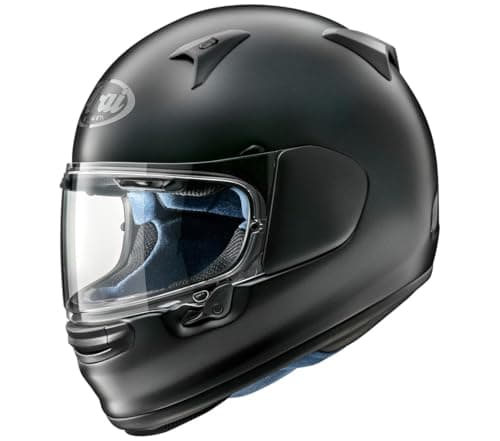
Product image supplied by Amazon
The Arai you can actually get on your head. Same Snell M2025 and DOT stack and the same four-shell-size philosophy as the Contour-X, but with a bottom opening widened at the chin and cheeks and a thinner neck roll — Arai's answer to the one complaint every Arai owner makes. It is the cheapest way into the brand's construction, and it gives up the premium shield hardware to get there.
Best for: Riders who want Arai's shell construction and Snell certification without the flagship price, and who have struggled to pull an Arai on
Price as of October 7, 2026. #ad How we’re funded
Strengths
- Snell M2025 plus DOT — the same certification stack as Arai's flagship street helmets, which is rare at this price
- Peripherally belted laminate shell in four shell sizes, so the outer shell grows with the head instead of the liner doing all the work
- Bottom opening widened in the chin and cheek area with a thinner, shorter neck roll — the donning problem Arai is known for, addressed in the shell rather than the padding
- VAS MAX Vision shield in the box, Free Flow System venting and a fully removable liner with a 5 mm peel-away layer for fine-tuning fit
Trade-offs
- No internal sun visor — Arai does not build them, so you are buying a tinted or photochromic shield separately
- Pinlock-ready, not Pinlock-included: RevZilla lists the insert as available separately
- Still premium money for a helmet with no electronics and no sun visor
- Arai publishes no spec sheet of its own for the model, and the two US sources we read disagree on the shell's name (PB SCLC vs PB-CLC1)
The spec sheet
| Certifications | DOT, Snell M2025 |
|---|---|
| Weight | 1547 g |
| Shell | PB SCLC — peripherally belted Super Complex Laminate Construction fiberglass, four shell sizes (RevZilla's string; Rider Magazine's review of the same helmet calls it PB-CLC1) |
| Head shape | Intermediate oval |
| Sizes | 2XS-3XL (51-66 cm) |
| Internal sun visor | No |
| Pinlock-ready | Yes |
Specs read from the manufacturer / retailer listing, on October 7, 2026. “Not published” means the maker does not state that figure.
Every Arai owner has the same story about the first time they tried one on. The shell is round, the opening is small, and getting it past your ears involves a maneuver with both hands and a certain amount of commitment. It is the direct cost of the thing Arai is actually selling — a shell shaped to deflect rather than catch, built in multiple sizes so the outer shell grows with the head instead of the padding doing all the work — and for decades the company’s answer was essentially that you get used to it.
The Regent-Xis the model where Arai stopped saying that. It is also the cheapest way into the brand’s construction, which makes it the Arai most riders should probably be looking at and the one least written about. Here is what its US paperwork actually says.
The certification, which is the headline
The US listing we read states “Snell M2025 certified and DOT approved.” That is worth stopping on, because it is the same stack Arai puts on helmets costing considerably more, and it is rare in this price bracket. DOT is the US legal minimum, self-certified by the manufacturer under FMVSS 218. Snell is a separate, voluntary, independently administered protocol with a stricter impact program, and a helmet carrying M2025 has been through it. Our Snell guide covers what the test actually adds and when it is worth paying for.
What the US listing does notstate is ECE 22.06. That is normal for a Snell-rated helmet sold in America and it is not a gap in the helmet — certification varies by market version on every brand — but it means that if you specifically want a published ECE 22.06 rating, this is not the helmet that has one. Our helmet safety ratings guide explains how the three systems differ and why a helmet can carry one, two or all three.
The shell, and the thing it was designed to fix
The listing calls the shell a “PB SCLC Shell” and states four shell sizesacross a range running from 2XS (51–52 cm) to 3XL (65–66 cm). Shell count is the quietest important number on an Arai spec sheet. A helmet built in one or two shells covers its size range by changing the thickness of the liner, which means a small-headed rider ends up with a physically large helmet carrying extra padding. Four shells means the outer shell itself steps up with the head, so the helmet stays proportionate and the EPS liner stays the thickness it was engineered to be.
The second thing that shell does is the Regent-X’s actual reason for existing. Rider Magazine’s gear review of the helmet describes a “Hyper-Ridge-reinforced bottom opening” that is “5mm wider in the chin and cheek area” with a neck roll that is “thinner and shorter back to front.” Five millimeters sounds like nothing. In the context of pulling a round shell past both ears it is the difference between a helmet you wrestle with and one you put on, and Arai solved it in the geometry of the shell rather than by thinning the cheek pads — which would have cost exactly the fit the shell count was there to protect.
Here is the one honest caveat on all of this: the two US sources we read disagree on what the shell is called. The retailer listing says “PB SCLC” (peripherally belted Super Complex Laminate Construction); Rider Magazine says “PB-CLC1” (Peripherally Belted — Complex Laminate Construction 1). Arai publishes no spec sheet of its own for the model — its Regent-X page is a color picker — so there is nothing to settle it with. Both names describe the same construction idea, and we print the conflict rather than quietly choosing the one that sounds better. Our shell materials guide explains what a laminate shell is doing differently from a polycarbonate one.
Fit: intermediate oval, and a liner you can adjust
The listing states an intermediate ovalfit, which is the shape most American heads are, and the one that makes an Arai workable for a mainstream buyer at all. If you have tried an Arai before and found it pressed hard on your forehead and crown with room at the sides, your head is probably long oval and the problem is not this helmet — our head shapes guide walks through how to tell.
Two liner details are worth knowing. The interior is fully removable and includes a 5 mm peel-away layer, which means you can take a measured amount of material out of the fit rather than guessing between two sizes — genuinely useful on a helmet you intend to keep for years. And the cheek pads use Arai’s Facial Contour System, described as “a foam spring support in the cheek pad that compresses and rebounds.” In practice that is what lets the pads give way as the helmet goes on and then close back around your face, which is the other half of the easy-entry story. Our guide to how tight a helmet should be covers what a correct fit feels like on day one versus month six.
Shield, venting, and what is not in the box
The shield is Arai’s VAS (Variable Axis System) with the VAS Shield Latch System, and a VAS MAX Vision clear face shield is included. VAS is the system that moves the shield pivot lower and further back than a conventional side pod, which is a direct consequence of Arai’s rule against anything that sticks out above the helmet’s test line.
Ventilation is Arai’s Free Flow System: dual intake front vents, side exhausts and a one-piece rear exhaust, with a three-position chin vent and a neck vent exhaust. That is a conventional, well-sorted arrangement with no gimmick in it, which describes most of this helmet.
Now the part to price in before you compare this helmet to anything else. It is “Pinlock Ready (available separately)”— the shield has the pins, the anti-fog insert does not come with it. And there is no internal sun visor, because Arai does not build them, so sun protection means buying a tinted or photochromic shield as a second purchase. Two helmets in our modular rankinginclude a Pinlock in the box at a higher price point, and plenty of cheaper helmets include a drop-down sun visor. Neither omission is a defect — they are Arai’s design positions, consistently held — but they are real money on top of the sticker, and a comparison that ignores them is not a fair one. Our anti-fog guide explains why the Pinlock is the fix rather than a nice-to-have.
Weight, and why we are careful with the number
The listing publishes 3.41 lb, roughly 1,547 g, and does not state the reference size. Arai publishes nothing. We record the figure because it is the only one anybody publishes, and we flag the missing reference size because on a four-shell helmet the spread between the smallest shell and the largest is real and nobody breaks it out for this model.
For context without pretending to a precision we do not have: that figure sits between the published numbers for the premium full-faces in our full-face rankingand well under the 1,700–1,900 g territory of the touring modulars. It is not a lightweight helmet and Arai has never sold it as one — a laminate shell with a reinforcing belt around the opening is not the recipe for the lightest thing on the shelf. If low weight is your first criterion rather than certification, our lightweight ranking is the better starting point.
Who should buy it
Buy the Regent-X if you want Arai’s construction and Snell certification at the lowest price Arai offers it, and especially if you have tried an Arai before and could not get it on comfortably. The certification stack is the real argument: DOT plus Snell M2025 in a peripherally belted laminate shell built in four shell sizes, with a fully removable liner and a 5 mm peel-away layer for tuning the fit, is a specification that does not exist at this price from most of the field.
Do not buy it if you want a sun visor, a Pinlock in the box, or the lowest weight on the shelf. Arai does not build sun visors, the Pinlock is a separate purchase, and this is a mid-weight helmet. Those are three legitimate reasons to buy something else, and if any of them is your first priority, our full-face rankinghas the helmets that solve each one. If what you want instead is Arai’s flagship street helmet with the same certification and better shield hardware, read our Contour-X comparison before you spend the difference.
One last practical note. A helmet you can get on easily is a helmet you will actually wear on the day you are tired and running late, which is not nothing. And if you plan to run an intercom in it, read our intercom rankingfirst — Arai builds no speaker pockets or antenna recesses into this shell, so a clamp-on unit is the path, and which one you pick changes what the install looks like.
Frequently asked questions
Is the Arai Regent-X Snell certified?
Yes. The US listing we read states 'Snell M2025 certified and DOT approved', which is the same certification stack Arai puts on its flagship street helmets and is unusual at this price — most helmets in this bracket carry DOT alone, or DOT plus ECE. It does not state ECE 22.06, and no Snell-rated US helmet is obliged to. If the Snell rating is the reason you are looking at this helmet, that is a defensible reason to buy it.
What is the difference between the Arai Regent-X and the Contour-X?
Price, shield hardware and finish, not the certification. Both carry DOT and Snell M2025, both use a peripherally belted laminate shell built in four shell sizes, and both are intermediate oval. The Contour-X is Arai's current flagship street full-face and costs substantially more; the Regent-X is the entry point into the same construction philosophy. The Regent-X's distinguishing feature is the other direction entirely: a bottom opening widened at the chin and cheeks so the helmet actually goes on.
Is the Regent-X easier to put on than other Arais?
That is the whole point of the model, and the claim is specific rather than vague. Rider Magazine's gear review of the helmet describes a bottom opening that is '5mm wider in the chin and cheek area' with a neck roll that is 'thinner and shorter back to front'. Arai's round shells are famously tight to pull over your ears; the Regent-X addresses that in the shell geometry rather than by thinning the cheek pads, which would have cost fit.
Does the Arai Regent-X have a sun visor?
No, and no Arai does. Arai does not build drop-down internal sun visors into its helmets — the company's position is that a sun visor means a second cut-out and more hardware inside the shell. The alternative is a tinted or photochromic shield, bought separately and swapped over using the VAS Shield Latch System. Budget for one if you ride in bright sun, because it is a real additional purchase, not an accessory.
Does the Regent-X come with a Pinlock insert?
No. The US listing we read lists it as 'Pinlock Ready (available separately)', meaning the shield has the pins but the anti-fog insert is a separate purchase. That is a meaningful omission at this price — the Shoei Neotec 3 and the Schuberth C5 both include one — and it is one of the two things, with the tinted shield, that you should price in before comparing this helmet to a rival that includes them.
How much does the Arai Regent-X weigh?
The US listing we read publishes 3.41 lb, which is about 1,547 g, and does not state which size that figure refers to. Arai publishes no weight on its own Regent-X page at all. Treat the number as a reference figure rather than the weight of the helmet you will receive: a helmet built in four shell sizes has a real spread between the smallest shell and the largest, and nobody publishes the per-size breakdown for this model.
Why do different sources call the shell by different names?
Because they do, and we would rather print the conflict than pick one. The US retailer listing we read calls it a 'PB SCLC Shell' — peripherally belted Super Complex Laminate Construction. Rider Magazine's gear review of the same helmet calls it 'Peripherally Belted - Complex Laminate Construction 1 (PB-CLC1)'. Both describe the same idea: a fiberglass laminate shell with a reinforcing belt running around the bottom opening. Arai publishes no spec sheet of its own for the model that would settle it.
Sources
- RevZilla — Arai Regent-X Helmet (US) — The only US page that publishes a Regent-X spec sheet: "Snell M2025 certified and DOT approved", "PB SCLC Shell" in "4 shell sizes", "3.41 lbs." with no reference size stated, "Intermediate Oval" fit, 2XS (51-52 cm) to 3XL (65-66 cm), "Pinlock Ready (available separately)", "VAS MAX Vision clear face shield included" with the "VAS Shield Latch System", "Free Flow System (FFS) ventilation" with "Three position chin vent" and "Neck vent exhaust", a liner with a "5mm peel-away layer", and FCS cheek pads that use "a foam spring support in the cheek pad that compresses and rebounds". No ECE rating stated and no internal sun visor (accessed October 7, 2026)
- Rider Magazine — Arai Regent-X Full-Face Helmet gear review — The source for the donning claim the helmet was designed around: the "Hyper-Ridge-reinforced bottom opening" of the shell is "5mm wider in the chin and cheek area" and "the neck roll is thinner and shorter back to front". Also the shell-name conflict we print rather than smooth: this review calls the construction "Peripherally Belted - Complex Laminate Construction 1 (PB-CLC1)" where RevZilla's listing says "PB SCLC" (accessed October 7, 2026)
- Snell Memorial Foundation — Standards — The current Snell motorcycle helmet standards and what each revision changed (accessed July 19, 2026)
- NHTSA — Motorcycle Safety — The US regulator behind the DOT FMVSS 218 helmet standard (accessed July 19, 2026)
- Pinlock — Anti-fog technology — The maker of the Pinlock anti-fog insert most premium shields are prepared for (accessed July 19, 2026)
Compare it against
Arai vs Shoei
The brand-level argument underneath this helmet: head shape, shell counts, certification and what each company actually optimizes for.
Read the comparisonShoei RF-1400 vs Arai Contour-X
The flagship version of this decision — the Contour-X is the helmet the Regent-X sits beneath in Arai's own range.
Read the comparisonBest full-face motorcycle helmets
Where the Regent-X lands against the Shoei RF-1400, the AGV K6 S and the value picks, on certification, weight and shell.
See the rankingHelmet head shapes explained
Why an intermediate oval helmet fits most American heads, and how to tell whether yours is one of them.
Read the guideThe most thoroughly certified helmets
Snell M2025 plus DOT is a rare combination at this price. Here is the whole field ranked on certification stack.
See the rankingDo I need a Snell helmet?
What Snell actually tests that DOT does not, and whether the rating is worth paying for on a street helmet.
Read the guideBest touring motorcycle gloves
The rest of the long-day kit — six waterproof gloves ranked on the EN 13594 clause each maker prints and how the membrane is built.
See the glove picks