Klim Krios Pro Review
The benchmark adventure lid — a full carbon shell at a published 1,450 g makes it one of the lightest ADV helmets made, and it reconfigures for street, adventure, dual-sport or dirt.
How this is funded: we earn a commission if you buy through our links, at no extra cost to you. It never changes which helmet we recommend, and we’ll tell you plainly when a cheaper or lighter one is the better buy. Full disclosure.
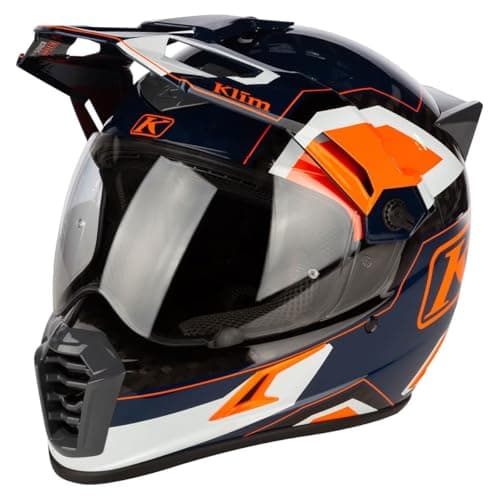
Product image supplied by Amazon
The benchmark ADV lid for a reason: a full carbon shell at a published 1,450 g in Large makes it one of the lightest adventure helmets made, and it reconfigures for street, adventure, dual-sport or dirt without buying a second helmet.
Best for: Adventure and dual-sport riders who want one carbon helmet for every surface
Price as of October 18, 2026. #ad How we’re funded
Strengths
- Full carbon shell — 1,450 g in Large is remarkably light for an ADV helmet with a peak
- DOT and ECE 22.06, plus Koroyd energy-absorbing structure
- Four ride modes (street, ADV, dual-sport, dirt) and a photochromic shield included
Trade-offs
- Premium price — you're paying for carbon and versatility
- No internal sun visor (the photochromic shield does that job instead)
The spec sheet
| Certifications | DOT, ECE 22.06 |
|---|---|
| Weight | 1450 g |
| Shell | Full carbon fiber (hand-laid) |
| Head shape | Intermediate oval |
| Sizes | XS-3XL |
| Internal sun visor | No |
| Pinlock-ready | No |
Specs read from the manufacturer / retailer listing, on July 19, 2026. “Not published” means the maker does not state that figure.
Why the Krios Pro is the ADV benchmark
Adventure helmets have a weight problem: adding a peak to a full-face shell makes an already-heavy helmet heavier, and the peak adds leverage that your neck feels on a long day. The Klim Krios Pro is the benchmark precisely because it solves that—a full carbon shell at a published 1,450 g in Large makes it one of the lightest ADV helmets on the market, peak and all. For a helmet you might wear for eight hours across mixed terrain, that’s the spec that matters most.
Construction and certification
The shell is hand-laid full carbon, and inside it Klim uses Koroyd—an energy-absorbing structure of welded tubes—alongside the EPS liner. It carries DOT and ECE 22.06, the current European standard with rotational and multi-point impact testing. That’s a modern, independently-tested certification in a genuinely lightweight package, which is a harder combination to achieve than it sounds.
Versatility: four helmets in one
The Krios Pro reconfigures for four riding styles—street, adventure, dual-sport and dirt—and includes a photochromic shield that self-tints with the light, so you don’t swap shields for sun. That flexibility is the practical case for the helmet: instead of a road helmet and a dirt helmet, you buy one carbon lid that does both. It’s goggle-compatible for the dirt configurations, too.
Who should buy it—and the honest caveat
The Krios Pro is for adventure and dual-sport riders who want one premium helmet for every surface and will pay for carbon. The caveat is exactly that price—it’s a flagship, and the flagship money buys the weight and versatility, not a sun visor. If you ride mostly pavement, a road-biased ADV helmet like the Shoei Hornet X2 in our adventure ranking may suit you better; if you want a Snell-rated ADV lid, look at the Arai XD-5. For lightest-possible carbon versatility, though, this is the one to beat.
Frequently asked questions
How light is the Klim Krios Pro?
Klim publishes 1,450 grams in size Large, which is remarkably light for an adventure helmet that carries a peak — RevZilla lists around 3.4 lb (~1,542 g) without specifying the size, which is normal variation. Either way it's one of the lightest ADV lids made, thanks to a hand-laid full carbon shell. That low weight is the single biggest reason to buy it.
Can the Klim Krios Pro convert between riding styles?
Yes — it's designed to run in four modes: street (shield, no peak), adventure (shield and peak), dual-sport, and dirt (peak and goggles). A photochromic shield that self-tints is included. That versatility is the point: one carbon helmet that covers your whole riding range instead of buying two.
Does the Krios Pro have a sun visor?
No internal drop-down sun visor — the included photochromic shield does that job instead, darkening in sunlight and clearing in low light. For an adventure helmet that's arguably a better solution, since it works with the peak and goggle configurations too.
Sources
- UNECE — Vehicle Regulations — The UN body behind ECE Regulation 22.06, the European helmet standard (accessed July 19, 2026)
- RevZilla Common Tread — Snell, ECE and DOT certifications explained — Plain-English overview of how the three certifications differ and who verifies them (accessed July 19, 2026)
Compare it against
Best adventure helmets
See how the Krios Pro ranks against the Arai XD-5 and value ADV picks.
See the rankingArai helmets
The Snell-rated, round-shell ADV alternative in the XD-5.
Read the overviewDOT vs ECE vs Snell
What ECE 22.06 and Koroyd construction bring to impact protection.
Read the guide