How this page is ranked, and how it differs from “safest”
Our safest motorcycle helmets page ranks on the entire published certification stack, which means helmets with ECE 22.06 and no Snell at all can finish near the top of it — the AGV K6 S and the Klim Krios Pro both do. This page asks a narrower question: which helmets carry Snell, and which of those is the one to buy? Because Snell has no levels, the rating cannot sort the list. So the ranking below is built in this order:
One: does the certification cover the whole size run? This matters more than it sounds. Scorpion states Snell M2025 for the EXO-R430, but RevZilla’s listing also states that the 3XL/4XL shell is DOT-only. A certification that stops at 2XL is still a real certification — it just is not a certification of the helmet you would be buying at 4XL.
Two: what else is published alongside it? Snell’s protocol is an impact-energy protocol. ECE 22.06 adds rotational (oblique-impact) testing as a type-approval requirement, and M2025R exists precisely so a helmet can hold both. One helmet here publishes both. That is a genuine difference in what has been measured, not a marketing one.
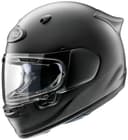
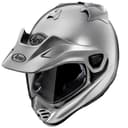
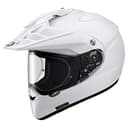
Three: weight, shell and shell count. Within a group of helmets whose certification is identical, these are the specs that actually differ, and they are the ones you will notice. The spread here is 1,515 g (Arai Contour-X) to 1,810 g (Shoei Hornet X2), and the construction runs from advanced polycarbonate to hand-laid fiberglass-and-organic-fiber laminate. See helmet shell materials for what each construction actually does, and helmet shell sizes for why the number of shells a maker tools changes how a small or a 2XL fits.
Four: price per certification. Since the badge is constant, the cheapest route to it is a real and defensible answer to the question “which Snell helmet should I buy?” — which is why a sub-$200 polycarbonate helmet is second on this page and a $700 hand-laid Arai is fifth.
What a Snell rating actually tells you
Snell certification is a pass. There is no Snell score, no Snell stars and no Snell level — which is exactly why the badge cannot tell the helmets on this page apart. A helmet submitted to the program either meets the M2025D or M2025R requirements or it does not get the sticker, and Snell buys helmets off the shelf afterwards to re-test them, which is the part of the program most worth paying attention to.
That is also the honest limit of this page. Snell tells you a helmet passed an independent impact protocol. It does not tell you the helmet is “safer for you” than a well-fitting ECE 22.06 helmet, because fit is the variable nobody certifies and the one that decides whether any of the testing applies to your head. If you take one thing from this page other than a pick, take that: get the size right first, then choose between certifications. Our do I need a Snell helmet guide argues the case for and against at length, and DOT vs ECE vs Snell explains how the three programs are administered differently.
What we left out, and why
Every modular helmet we list. Not one flip-up in our registry — the Shoei Neotec 3, Schuberth C5, HJC RPHA 91, Scorpion EXO-GT930 or Sena Outrush R — states a Snell rating on the page we read. If a Snell sticker is non-negotiable for you, that currently rules out the entire modular helmet category as we have it sourced, and it is better to know that before you start shopping.
The ECE 22.06 helmets. The AGV K6 S, Klim Krios Pro, LS2 Stream II, Scorpion EXO-AT960 and Bell MX-9 Adventure all publish ECE 22.06 and no Snell. That is a different, newer protocol with rotational testing built in, not a lesser one, and several of them are on our safest helmets list for that reason. They are simply not Snell helmets, so they are not on this page.
The Bell Qualifier DLX. It carries MIPS, which addresses rotational forces, and DOT. MIPS is a feature, not a certification — nobody independently certifies an individual helmet’s MIPS implementation — and the listing claims no Snell. It belongs on our budget helmets page, where it is, and not here.
Older Snell ratings. We only list helmets whose pages state a current M2025-series rating. A helmet certified to M2015 or M2020 is not unsafe and is often an excellent closeout buy, but “Snell approved” with a decade-old standard behind it is a different claim from the one this page makes. See how to check a helmet’s age before you buy a discounted lid.