The Lid Test

The Best Summer Motorcycle Gloves

A summer glove is an argument between airflow and the hardware that protects your hands, and the market mostly resolves it by quietly dropping the certification. Four ranked on how the venting is built first, then on the EN 13594 clause the maker actually prints.

By Stephen V.Last verified How we compare

The verdict

Buy the Klim Induction. It is the only glove we could source that is genuinely engineered for airflow — a mesh backhand with mapped perforations, not a few holes punched in leather — and still carries a printed certification: Klim states “CE Level 1 KP rating certified to EN 13594” on a fully vented glove, which is unusual enough that it decided this page. It also has the only carbon-fiber hard knuckle here and an aramid-reinforced Schoeller fabric palm pad, which is the most specific abrasion claim any maker on this page makes. It is for the rider who wants one certified glove for hot months and will own a separate pair for rain.

If the budget is the constraint, the Alpinestars SMX-1 Air V2 is the sensible short glove: a perforated leather and air-mesh chassis, a hard polymer knuckle and touchscreen fingertips for roughly half the Klim’s money. Alpinestars states CE Level 1 but does not cite the EN 13594 test on the page we read, which is a weaker claim than Klim’s and the reason it is second rather than first.

And the finding worth taking away even if you buy neither: ventilation and published certification almost never arrive together in this category. The most ventilated glove on this page, the ScorpionEXO SG3 MK III, publishes no EN 13594 clause at all despite carrying a palm slider and a carbon-reinforced knuckle. That is not proof it is uncertified. It is the one omission we cannot rank around.

Hot-weather gloves are where riders quietly give up the most protection, and they do it for an understandable reason: a leather glove in 95-degree traffic is genuinely unpleasant, and the obvious fix is to buy something with holes in it. The problem is that “has holes in it” covers two completely different engineering approaches and one marketing one.

So this page ranks on how the airflow is built, in this order. One: a mesh panel. Replacing the backhand material entirely with mesh moves far more air than perforation can, because the opening is continuous rather than a grid of 2 mm holes. Only one glove here does it. Two: mapped perforation. Holes placed where the hand actually sheds heat — the back, between the fingers, the side walls — rather than uniformly across a panel that also has to resist abrasion. Three: perforated leather alone, which works and is the standard budget answer. Four: nothing, which is where our fourth pick sits, and we say so in its own entry rather than implying otherwise.

Then the second axis, and the one that reorders the list: what certification clause the maker actually prints. EN 13594:2015 is the European standard for motorcycle gloves. The test house SATRA describes its two levels plainly — Level 1 for gloves giving protection with low ergonomic penalties, Level 2 for greater protection — and notes that knuckle impact protection is optional for Level 1 and mandatory for Level 2, which is exactly why the “KP” suffix on a Level 1 glove is worth looking for. Every certified glove on this page is Level 1 KP, and none is Level 2.

The scarcity is the story. Of every glove in our registry, exactly one is both genuinely ventilated and carries a printed EN 13594 clause. Not one is a vented glove at Level 2. If you want maximum airflow and maximum published protection in the same glove, as we have the US market sourced, that glove does not exist yet — and we would rather tell you that than rank four near-identical mesh gloves and pretend the decision is hard.

We have worn none of these gloves and own none of them. Here is what we do instead. Every spec below comes from the page named on each product card, read on the date recorded there. Prices are live on the buy buttons and carry their own date; nothing in this text quotes a number.

How this is funded: we earn a commission if you buy through our links, at no extra cost to you. It never changes which helmet we recommend, and we’ll tell you plainly when a cheaper or lighter one is the better buy. Full disclosure.

Quick picks

Ranked on our spec score — certification, weight, features and value. Select a row to jump to the full write-up. We have not tested these gloves; here is exactly how we compare them instead.

#GloveBest forCE armorMaterialWaterproofOur scorePrice
1
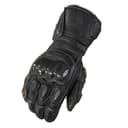
Klim Induction

Klim Induction

The hot-weather half of a touring glove drawer, and the only pick here with a carbon-fiber hard knuckle. A mesh backhand and mapped perforations move real air, the aramid-reinforced palm pad is the most specific abrasion claim on the page, and Klim still prints the EN 13594 clause. It is not waterproof, and does not pretend to be.

Best overallCE Level 1 KP certified to EN 13594; carbon-fiber hard knuckle protector, 5 mm XRD impact foam in palm and knuckle pads, aramid-reinforced Schoeller fabric palm pad overlayPremium goat leather with a mesh backhand and mapped perforationsNo8.5
$149.99 · View on Amazon

Price as of October 16, 2026. #ad How we’re funded

2
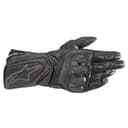
Alpinestars SMX-1 Air V2

Alpinestars SMX-1 Air V2

The hot-weather value glove. Perforated leather and air mesh keep your hands cool, a hard polymer knuckle handles the important protection, and touchscreen fingertips keep it practical — at around $80, the sensible summer short glove.

Best value short cuffCE Level 1; hard polymer knuckle (EN 13594 not stated on the maker page)Perforated leather with air meshNo8.0
$76.00 · View on Amazon

$79.955% off

Price as of October 16, 2026. #ad How we’re funded

3
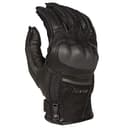
Scorpion SG3 MK III

Scorpion SG3 MK III

The most race hardware per dollar here by a distance: a carbon-fiber-reinforced TPU knuckle, a custom palm slider and hard TPU on the fingers, on perforated goat leather with a dual-closure gauntlet. The catch is the one that matters most on a protection page — the listing publishes no EN 13594 certification at all.

Most ventilated gauntletNo EN 13594 certification published on the listing; carbon-fiber-reinforced TPU knuckle guard, custom palm slider, hard TPU finger armor with impact-absorbing foamPerforated and non-perforated goat leather with goat leather overlay on the pinky, fingers, thumb and palm, plus a textured microsuede palm overlayNo7.8
$134.95 · View on Amazon

Price as of October 16, 2026. #ad How we’re funded

4
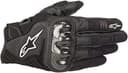
Alpinestars SP-8 V3

Alpinestars SP-8 V3

The default do-everything sport glove. Full-grain goat leather with a MotoGP-derived dual-density knuckle, CE Level 1 KP certification and a gauntlet cuff that covers the wrist a short glove leaves exposed. Touchscreen fingertips make it livable day to day.

Best if you only own one pairCE Level 1 KP (EN 13594:2015); MotoGP-derived dual-density knuckleFull-grain goat leather with synthetic panelsNo8.4
$124.95 · View on Amazon

Price as of October 16, 2026. #ad How we’re funded

Specs read from each manufacturer or retailer listing on the date shown in that glove’s write-up below; “Not published” means the maker does not state that figure. Prices are pulled live from Amazon and were last checked October 16, 2026.

The picks in full

#1Best overallOur score8.5

Klim Induction

The hot-weather half of a touring glove drawer, and the only pick here with a carbon-fiber hard knuckle. A mesh backhand and mapped perforations move real air, the aramid-reinforced palm pad is the most specific abrasion claim on the page, and Klim still prints the EN 13594 clause. It is not waterproof, and does not pretend to be.

Strengths

  • "CE Level 1 KP rating certified to EN 13594" in a fully vented glove, which is unusual
  • Carbon-fiber hard knuckle protector plus 5 mm XRD impact foam in the palm and knuckle pads
  • Aramid-reinforced Schoeller fabric palm pad overlay — the most specific abrasion claim any maker makes on this page
  • Mesh backhand with mapped perforations, premium goat leather chassis and Mult-E-Touch pads

Trade-offs

  • No membrane at all: RevZilla's listing publishes no waterproofing, so this is a dry-weather glove
  • Mesh and perforations are not reversible — it is cold at highway speed once the temperature drops into the fifties
  • RevZilla publishes no cuff description and no visor wiper for it
  • Costs within a few dollars of the waterproof picks here while doing one job instead of two
MaterialPremium goat leather with a mesh backhand and mapped perforations
ArmorCE Level 1 KP certified to EN 13594; carbon-fiber hard knuckle protector, 5 mm XRD impact foam in palm and knuckle pads, aramid-reinforced Schoeller fabric palm pad overlay
WaterproofNo
Best forSummer touring and hot-climate riders who want a certified vented glove and will carry a waterproof pair for the rain

Notable. Mesh backhand with mapped perforations; carbon-fiber hard knuckle; aramid-reinforced Schoeller palm pad; Mult-E-Touch; XS-3XL

Specs read from the manufacturer / retailer listing, on October 7, 2026. “Not published” means the maker does not state that figure.

#2Best value short cuffOur score8.0

Alpinestars SMX-1 Air V2

The hot-weather value glove. Perforated leather and air mesh keep your hands cool, a hard polymer knuckle handles the important protection, and touchscreen fingertips keep it practical — at around $80, the sensible summer short glove.

Strengths

  • Perforated leather and air-mesh chassis for genuine hot-weather airflow
  • Hard polymer knuckle protector; CE-certified Level 1
  • Touchscreen-compatible fingertips at a budget price

Trade-offs

  • Short cuff and mesh construction — a summer glove, not a wet- or cold-weather one
  • The maker's page states CE Level 1 but doesn't cite the EN 13594 test on it directly
MaterialPerforated leather with air mesh
ArmorCE Level 1; hard polymer knuckle (EN 13594 not stated on the maker page)
WaterproofNo
Best forWarm-weather riders who want a ventilated short glove on a budget

Notable. Perforated leather/mesh airflow; hard knuckle; touchscreen

Specs read from the manufacturer / retailer listing, on July 19, 2026. “Not published” means the maker does not state that figure.

#3Most ventilated gauntletOur score7.8

Scorpion SG3 MK III

The most race hardware per dollar here by a distance: a carbon-fiber-reinforced TPU knuckle, a custom palm slider and hard TPU on the fingers, on perforated goat leather with a dual-closure gauntlet. The catch is the one that matters most on a protection page — the listing publishes no EN 13594 certification at all.

Strengths

  • Carbon-fiber-reinforced TPU knuckle guard, a custom palm slider and hard TPU finger armor over impact foam
  • Perforated goat leather on the back of the hand and side walls, so it is the most ventilated glove here
  • Dual-closure gauntlet with accordion stretch zones and a pre-curved palm and fingers
  • Touchscreen-compatible thumb, index and middle finger — the only glove on this page that is

Trade-offs

  • No EN 13594 certification published anywhere on the listing we read, which is why it ranks below gloves with less hardware
  • No finger bridge, so the third and fourth fingers are free to separate in a slide
  • Perforation is the wrong feature for cold or wet riding — this is a dry-weather glove
MaterialPerforated and non-perforated goat leather with goat leather overlay on the pinky, fingers, thumb and palm, plus a textured microsuede palm overlay
ArmorNo EN 13594 certification published on the listing; carbon-fiber-reinforced TPU knuckle guard, custom palm slider, hard TPU finger armor with impact-absorbing foam
WaterproofNo
Best forRiders who want a vented gauntlet with a palm slider for well under half the price of a race glove

Notable. Palm slider and carbon-reinforced knuckle at a mid-tier price; perforated leather; touchscreen thumb, index and middle finger; sizes XS-3XL

Specs read from the manufacturer / retailer listing, on October 14, 2026. “Not published” means the maker does not state that figure.

#4Best if you only own one pairOur score8.4

Alpinestars SP-8 V3

The default do-everything sport glove. Full-grain goat leather with a MotoGP-derived dual-density knuckle, CE Level 1 KP certification and a gauntlet cuff that covers the wrist a short glove leaves exposed. Touchscreen fingertips make it livable day to day.

Strengths

  • CE Level 1 KP certified to EN 13594:2015 with a dual-density hard knuckle
  • Full-grain goat leather with a gauntlet cuff for wrist coverage a short glove skips
  • Touchscreen-compatible at the index finger and thumb

Trade-offs

  • Leather sport glove with no waterproof membrane — not a wet-weather glove
  • Gauntlet cuff takes a moment longer to get on and off than a short glove
MaterialFull-grain goat leather with synthetic panels
ArmorCE Level 1 KP (EN 13594:2015); MotoGP-derived dual-density knuckle
WaterproofNo
Best forAll-round sport and street riders who want one versatile leather glove

Notable. MotoGP-derived knuckle; gauntlet cuff; touchscreen fingertip

Specs read from the manufacturer / retailer listing, on July 19, 2026. “Not published” means the maker does not state that figure.

Short cuff or gauntlet in summer?

This is the decision riders get wrong most often on a hot day, because the short glove feels cooler in the driveway. Two of our picks are short-cuff and two are gauntlets, and the trade is not really about temperature.

A gauntlet overlaps the jacket sleeve, which means there is no gap at the wrist for a sleeve to ride up and expose skin — and the wrist is where a hand lands. A short cuff tucks under the sleeve, goes on and off faster at every stop, and is cooler at low speed because the cuff is not sealing anything. Above about 40 mph the difference narrows sharply, because at that point the airflow through the glove shell matters far more than whether air can get in at the cuff.

Our honest read: if you are riding a sportbike in summer, buy the gauntlet and accept the thirty extra seconds. If you are commuting in traffic and taking the gloves off six times a day, the short cuff is the one you will actually keep wearing, and a glove you wear beats a glove you leave at home. Our guide to choosing motorcycle gloves works through the cuff decision alongside the other five.

What perforation costs you, and what it does not

It is worth being precise about this, because the internet is not. Punching holes in leather does reduce the material in the abrasion path — there is less of it, by definition. What it does not do is make the leather tear-prone the way people assume, because the perforated panels on every glove here are on the back of the hand and the side walls, not on the palm. Every glove on this page has an unperforated palm, which is the surface that actually contacts the road first.

That is why the perforation question is secondary and the knuckle question is not. A vented glove with a hard knuckle and a solid palm is a reasonable summer compromise. A vented glove with a soft knuckle and a perforated palm is not a glove we would put on a ranking.

The other cost of perforation is one nobody mentions at purchase: it is irreversible. A mesh-backed glove is cold at highway speed the moment the temperature drops into the fifties, and a wet mesh glove is a cold wet mesh glove for the rest of the ride. There is no closing a vent that is a hole. Summer gloves are a second pair, not a replacement for a three-season touring glove or a winter pair.

How this page relates to our other glove rankings

Best motorcycle gloves is the all-round ranking and the page to read if you are buying one pair for everything. Touring gloves and winter gloves are both organized around a waterproof membrane, which is the opposite of what this page wants — a membrane is a layer air cannot pass through, so a genuinely waterproof glove cannot also be a genuinely vented one. Racing gloves ranks on track hardware: palm slider, finger bridge, kangaroo palm. And beginner gloves is the first-purchase page. This one does the job none of them do, which is rank on airflow.

What we left out, and why

Mesh gloves with no published certification and no hard knuckle. Search this category and the cheapest results are summer gloves that are mostly mesh, often with a soft foam knuckle and frequently with a perforated palm. Several may be perfectly adequate. We could not find a maker’s certification statement for any of them to check, which is the same rule we apply on every gear page.

The Alpinestars Faster. It is on our all-round glove ranking and it is a good urban glove, but its backhand is a softshell windbreaker panel — built to keep wind out. That is the opposite specification, so including it here on the strength of being a short, light glove would be misleading.

Perforated race gloves. The Alpinestars GP Pro R4 has a ventilated knuckle gusset, and several race gauntlets carry some perforation, but none of them is specified as a hot-weather glove by its maker and ranking them here on a feature that is incidental to their design would be inventing a category. The ScorpionEXO SG3 MK III is on this page because its listing specifically describes perforated goat leather across the back of the hand and the side walls.

Anything claiming “CE certified” in a listing title only. A listing title is not a maker’s certification statement. Where a glove’s own page or a retailer’s spec block prints the clause, we quote it; where it does not, the card says so, as it does for our third pick.
Frequently asked questions

What are the best summer motorcycle gloves?

The Klim Induction, on the basis that it is the only glove we could source that is both genuinely engineered for airflow and carries a printed certification. Klim states 'CE Level 1 KP rating certified to EN 13594' on a fully vented glove — a mesh backhand with mapped perforations rather than holes punched in a leather panel — and adds a carbon-fiber hard knuckle, 5 mm XRD impact foam in the palm and knuckle pads, and an aramid-reinforced Schoeller fabric palm overlay. The catch is that it has no membrane at all, so it is a dry-weather glove and you will want a second pair for rain.

Are mesh motorcycle gloves safe?

It depends entirely on where the mesh is. On every glove on this page the mesh and the perforation sit on the back of the hand and the side walls, and the palm — the surface that hits the road first — is solid leather. That is a reasonable compromise. A mesh glove with a perforated palm or a soft foam knuckle is a different product, and we did not rank any. The useful test when you are shopping is to turn the glove over: if the palm has holes in it, the airflow is being bought with the wrong material.

Should summer motorcycle gloves be short cuff or gauntlet?

Short cuff if you are taking them off constantly in traffic, gauntlet if you are riding fast. The temperature difference between the two is real only at low speed, because above roughly 40 mph the airflow through the glove shell dominates whatever gets in at the cuff. What the gauntlet buys is the overlap with your jacket sleeve, so there is no gap at the wrist for the sleeve to ride up and leave skin exposed. Two of our four picks are short, two are gauntlets.

Is there a vented motorcycle glove with CE Level 2 certification?

Not in anything we have been able to source. Every certified glove in our registry, vented or not, is EN 13594:2015 Level 1 KP, and that holds across a very wide price spread. SATRA's own summary of the standard explains part of why: Level 2 requires more protection and makes knuckle impact protection mandatory, and the cuff length minimum alone jumps from 5 mm to 50 mm from the wrist line. Those requirements push a glove away from being a light, airy summer glove. If airflow is your priority, Level 1 KP with a hard knuckle is realistically the ceiling today.

Can I use summer gloves in the rain?

You can ride home in them, and they will be soaked and cold within a mile. None of the four gloves here has a waterproof membrane, and that is not an oversight on the makers' part — a membrane is a layer air cannot pass through, so a glove cannot be genuinely waterproof and genuinely vented at the same time. Treat summer gloves as a second pair alongside a three-season or waterproof glove, not as a replacement for one.

Why does the Scorpion SG3 MK III rank third with the most hardware?

Because the listing we read publishes no EN 13594 certification at all — no level, no year, no KP mark — and this page ranks on published protection rather than on hardware we can see in a photograph. On features alone it would rank higher: a carbon-fiber-reinforced TPU knuckle, a custom palm slider, hard TPU finger armor and the most perforated shell on the page. The absence of a clause is not proof the glove is uncertified, but it is the one gap we cannot rank around. We apply the same rule to it on our racing gloves page, where it also ranks below gloves with less hardware.

Do summer motorcycle gloves work with a touchscreen?

Three of the four here do, and the makers state it: the Klim Induction has Mult-E-Touch pads, the Alpinestars SMX-1 Air V2 has touchscreen fingertips, and the Alpinestars SP-8 V3 is conductive at the index finger and thumb. The ScorpionEXO SG3 MK III goes furthest, with a touchscreen-compatible thumb, index and middle finger. It is worth checking per model rather than assuming, because it is a feature makers add and drop between generations without renaming the glove.

How much should I spend on summer gloves?

The spread on this page is roughly threefold, and the honest answer is that the certification does not move with the price — every certified glove here is the same Level 1 KP. What the money buys is the construction of the airflow (a mesh panel costs more to engineer than a perforated panel), the knuckle material, and specific abrasion claims like Klim's aramid-reinforced palm overlay. If the budget is tight, the cheapest pick here is a perforated-leather-and-air-mesh glove with a hard polymer knuckle, and that is a genuinely sensible summer glove rather than a compromise we are talking you into.

Sources

  • SATRA — EN 13594:2015, protective gloves for motorcycle riders — The test house's summary of the glove standard: "Level 1 for gloves designed to give protection while having low ergonomic penalties, and level 2 for gloves providing greater protection than level 1"; knuckle impact protection "is an optional feature for level 1 gloves" and mandatory for level 2; minimum cuff length 5 mm (Level 1) or 50 mm (Level 2) from the wrist line (accessed September 21, 2026)
  • KLIM — The Idaho adventure-gear maker behind the Krios Pro helmet, the GORE-TEX jackets and gloves and the K Fifty 2 riding jean — and the maker that prints the most complete certification clauses of anyone we track (accessed October 17, 2026)
  • RevZilla — Klim Induction Gloves (US) — The vented pick: "CE Level 1 KP rating certified to EN 13594" with "Premium goat leather construction", a "Mesh backhand", "Mapped perforations for airflow and abrasion protection", a "Carbon fiber hard knuckle protector", "5mm XRD impact protection foam in palm and knuckle pads" and an "Aramid-reinforced Schoeller fabric palm pad overlay", sizes XS-3XL. No waterproofing published anywhere on the listing (accessed October 7, 2026)
  • Alpinestars — The maker behind most of our gear picks — published materials, CE armor and garment certifications (accessed July 19, 2026)
  • Cycle Gear — Scorpion EXO SG3 MK III Gloves (US) — The listing for the value gauntlet, cited for what it does and does NOT publish: a "combination of perforated and non-perforated top quality goat leather", "goat leather overlay on pinky, fingers, thumb and palm", a "textured microsuede palm overlay", a "carbon fiber reinforced TPU knuckle protector", a "custom palm slider", a "dual closure gauntlet and strap", a "touchscreen compatible thumb, index and middle finger" and sizes XS-3XL — but NO CE or EN 13594 certification statement anywhere on the page (accessed October 14, 2026)
  • RevZilla Common Tread — RevZilla's editorial hub — gear explainers and how CE armor and EN 17092 garment ratings work (accessed July 19, 2026)

Keep reading