Sena Stryker Review
A full-face helmet with mesh intercom, Harman Kardon speakers and LED taillights designed into the shell, plus a drop-down sun visor Sena's own flagship does not publish. Here is what the previous-generation radio actually costs you, and the one spec Sena publishes two different answers for.
How this is funded: we earn a commission if you buy through our links, at no extra cost to you. It never changes which helmet we recommend, and we’ll tell you plainly when a cheaper or lighter one is the better buy. Full disclosure.
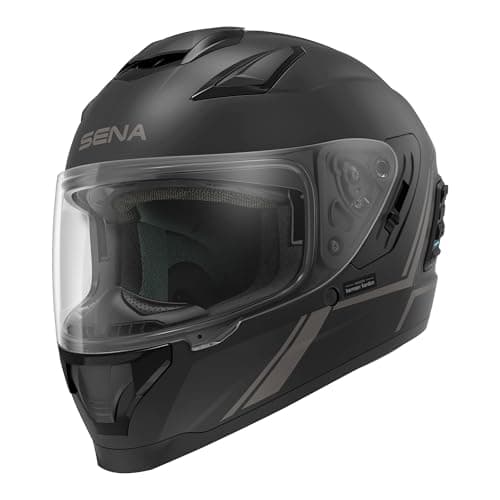
Product image supplied by Amazon
The previous-generation full-face, and the cheapest route to a composite shell with Harman Kardon audio, Mesh Intercom 3.0 and a retractable sun visor. The radio is a generation behind the Phantom's and the quoted mesh talk time is roughly a third of it — that is the trade you are making for the money.
Best for: Riders who want mesh, a sun visor and a composite shell without paying for the newest radio
Price as of October 21, 2026. #ad How we’re funded
Strengths
- Retractable sun visor — the cheapest route to one in Sena's smart-helmet range; Sena publishes no sun visor at all for the newer Phantom, and the Specter that does state one costs more
- Composite fiberglass shell, the same construction family as the Phantom, at 1,750 ±50 g in a Medium
- Mesh Intercom 3.0 with a quoted 2 km (1.2 mi) range and Group Mesh for 24 riders
- Premium speakers and microphone with sound by Harman Kardon
- Integrated LED taillights, so the helmet is lit from behind as well as connected
Trade-offs
- Bluetooth 5.0, a generation behind the Phantom and the Specter
- Sena quotes up to 13 hours on Mesh (20 hours on Bluetooth intercom) against 35 hours for the Phantom, and says LED use shortens both
- The European version is ECE 22.05, the superseded standard; the US version is DOT only
- The Pinlock anti-fog insert is an accessory, not something Sena includes
The spec sheet
| Certifications | DOT |
|---|---|
| Weight | 1750 g |
| Shell | Composite fiberglass shell |
| Head shape | Not published |
| Sizes | S-XXL |
| Internal sun visor | Yes |
| Pinlock-ready | Yes |
Specs read from the manufacturer / retailer listing, on September 24, 2026. “Not published” means the maker does not state that figure.
The Sena Stryker is the helmet Sena built before its current flagships, and the usual way to describe a product in that position is as the one to skip. That is not quite right here, because the Stryker is the cheapest route in Sena's smart-helmet range to a retractable internal sun visor— a feature the flagship Phantom does not publish at all, and which otherwise costs you the step up to the Specter. On a helmet whose whole premise is “stop bolting things to your lid,” the one piece of hardware you would otherwise be swapping at a gas station is the tinted shield, and this is the cheap Sena that saves you from doing it.
Everything else about it is a generational trade, and this review is mostly about pricing that trade honestly. Below is what Sena publishes, what it publishes twice with two different answers, and the specific rider the helmet is still the right purchase for.
What you are actually buying
The shell is composite fiberglass with a quick-release system, published at about 1,750 g (62 oz) with a ±50 g tolerance in a size Medium — and Sena states that same figure for both the DOT and the ECE versions, which is a slightly unusual piece of candor, since most makers publish one weight and leave you to guess which market it refers to. Sizes run S to XXL, with Medium charted at 57–58 cm of head circumference.
Inside the shell: Mesh Intercom 3.0 running on Bluetooth 5.0, Open Mesh across six channels, Group Mesh for up to 24 riders, and a four-rider Bluetooth intercom for the people in your group who are not on Sena mesh. Speakers and microphone are sound by Harman Kardon. There is an integrated LED taillight at the rear, which is the feature riders either love or never switch on, and a 1,300 mAh lithium-polymer battery that charges in roughly 2.5 hours through a magnetic pogo port on the back of the helmet rather than a flap-covered USB socket.
In the box: the helmet, a pouch, a USB power and data cable, the magnetic USB-C adapter and a quick start guide. Both the Pinlock antifog insert and the tinted shield are listed as extra items. That is worth noting before you compare prices against a conventional helmet that includes a Pinlock lens, because it is a real additional purchase and the shield’s built-in fog-resistant coating is a treatment rather than a sealed second lens.
The certification, which is the honest weak point
Sena states the shell is “DOT or ECE-rated – depending on region.” For an American buyer that means DOT only— FMVSS 218, the US legal minimum, which NHTSA administers and which manufacturers largely self-certify. There is no Snell rating. The European version is ECE 22.05, which the UNECE regulation has since superseded with 22.06, and 22.06 is the revision that added oblique-impact testing for rotational acceleration. The electronics carry CE, FCC, IC and KC approvals, which govern the radio rather than the helmet.
We state that plainly because it is the one place a smart helmet asks you to accept less than a conventional helmet at the same money would give you. Snell-rated helmets exist well below this price, and several of the budget full-faces on our budget ranking carry a current certification the Stryker does not. If certification is the axis you are buying on, buy the certified helmet and clamp a mesh unit to it. If the integration is what you want, this is the compromise the whole category asks for — and it asks it of the Phantom and the Specter too.
Our guide to helmet safety ratings explains what each of those marks actually tests, and ECE 22.06 vs 22.05 covers exactly what the newer revision added, which is the specific thing the European Stryker does not have.
The range figure Sena publishes twice
One contradiction is worth a section of its own, because it is on Sena’s own page and nobody reconciles it. The spec sheetstates Mesh Intercom 3.0 range as “up to 2 km (1.2 mi) in open terrain.” The overviewsection of the same page claims “up to 5 miles / 8 km” for Open Mesh. Those are not the same number, and Sena does not say which is which.
The likeliest explanation is the one mesh marketing always relies on: the smaller figure is one unit talking directly to another, and the larger one is the span of a relayed group, where each helmet hands the signal on to the next. That is genuinely how mesh works and it is a real advantage over Bluetooth chaining. But it means the headline number is only achievable with a line of riders strung out between the two ends — so the number to plan a ride around is 2 km, and the 5-mile claim is a best case that requires other people. Our Bluetooth vs mesh explainer goes through why the two technologies quote range so differently.
Where it sits against the newer Senas
The comparison that decides most purchases is the Stryker against the Phantom, and it comes down to four published numbers and one feature.
The Phantom moves to Bluetooth 5.3 where the Stryker is on 5.0. It publishes up to 35 hours of talk time where the Stryker publishes up to 13 on mesh and up to 20 on Bluetooth intercom, with Sena noting that LED use shortens both. It is lighter, at 1,690 ±50 g against 1,750. And it adds second-generation Harman Kardon speakers plus a front flashlight alongside the rear LEDs. On paper that is a clean generational win.
The one thing it does not publish is a sun visorof any kind. For a rider doing long days in changing light, that single omission is enough to keep the Stryker on the table — a drop-down visor is a lever you move at 60 mph, and a tinted shield is a part you swap in a parking lot with a screwdriver and somewhere to put the clear one. The Specter does state a built-in sun visor, on a Kevlar-reinforced shell with the newer radio and 30 hours of talk time, and it is the helmet to buy if you want both the visor and the current generation. It also costs more than either of them.
The talk-time gap is the real cost of choosing the older helmet. Thirteen hours of mesh covers any single day of riding, including a long one. It does not survive two days without a charger, and on a tour that means the helmet joins the nightly charging pile rather than sitting out of it. If you ride in a group every weekend, pay for the newer radio. If you mostly ride alone with music and a phone, 20 hours of Bluetooth is more than you will use.
Who should buy it
The Stryker makes sense for a rider who wants the whole package in one box, rides in daylight that changes, and does not need a mesh group to last two days. It is a composite shell rather than polycarbonate, the audio is a named partnership rather than “HD speakers,” the charging port is magnetic rather than a rubber flap that eventually tears, and the sun visor is a feature Sena's own flagship does not have at all.
It is the wrong buy in two cases. If certification is your priority, the DOT-only US version and the 22.05 European one are both behind what a conventional helmet at this money gives you, and you should buy the certification and add a mesh intercom. And if one specific helmet shape is the only one that fits your head — which our head shapes guide covers properly — then a smart helmet is the wrong product category for you entirely, because you cannot choose the shell separately from the radio.
We have not worn this helmet and we do not own it. Here is what we do instead — every figure above was read from Sena’s own product page, on the dates recorded in the sources below, and where Sena publishes two answers we have printed both. The price on the buy button is live and carries its own date.
Frequently asked questions
Is the Sena Stryker DOT approved?
Yes. Sena states the shell is 'DOT or ECE-rated – depending on region', which for the US version means DOT under FMVSS 218 and nothing else. The European version is ECE 22.05, the superseded standard rather than the current 22.06. There is no Snell rating and no published rotational-impact test result for either version. If a current certification matters to you more than built-in electronics, that is the single strongest argument against this helmet.
Does the Sena Stryker have a sun visor?
Yes, a retractable internal sun visor, and it is the reason this helmet is still worth writing about. Sena publishes no sun visor at all for the Phantom, its newer and more expensive flagship. The Specter above it does state a built-in one, so the Stryker is not unique in the range — it is the cheapest way into the feature. On a comms helmet that matters more than it would otherwise: a drop-down visor is one less thing to swap at the roadside when you are already carrying a charging cable.
How much does the Sena Stryker weigh?
About 1,750 g (62 oz) with a ±50 g tolerance, in a size Medium, and Sena publishes that same figure for both the DOT and the ECE versions. That is heavy for a full-face, and it should be: there is a battery, a radio, two speakers, a microphone and an LED taillight inside the shell. For comparison inside Sena's own range, the Phantom is published at 1,690 ±50 g in the same reference size. A conventional full-face plus a clamp-on intercom usually lands in the same place once you add the unit, so the weight is the cost of the category rather than of this helmet specifically.
What is the Sena Stryker's mesh range?
Sena's own page gives two different answers, and we would rather print that than pick one. The spec sheet states Mesh Intercom 3.0 at 'up to 2 km (1.2 mi) in open terrain'. The overview section on the same page claims 'up to 5 miles / 8 km' for Open Mesh. Sena reconciles the two nowhere we could find. The likeliest reading is that the smaller figure is unit-to-unit and the larger one is the end-to-end span of a relayed mesh group, which is how mesh is supposed to work — but Sena does not say that, so treat 2 km as the number you can hold it to and the 5-mile claim as the best case across a full group.
How long does the Sena Stryker battery last?
Up to 20 hours on Bluetooth intercom and up to 13 hours on Mesh intercom, from a built-in 1,300 mAh lithium-polymer battery that charges in about 2.5 hours through a magnetic pogo port at the rear of the shell. Sena adds the caveat that LED use shortens both figures. The mesh number is the one that matters for a group ride, and it is the Stryker's clearest generational gap: Sena publishes up to 35 hours for the Phantom. A 13-hour mesh day is enough for almost any single day of riding and not enough to skip a nightly charge on a tour.
Does the Sena Stryker come with a Pinlock insert?
No. Sena lists the Pinlock antifog insert lens and the tinted shield as extra items rather than box contents — the box is the helmet, a pouch, a USB power and data cable, a magnetic USB-C adapter and a quick start guide. The shield is scratch, UV and fog resistant, which is a coating rather than a sealed second lens. If you ride in the cold or in rain, budget for the insert on day one; our guide to stopping a helmet fogging explains why the coating alone is not the same thing.
Sena Stryker or Sena Phantom?
The Phantom if you ride in groups and want the current radio, the Stryker if the sun visor matters more to you than the hardware generation. The Phantom moves to Bluetooth 5.3, publishes up to 35 hours of talk time against the Stryker's 13 on mesh, is slightly lighter at 1,690 ±50 g, and adds second-generation Harman Kardon speakers and a front flashlight alongside the rear LEDs. What it does not publish is the Stryker's retractable sun visor. Both are DOT in the US with no Snell and no published 22.06 result, so this is a features-and-radio decision rather than a safety one.
Is a smart helmet better than a helmet plus an intercom?
It is tidier and it is more locked in, and which of those dominates depends on your head. A built-in system has no clamp, no boom, nothing to snag, and the speakers are designed into the shell rather than wedged into a pocket that may not be deep enough. The cost is that the helmet and the radio age and fail together, you choose the shell from one maker's small range rather than from every helmet that fits you, and a firmware generation cannot be upgraded without replacing the helmet. Our honest default: if a particular helmet shape fits your head and nothing else does, buy that helmet and add a mesh unit. If several shapes fit you, a smart helmet is a legitimate way to buy the whole package once.
Sources
- Sena — Stryker — The maker's own spec sheet: DOT (US) / ECE 22.05 (Europe), composite fiberglass shell, 1,750 ±50 g in a Medium, retractable sun visor, Mesh Intercom 3.0 with Bluetooth 5.0, up to 20 hours Bluetooth and 13 hours Mesh talk time, Harman Kardon speakers, integrated LED taillights, Pinlock insert listed as an accessory (accessed September 24, 2026)
- Sena — Stryker (re-read for the review) — The same maker page read again on this date for the single-model review, and the source of the contradiction the review leads on: the SPEC SHEET states Mesh Intercom 3.0 range as "up to 2 km (1.2 mi) in open terrain" while the OVERVIEW section on the same page claims "up to 5 miles / 8 km" for Open Mesh — two different numbers for one radio, on one page, and Sena reconciles them nowhere. Otherwise confirmed unchanged: shell "DOT or ECE-rated – depending on region" (DOT for the US, ECE 22.05 for Europe) with CE/FCC/IC/KC certified electronics, composite fiberglass shell, 1,750 ±50 g (62 oz) in size M for both versions, S-XXL with M covering 57-58 cm, a retractable sun visor, Bluetooth 5.0, Open Mesh on 6 channels, Group Mesh for 24 riders, Bluetooth intercom for 4 riders, up to 20 hours Bluetooth and up to 13 hours Mesh talk time with both varying by LED use, speakers and microphone "SOUND BY Harman Kardon", an integrated LED taillight, a 1,300 mAh built-in lithium-polymer battery charging in about 2.5 hours through a rear magnetic pogo port, and a box containing the helmet, pouch, USB power/data cable, magnetic USB-C adapter and quick start guide — with the Pinlock antifog insert and the tinted shield both listed as extra items rather than inclusions (accessed October 21, 2026)
- Sena — Phantom — The maker's own spec sheet: "USA: DOT" / "Europe: ECE R22.06", composite fiberglass shell, 1,690 ±50 g in a Medium, Mesh Intercom 3.0 with Bluetooth 5.3, 2 km quoted range, Group Mesh for 24, 35 hours talk time, 2nd-generation Harman Kardon speakers, front flashlight and rear running/brake LEDs (accessed September 24, 2026)
- Sena — Specter — The maker's own spec sheet: "USA: DOT - Europe: ECE R22.06 P/J Dual homologation", fiberglass with DuPont Kevlar fiber, 1,700 ±50 g (reference size not stated), built-in internal sun visor, "DOT: Pinlock 120XLT ready", Mesh Intercom 3.0 with Bluetooth 5.3, 30 hours talk time (accessed September 24, 2026)
- Sena — Sena's official site — mesh and Bluetooth intercom specifications (accessed July 19, 2026)
- NHTSA — Motorcycle Safety — The US regulator behind the DOT FMVSS 218 helmet standard (accessed July 19, 2026)
- UNECE — Vehicle Regulations — The UN body behind ECE Regulation 22.06, the European helmet standard (accessed July 19, 2026)
- Pinlock — Anti-fog technology — The maker of the Pinlock anti-fog insert most premium shields are prepared for (accessed July 19, 2026)
Compare it against
Best smart motorcycle helmets
The whole category ranked on what the built-in hardware actually does, and honest about the lock-in you accept with it.
See the rankingBest Bluetooth motorcycle helmets
Helmets with comms built in against helmets you add a unit to — and when the second route is the better buy.
See the picksBest mesh intercoms
The alternative to a smart helmet: a mesh unit you bolt to whichever helmet actually fits your head.
See the rankingCardo vs Sena
The brand decision underneath this helmet — DMC mesh against Open Mesh, and which one suits how you ride.
Read the comparisonSena intercoms, model by model
The rest of Sena's lineup, including the clamp-on units that do the same job on a helmet you chose for fit.
See the lineupBest helmets for touring
Where a comms-first helmet earns its money, and the quieter alternatives at the same price.
See the rankingHow to stop a helmet fogging
Worth reading before you buy, because the Stryker's Pinlock insert is an accessory rather than an inclusion.
Read the guide