What a Packtalk is actually known for
Worth separating into the parts you can replace and the parts you cannot, because the marketing does not.
DMC mesh, and the group size. Cardo’s mesh auto-manages a group of up to 31 riders with no manual re-pairing when someone drops out and returns. Sena’s mesh does the same job and caps Group Mesh at 24. For any realistic group both are plenty; if you genuinely ride in a pack of thirty, Cardo is the only one that publishes the number.
JBL audio and “Hey Cardo”. The 40 mm JBL speakers are a real differentiator and the natural-voice control is the feature owners mention most, because it means you are not pressing buttons in gloves. Sena’s answer on the 50S is Harman Kardon speakers and microphone — a genuine like-for-like on audio, from a brand that is also a household name in sound.
The Air Mount. Not replaceable, and it is the part that is easiest to underrate. A magnetic bracket means the unit snaps on and off in gloves without fighting a clamp. Nothing on this page has it, and nothing from Cardo below the Edge has it either.
IP67. Also not replaceable here, and it is the honest reason to buy a Cardo. Cardo publishes IP67 on the Edge and the Neo. On the pages we checked, Sena publishes no IP rating at all for the 50S or the 30K — the 5S is described as “water resistant” without a figure. Every product in our registry records what the maker published, and that gap is real rather than an oversight on our part.
The picks, and what each one actually swaps
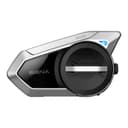
Sena 50S — the direct rival. Mesh plus Bluetooth, Group Mesh to 24 riders, a headline 5-mile Open Mesh range against Cardo’s claimed 1 mile, 16 hours of talk time against about 13, and Harman Kardon speakers and mic with Advanced Noise Control. If your group runs Sena, this is the unit that talks to them natively. Two things we would say out loud: no published IP rating, and the 50S is no longer Sena’s flagship — the 60S sits above it with Mesh 3.0 and an IPX7 rating. Our Packtalk Edge vs Sena 50S comparison is this decision in full.
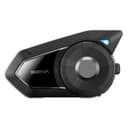
Sena 30K — the value mesh unit, and it out-publishes the 50S on battery. The previous-generation Sena mesh unit, still widely sold, and the quiet finding from our own 50S vs 30K comparison is that the older unit publishes the longer talk time of the two — 17 hours, and more than either Cardo. It has auto-reconnecting mesh, 24-rider Group Mesh, Audio Multitasking so you can talk on mesh while streaming Bluetooth, and it still joins a 50S group in mesh. It has no Harman Kardon speakers and none of the 50S’s refinements, and third-party listings sometimes price it above the newer 50S — so compare the two live prices on this page before you choose, because that is the whole argument for it.
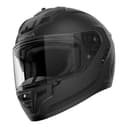
Sena Phantom — skip the separate unit entirely. A different kind of alternative: rather than replacing the Cardo with another clamp-on unit, this replaces the helmet-plus-unit purchase with one object, and it is the only pick here that answers a Packtalk on its own terms — Mesh Intercom 3.0 with Bluetooth 5.3, quoted at 2 km (1.2 mi) in open terrain with Group Mesh for 24 participants, second-generation Harman Kardon speakers and microphone, and 35 hours of quoted talk time from a 2.5-hour charge, which is the longest published battery figure on this page by a distance. Front and rear LEDs are wired into the shell as a flashlight and as running and brake lights.
The costs are permanent and stated on its card. Sena’s spec sheet gives the US version DOT and the European version ECE R22.06, so the helmet sold here carries DOT alone and no Snell; Sena states no internal sun visor on any page we could read, so we record none; the electronics are not removable, so when the radio generation dates it dates inside the helmet; and it is premium money for a DOT-only fiberglass shell. It is the top pick on our smart helmet ranking. If you want the same idea in a cheaper Bluetooth-only helmet, the Sena Outrush R is on our Bluetooth helmet ranking.
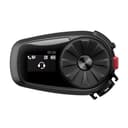
Sena 5S — the cheaper-Cardo answer, with the honest catch. The budget pick, and the one most people searching for a cheap Cardo alternative should look at first. A simple, reliable two-way Bluetooth intercom, redesigned HD speakers, a backlit LCD you can read before you set off, and 18 hours of talk time — longer than either Cardo, and longer than the two mesh units above it. The catch is not hidden: no mesh, a two-rider cap and a 0.4-mile range. For a solo rider, a two-up pair or a regular pair of riding partners, it does the whole job for a fraction of the money. For a group, it is the wrong tool and the mesh units above it are the point.
If your real question is a cheaper Cardo
Then the answer is the Cardo Packtalk Neo, and we are not going to pretend otherwise just because this page is titled “alternatives”. It has the identical second-generation DMC mesh, the same JBL speakers, the same 31-rider groups, the same 1-mile range, the same IP67 rating and the same natural-voice control as the Edge. What it gives up is the Air Mount magnet, in exchange for a traditional clamp mount and a lower price.
It is not in the picks above because it is a Cardo, and a list of Cardo alternatives that quietly includes a Cardo is a bait-and-switch. But if the magnet is the only thing you were going to drop, it is the better buy than anything on this page — our Packtalk Edge vs Neo comparison prices that difference out, and the Cardo range page covers the whole lineup including the Packtalk Pro above the Edge.
Before you switch brands, check one thing
What the people you ride with already own. It is the cheapest decision input available and the one most often skipped. Cardo’s DMC and Sena’s Mesh are different proprietary protocols: a mixed group falls back to universal-mode Bluetooth, which typically means a two-way link rather than a self-healing group, and the mesh features you paid for are the ones you lose. Our page on whether Cardo and Sena can connect sets out exactly what works and what does not, and our Cardo vs Sena comparison takes the two ecosystems head to head rather than unit by unit. If you ride alone, none of this matters and you should be reading our Bluetooth vs mesh guide to decide whether you need mesh at all.