The Lid Test

The Best Motorcycle Half Helmets

Three half shells, ranked on the laminate, the published weight and whether they fix the two things that actually annoy half-helmet riders — glare and nowhere to put a comms unit. Plus what the shape costs you.

By Stephen V.Last verified How we compare

The verdict

The Sena Cavalry 2 is the pick if you ride in a group: it is a composite fiberglass shell with Sena’s Mesh Intercom 3.0 built into it, which solves the problem that defines this category — on a half helmet there is nowhere sensible to clamp a comms unit — and at 950 g (±30) in a Medium it is also the lightest helmet on the page. If glare is what bothers you, the HJC IS-Cruiser has a pull-down sun shield with tabs you can find in gloves, for about a third of the price. The budget pick is the LS2 Bagger at a published 1,012 g on a fiberglass composite shell — the cheapest helmet we rank anywhere. All three are DOT-only, and none of them can give you a chin bar. Prices are pulled live from Amazon and were last checked November 11, 2026.

A half helmet is the least protective shape sold for road use, and saying so first is the only way the rest of this page is worth reading. It covers the crown and the back of the head and stops there: no chin bar, no jaw coverage, usually no face shield. If you want to know what that trade actually costs in the data, our open-face vs full-face comparison is the honest version and it does not favor this category.

But people buy them anyway, for reasons that are not stupid — heat, visibility and peripheral awareness in slow traffic, comfort on a cruiser at legal speeds, and the fact that a helmet you will actually wear beats one that stays on the garage shelf. So the useful question is not whether to talk you out of it. It is which half helmet is built better than the others, and that comes down to three things a maker either publishes or does not: what the shell is laid up from, what it weighs, and whether it solves glare and comms, the two complaints every half-helmet rider eventually has. Ranked on those, the order below is not the order of the price tags.

One scope note, because the site covers both shapes. Our open-face ranking puts three-quarter and half helmets in one list and answers “which non-full-face lid should I buy” — and its answer is a three-quarter helmet, because a three-quarter helmet is the better object. This page assumes you have already made that call and ranks the three half shells against each other.

How this is funded: we earn a commission if you buy through our links, at no extra cost to you. It never changes which helmet we recommend, and we’ll tell you plainly when a cheaper or lighter one is the better buy. Full disclosure.

Quick picks

Ranked on our spec score — certification, weight, features and value. Select a row to jump to the full write-up. We have not tested these helmets; here is exactly how we compare them instead.

#HelmetBest forCertificationsWeightShellOur scorePrice
1
Sena Cavalry 2

Sena Cavalry 2

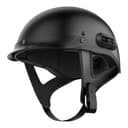
A composite-shell half helmet with Sena's current Mesh Intercom 3.0 built into it, which removes the thing that makes comms awkward on a half helmet: there is nowhere sensible to clamp a unit. At 950 g it is also the lightest helmet on this page, and the intercom hardware is the part carrying the price.

Best overallDOT950 gComposite fiberglass shell over EPS8.0
$346.88 · View on Amazon

Price as of November 11, 2026. #ad How we’re funded

2
HJC IS-Cruiser

HJC IS-Cruiser

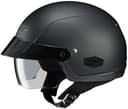
The half helmet that solves glare. HJC's integrated HJ-V4 sun shield pulls down out of the shell, which is the feature the rest of this category charges you extra for or skips entirely, and the whole helmet still lands in budget territory. Polycarbonate and DOT-only are the costs.

Best for glareDOT1197 gAdvanced polycarbonate composite7.7
$119.99 · View on Amazon

Price as of November 11, 2026. #ad How we’re funded

3
LS2 Bagger

LS2 Bagger

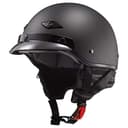
The cheapest sensible way onto this list, and it is cheap without being nasty: an HPFC fiberglass composite shell, a zip-off neck skirt for cold mornings, and speaker pockets with a hidden channel for the wires. What you give up is any kind of eye protection beyond a snap-on peak.

Cheapest, and lightestDOT1012 gHPFC (High Performance Fiberglass Composite), two shell sizes7.4
$99.98 · View on Amazon

Price as of November 11, 2026. #ad How we’re funded

Specs read from each manufacturer or retailer listing on the date shown in that helmet’s write-up below; “Not published” means the maker does not state that figure. Prices are pulled live from Amazon and were last checked November 11, 2026.

The picks in full

#1Best overallOur score8.0

Sena Cavalry 2

A composite-shell half helmet with Sena's current Mesh Intercom 3.0 built into it, which removes the thing that makes comms awkward on a half helmet: there is nowhere sensible to clamp a unit. At 950 g it is also the lightest helmet on this page, and the intercom hardware is the part carrying the price.

Strengths

  • Sena Mesh Intercom 3.0 built in, quoted at up to 0.8 miles bike-to-bike in open terrain, with Group Mesh for up to 24 participants
  • Wave Intercom works over cellular data, so range stops being a distance problem when riders spread out
  • Composite fiberglass shell over an EPS liner, and 950 ±30 g in a size Medium — the lightest lid here
  • 18 hours of talk time, Bluetooth 5.2, integrated speakers and mic, and over-the-air firmware updates

Trade-offs

  • DOT only; no ECE and no Snell is stated on Sena's US page
  • Sena's specification does not state an internal sun visor, so glare is on your sunglasses
  • The comms hardware is not removable — when the electronics date, they date inside the helmet
  • Costs multiples of a plain half helmet, and you are paying for the intercom, not the shell
CertificationsDOT
Weight950 g
ShellComposite fiberglass shell over EPS
Head shapeNot published
SizesS-2XL (55-64 cm)
Internal sun visorNot published
Pinlock-readyNo

Notable. Built-in Sena Mesh Intercom 3.0 and Wave Intercom, Bluetooth 5.2, 18 hours talk time, integrated premium speakers and mic, double D-ring chinstrap

Specs read from the manufacturer / retailer listing, on August 31, 2026. “Not published” means the maker does not state that figure.

#2Best for glareOur score7.7

HJC IS-Cruiser

The half helmet that solves glare. HJC's integrated HJ-V4 sun shield pulls down out of the shell, which is the feature the rest of this category charges you extra for or skips entirely, and the whole helmet still lands in budget territory. Polycarbonate and DOT-only are the costs.

Strengths

  • Integrated pull-down HJ-V4 light-smoke sun shield with exposed tabs you can find in gloves
  • Removable, washable anti-bacterial Nylex liner rather than glued-in foam
  • XS-2XL run on a 54-63 cm span, so it fits a wider range of heads than most half helmets
  • Consistently one of the cheapest ways to get a sun shield on your head

Trade-offs

  • Advanced polycarbonate composite shell — injected, not a fiberglass or aramid layup
  • 2.64 lb (about 1,197 g) makes it the heaviest half helmet on this page
  • DOT only; no ECE and no Snell is stated
  • No face shield and no published speaker pockets, so eyewear and comms are both aftermarket problems
CertificationsDOT
Weight1197 g
ShellAdvanced polycarbonate composite
Head shapeIntermediate oval
SizesXS-2XL (54-63 cm)
Internal sun visorYes
Pinlock-readyNo

Notable. Integrated pull-down HJ-V4 light-smoke sun shield; removable washable anti-bacterial Nylex interior; nylon D-ring retention

Specs read from the manufacturer / retailer listing, on August 31, 2026. “Not published” means the maker does not state that figure.

#3Cheapest, and lightestOur score7.4

LS2 Bagger

The cheapest sensible way onto this list, and it is cheap without being nasty: an HPFC fiberglass composite shell, a zip-off neck skirt for cold mornings, and speaker pockets with a hidden channel for the wires. What you give up is any kind of eye protection beyond a snap-on peak.

Strengths

  • HPFC (High Performance Fiberglass Composite) shell rather than injected polycarbonate at a budget price
  • 2.23 lb (about 1,012 g) makes it one of the lightest helmets on this page
  • Zip-off neck skirt plus speaker pockets with a hidden channel to route comms wiring
  • Removable, washable comfort liner and a quick-release strap

Trade-offs

  • Only two shell sizes across an XS-2XL run, so the extremes carry more EPS than shell
  • DOT only; no ECE and no Snell is claimed
  • No sun visor and no face shield — just a removable three-snap peak
  • Half-helmet coverage is the least protective shape sold, and no amount of shell material changes that
CertificationsDOT
Weight1012 g
ShellHPFC (High Performance Fiberglass Composite), two shell sizes
Head shapeIntermediate oval
SizesXS-2XL (53-64 cm)
Internal sun visorNo
Pinlock-readyNo

Notable. Removable three-snap peak; zip-off neck skirt; speaker pockets with a hidden wire channel; quick-release strap

Specs read from the manufacturer / retailer listing, on August 31, 2026. “Not published” means the maker does not state that figure.

How we ranked three half helmets

Shell construction, first. This is where the three separate most clearly and where the price tags are least informative. The Sena Cavalry 2 and the LS2 Bagger both use a fiberglass composite shell over EPS; the HJC IS-Cruiser, the middle-priced helmet, uses an injected advanced-polycarbonate composite. A laid-up shell is stiffer per gram than an injected one, which is the direct cause of the weight order below. Our shell materials guide explains what each construction actually is.

Published weight, with the reference size where there is one. Sena publishes 950 ±30 g for a size Medium, which is both the lightest figure and the only one of the three that states the size it applies to. LS2 publishes about 1,012 g. HJC’s US listing gives 2.64 lb, roughly 1,197 g, with no reference size — and that makes the IS-Cruiser the heaviest helmet here by about 250 g while covering no more of your head.

Does it solve glare? One of three does. The IS-Cruiser’s integrated HJ-V4 pull-down shield is the reason to buy it, and the reason it beats the Bagger despite being heavier and more expensive. Riding into low sun with no shield and no visor is the most common half-helmet regret.

Does it solve comms? One of three solves it properly and one makes it possible. The Cavalry 2 has Mesh Intercom 3.0 built in, quoted at up to 0.8 miles bike-to-bike in open terrain with Group Mesh for up to 24 participants, plus Wave Intercom over cellular data when riders spread out beyond mesh range. The Bagger gives you speaker pockets and a hidden wiring channel. The IS-Cruiser publishes neither.

Shell sizes, which is where all three are weak. The Bagger is built from two shell sizes across an XS–2XL run, so the extremes carry more EPS than shell. This is normal in the category and it is still a cost — see our shell sizes guide for why it matters more than most spec sheets admit.

What you are actually giving up

Be specific about it rather than gesturing at “less safe”. A half helmet gives up the chin bar, which is the structure protecting the jaw and lower face — a frequent impact region in motorcycle crashes and the reason the full-face exists. It gives up the face shield, so your eyes are protected by whatever you remembered to bring, and in rain or at night that becomes a visibility problem rather than a comfort one. It gives up the seal, which costs you noise, warmth and the ability to ride in weather.

What it does not give up is the certification over the area it does cover. All three of these are DOT-certified, and a certified half shell manages crown impacts to the same required standard as any other certified helmet. None of them states ECE or Snell — no half helmet in our registry does — so if certification depth is what you care about, that is a reason to look at our safest-helmet ranking instead, where the entries are full-face and modular because that is where the certifications are.

Match the pick to your riding

Group rides, cruiser, you want music and intercom: the Sena Cavalry 2. It is the best-built helmet here and the only one where comms is not an afterthought — 18 hours of talk time, Bluetooth 5.2, integrated speakers and mic, over-the-air firmware updates. Two honest costs: it is several times the price of a plain half helmet, and the electronics are not removable, so when the hardware dates it dates inside the helmet. If you would rather pair a separate unit with a better shell, our mesh intercom ranking is the other route.

Commuting into low sun, or any ride where glare is the problem: the HJC IS-Cruiser. The pull-down sun shield is the right feature at the right price, the Nylex liner is removable and washable rather than glued in, and the XS–2XL run on a 54–63 cm span fits a wider range of heads than most half helmets. It is the heaviest helmet here and it is polycarbonate, and at this price those are reasonable trades for the shield.

Cheapest sensible lid, and you already ride in sunglasses: the LS2 Bagger. A fiberglass composite shell at a published 1,012 g for under $100 is a genuinely good spec sheet, and the zip-off neck skirt plus speaker pockets with a hidden wiring channel are features the IS-Cruiser does not have. What you give up is any eye protection at all beyond the three-snap peak.

Not sure a half helmet is right for you? Read our cruiser helmet ranking, which takes the same riding position and answers it with full-face and modular helmets instead — including one that converts to open-face, which is the way to have this argument with yourself only once.
Frequently asked questions

Are half helmets DOT approved?

They can be, and all three here are. DOT FMVSS 218 does not mandate a shape — it mandates performance on impact attenuation, penetration and retention, and a half shell can be built to pass it. What it cannot do is protect an area it does not cover, which is why a DOT half helmet and a DOT full-face are both legal and not equivalent. Be alert for "novelty" half helmets sold with no DOT certification at all; those are not helmets in any useful sense, and none is in our registry.

Is a half helmet safer than no helmet?

Substantially, yes. The crown and the back of the head are common impact sites and a certified half shell manages energy there exactly the way a full-face does over the same area. The honest framing is a ladder rather than a yes or no: no helmet, then a certified half helmet, then a three-quarter helmet, then a full-face. Each rung adds coverage. A half helmet is a real rung on that ladder and it is not the top one.

Can you put Bluetooth on a half helmet?

It is the hardest shape to do it on, which is why one of these helmets builds it in. A clamp-on intercom needs a shell edge to grip and a cheek area to sit against, and a half shell gives you very little of either. The Sena Cavalry 2 solves it by integrating Mesh Intercom 3.0, speakers and a mic into the helmet, with 18 hours of quoted talk time. The LS2 Bagger takes the other approach: speaker pockets plus a hidden channel to route the wiring. The HJC IS-Cruiser publishes no speaker pockets at all, which makes comms an aftermarket problem.

Do half helmets come with a visor or sun shield?

Rarely a face shield, sometimes a sun shield, and it is the single feature most worth paying for. The HJC IS-Cruiser has an integrated pull-down HJ-V4 light-smoke shield with exposed tabs you can operate in gloves — on a helmet this cheap, that is the standout spec. The LS2 Bagger has no sun visor and no face shield, just a removable three-snap peak. The Sena Cavalry 2's specification does not state an internal sun visor either. On two of these three, eye protection is sunglasses or goggles, bought separately and remembered every time.

How heavy should a half helmet be?

Lighter than anything else you can buy, because there is less of it — and the spread here is worth knowing. The Sena Cavalry 2 is 950 g (±30) in a Medium, the LS2 Bagger a published 1,012 g, and the HJC IS-Cruiser 2.64 lb, about 1,197 g. For context, the lightest full-face we rank is 1,255 g. So a heavy half helmet weighs nearly as much as a light full-face while covering far less of your head, which is the one specification on this page that can make a pick look silly.

Will a half helmet be quieter than a full-face?

No, the opposite, and it surprises people. A full-face seals around your head and manages airflow deliberately; a half helmet leaves your ears in open air at road speed, so wind noise is louder, not quieter. Riders who move to a half helmet for a sense of freedom often report more fatigue on a long day for exactly this reason. Earplugs matter more here than on any other shape — our guide on reducing wind noise covers which kind to buy.

Sources

Keep reading