The Lid Test

The Best Carbon Fiber Motorcycle Helmets

Of every helmet in our registry, exactly one publishes a full carbon shell. Every other helmet sold on the strength of the word “carbon” is a blend — carbon woven in with glass, aramid or linen. That is not a downgrade, and this page is about why.

By Stephen V.Last verified How we compare

The verdict

The Klim Krios Pro is the pick, and the reason is unglamorous: it is the only helmet here whose maker and whose US retailer both describe the shell as carbon fiber with nothing else woven in (“Carbon fiber hand-laid shell”), and it carries DOT and ECE 22.06 while doing it. If you want the lightest carbon-shelled road helmet instead, the AGV K6 S publishes 1,255 g. And if you came here assuming carbon means safer, the honest answer is in the next section: it does not, and no certifying body ranks helmets by shell material.

“Carbon” is the most abused word on a helmet box. It appears on shells that are entirely carbon fiber, on shells where carbon is one of three fibers in the weave, and on shells where carbon is a cosmetic surface layer over something cheaper. All three are legal descriptions. Only the first is what most riders think they are buying.

So this ranking does not start from a marketing phrase. It starts from what the maker publishes about the laminate, in this order: whether the shell is full carbon or a carbon blend, what the helmet actually weighs and at which size, what certifications the helmet sold in the US carries, and how many shell sizes the fit is built from. Where a maker does not publish a figure, the table below says “Not published” rather than guessing — and one of our picks is penalized in its own write-up for exactly that. Prices in the prose are qualitative; the live number sits on each buy button.

How this is funded: we earn a commission if you buy through our links, at no extra cost to you. It never changes which helmet we recommend, and we’ll tell you plainly when a cheaper or lighter one is the better buy. Full disclosure.

Quick picks

Ranked on our spec score — certification, weight, features and value. Select a row to jump to the full write-up. We have not tested these helmets; here is exactly how we compare them instead.

#HelmetBest forCertificationsWeightShellOur scorePrice
1
Klim Krios Pro

Klim Krios Pro

The benchmark ADV lid for a reason: a full carbon shell at a published 1,450 g in Large makes it one of the lightest adventure helmets made, and it reconfigures for street, adventure, dual-sport or dirt without buying a second helmet.

Best overallDOT, ECE 22.061450 gFull carbon fiber (hand-laid)9.1
$599.74 · View on Amazon

Price as of November 11, 2026. #ad How we’re funded

2
AGV K6 S

AGV K6 S

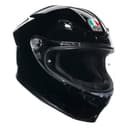
A carbon-aramid shell at roughly 1,255 g makes the K6 S one of the lightest DOT-and-ECE-22.06 full-faces you can buy, with a genuinely wide 190-degree eye port. If you notice helmet weight on a long day, this is the short list.

LightestDOT, ECE 22.061255 gCarbon-aramid fiber9.1
$639.00 · View on Amazon

Price as of November 11, 2026. #ad How we’re funded

3
Schuberth S3

Schuberth S3

Schuberth's sport-touring full-face, and the German quiet-and-integration argument in its purest form: a carbon-reinforced DFP fiberglass shell, a Pinlock 120 already fitted to the clear shield, and speakers plus antennas laid into the shell so a comms unit plugs in rather than clamps on. What the US listing does not give you is a certification above DOT, or a published weight to rank it by.

Best for touringDOTNot publishedDFP (Direct Fiber Processing) glass fiber reinforced with carbon fiber8.6
$599.00 · View on Amazon

Price as of November 11, 2026. #ad How we’re funded

4
HJC RPHA 91

HJC RPHA 91

HJC's composite touring modular splits the difference: a P.I.M. EVO carbon-blend shell and a drop-down sun visor at a mid price, ready for HJC's own SMART Bluetooth. Not as quiet as a Schuberth, a lot cheaper than one.

Best modularDOT1742 gP.I.M. EVO (carbon, carbon-glass and linen fiber)8.5
$545.00 · View on Amazon

Price as of November 11, 2026. #ad How we’re funded

5
Bell Pit Boss

Bell Pit Boss

The open-face that fixes the two things riders actually complain about: it has a drop-down sun shade, and Bell's Speed Dial system tightens the fit at the back of the head so the helmet stops trying to lift off at speed. A composite shell and speaker pockets at this price is a genuinely strong spec sheet.

Cheapest way inDOT1107 gTriMatrix composite (Kevlar, carbon and fiberglass blend), two shell sizes7.9
$159.95 · View on Amazon

Price as of November 11, 2026. #ad How we’re funded

Specs read from each manufacturer or retailer listing on the date shown in that helmet’s write-up below; “Not published” means the maker does not state that figure. Prices are pulled live from Amazon and were last checked November 11, 2026.

The picks in full

#1Best overallOur score9.1

Klim Krios Pro

The benchmark ADV lid for a reason: a full carbon shell at a published 1,450 g in Large makes it one of the lightest adventure helmets made, and it reconfigures for street, adventure, dual-sport or dirt without buying a second helmet.

Strengths

  • Full carbon shell — 1,450 g in Large is remarkably light for an ADV helmet with a peak
  • DOT and ECE 22.06, plus Koroyd energy-absorbing structure
  • Four ride modes (street, ADV, dual-sport, dirt) and a photochromic shield included

Trade-offs

  • No longer Klim's top adventure helmet — the X1 Alpha sits above it, a hand-laid carbon shell over Koroyd and EPS with more shell sizes and a road-touring bias, for meaningfully more money
  • Premium price — you're paying for carbon and versatility
  • No internal sun visor (the photochromic shield does that job instead)
CertificationsDOT, ECE 22.06
Weight1450 g
ShellFull carbon fiber (hand-laid)
Head shapeIntermediate oval
SizesXS-3XL
Internal sun visorNo
Pinlock-readyNo

Notable. Koroyd construction; four ride modes; photochromic shield; goggle-compatible

Specs read from the manufacturer / retailer listing, on July 19, 2026. “Not published” means the maker does not state that figure.

#2LightestOur score9.1

AGV K6 S

A carbon-aramid shell at roughly 1,255 g makes the K6 S one of the lightest DOT-and-ECE-22.06 full-faces you can buy, with a genuinely wide 190-degree eye port. If you notice helmet weight on a long day, this is the short list.

Strengths

  • Carbon-aramid shell — AGV's published 1,255 g is class-leadingly light for the segment
  • Certified to ECE 22.06, the newest standard with rotational and multi-point impact testing
  • Ultravision visor gives a 190-degree horizontal field of view and ships Pinlock-ready

Trade-offs

  • No internal sun visor — a tinted shield is a separate purchase
  • Sport-leaning fit and shell shape suit an intermediate-oval head best
CertificationsDOT, ECE 22.06
Weight1255 g
ShellCarbon-aramid fiber
Head shapeIntermediate oval
SizesXS-2XL
Internal sun visorNo
Pinlock-readyYes

Notable. 190-degree Ultravision visor (Optical Class 1); 5-density EPS; ARK comms-ready

Specs read from the manufacturer / retailer listing, on July 19, 2026. “Not published” means the maker does not state that figure.

#3Best for touringOur score8.6

Schuberth S3

Schuberth's sport-touring full-face, and the German quiet-and-integration argument in its purest form: a carbon-reinforced DFP fiberglass shell, a Pinlock 120 already fitted to the clear shield, and speakers plus antennas laid into the shell so a comms unit plugs in rather than clamps on. What the US listing does not give you is a certification above DOT, or a published weight to rank it by.

Strengths

  • DFP (Direct Fiber Processing) glass fiber reinforced with carbon fiber — a genuine composite shell, not the polycarbonate common even at this price
  • Ships with a Pinlock 120 anti-fog lens already installed in the clear shield, rather than merely being Pinlock-ready
  • Speakers and integrated antennas are built into the shell for a plug-and-play Bluetooth system, so nothing bolts to the outside
  • Two shell sizes cover seven head sizes from 52 to 65 cm, with a V-lock drop-down sun visor as standard

Trade-offs

  • Neither Schuberth's US listing nor RevZilla publishes a weight, so it cannot be ranked against the composites we do have figures for
  • The US listing states DOT only — no ECE 22.06 and no Snell for the helmet sold here, even though Schuberth's own S3 data sheet describes the model as its first ECE 22.06 full-face
  • Premium money for a certification stack that budget Snell helmets match on paper
CertificationsDOT
WeightNot published
ShellDFP (Direct Fiber Processing) glass fiber reinforced with carbon fiber
Head shapeIntermediate oval
SizesXS-3XL (52-65 cm)
Internal sun visorYes
Pinlock-readyYes

Notable. Pinlock 120 preinstalled; V-lock drop-down sun visor; in-shell speakers and antennas; filtered double chin intake; back spoiler air extractor

Specs read from the manufacturer / retailer listing, on August 30, 2026. “Not published” means the maker does not state that figure.

#4Best modularOur score8.5

HJC RPHA 91

HJC's composite touring modular splits the difference: a P.I.M. EVO carbon-blend shell and a drop-down sun visor at a mid price, ready for HJC's own SMART Bluetooth. Not as quiet as a Schuberth, a lot cheaper than one.

Strengths

  • P.I.M. EVO shell blends carbon, glass and linen fibers — lighter than a polycarbonate modular
  • Drop-down sun visor and a Pinlock-ready face shield included
  • Purpose-made for the SMART HJC 21B/50B Bluetooth units

Trade-offs

  • The page we verified listed DOT only (no ECE/Snell stated)
  • Comms is HJC-specific; heavier than the flagship composites
CertificationsDOT
Weight1742 g
ShellP.I.M. EVO (carbon, carbon-glass and linen fiber)
Head shapeIntermediate oval
SizesXS-2XL
Internal sun visorYes
Pinlock-readyYes

Notable. Drop-down sun visor; Pinlock-ready shield; SMART HJC Bluetooth-ready

Specs read from the manufacturer / retailer listing, on July 19, 2026. “Not published” means the maker does not state that figure.

#5Cheapest way inOur score7.9

Bell Pit Boss

The open-face that fixes the two things riders actually complain about: it has a drop-down sun shade, and Bell's Speed Dial system tightens the fit at the back of the head so the helmet stops trying to lift off at speed. A composite shell and speaker pockets at this price is a genuinely strong spec sheet.

Strengths

  • TriMatrix composite shell blending Kevlar, carbon and fiberglass, where most helmets at this price are polycarbonate
  • Internal drop-down sun shade with 100% UVA and UVB protection — the single most useful feature an open-face can have
  • Speed Dial adjustable fit system directly targets the open-face habit of lifting off the head in wind
  • Speaker pockets and a removable neck curtain are both included rather than sold as accessories

Trade-offs

  • DOT only — no ECE and no Snell is stated on the US listing
  • 2.44 lb (about 1,107 g) is heavy for a helmet with no chin bar and no face shield
  • Only two shell sizes across a XS/SM-3XL run, so the smallest and largest sizes carry more EPS than shell
  • No face shield at all, so eye protection is glasses, goggles or an aftermarket snap-on
CertificationsDOT
Weight1107 g
ShellTriMatrix composite (Kevlar, carbon and fiberglass blend), two shell sizes
Head shapeIntermediate oval
SizesXS/SM-3XL (53-64 cm)
Internal sun visorYes
Pinlock-readyNo

Notable. Speed Dial adjustable fit system; internal drop-down sun shade; removable neck curtain; speaker pockets for a comms unit

Specs read from the manufacturer / retailer listing, on August 31, 2026. “Not published” means the maker does not state that figure.

How we ranked these

Full carbon or a blend — and we say which. One helmet here is described by both its maker and its US retailer as a carbon shell with nothing else in the laminate: the Klim Krios Pro, as a “Carbon fiber hand-laid shell”. Every other pick on this page is a blend, named honestly in the comparison table — carbon-aramid on the AGV, carbon-reinforced glass on the Schuberth, carbon with carbon-glass and linen on the HJC, and Kevlar-carbon-glass on the Bell. If a helmet listing will not tell you what is in the weave, that is the answer to your question.

Published weight, with the reference size if there is one. Carbon only earns its premium if the finished helmet is actually lighter, and the only way to know is a number the maker put in print. We rank on published figures and flag the reference size where it is stated. Two picks are marked down here: the Schuberth S3 has no published weight at all, and the Krios Pro has two figures that disagree with each other depending on whether you read Klim or RevZilla.

Certification on the helmet sold in the US. This is where carbon shoppers get caught. A European-market carbon flagship may carry ECE 22.06 while the version imported here carries DOT only, and the shell being carbon does nothing to close that gap. Our safety-ratings guide explains what each standard actually tests; the safest-helmet ranking is the page to read if certification, not weight, is what you are optimizing for.

Shell sizes, because fit outranks laminate. A helmet built from more shell sizes puts less EPS between your head and the outside at the small end and keeps the external shape in proportion at the large end. A single-shell carbon helmet in three head sizes is a worse buy than a two-shell composite in the same sizes, and no amount of carbon fixes a shape that does not match your head shape.

What carbon actually does, and what it does not

Carbon fiber has the best stiffness-to-weight ratio of the three materials used for helmet shells. That is a real, measurable property and it is why carbon helmets are the featherweights. What it is not is a protection claim, and the distinction matters more than the marketing suggests: a helmet shell is not the part that absorbs the impact. The shell spreads the load and resists penetration; the crushable EPS liner underneath it does the energy management, by deforming at a controlled rate. Make a shell stiffer and you change how force arrives at that liner — you do not change how much energy the helmet can absorb.

Which is exactly why no certification body grades by material. DOT, ECE 22.06 and Snell all test a finished helmet on a headform and measure what reaches it. There is no carbon class in any of them, and the SHARP program — the only large comparative rating scheme that publishes per-model results — hands out five-star scores to polycarbonate helmets and three-star scores to premium composites. Our cheap-helmet guide goes further into why a $200 lid can out-certify a $900 one.

So buy carbon for the three things it genuinely delivers. Less mass on your neck, which is the one you will feel on hour six and the entire argument for carbon on an adventure helmet carrying a peak in a crosswind. A stiffer shell for a given thickness, which lets a maker hold the external dimensions down so the helmet looks less like a fishbowl. And the finish, which is not nothing — people buy exposed weave because they like it, and there is no need to dress that up as a safety feature.

Match the pick to your riding

The Klim Krios Pro is our overall pick because it is the only helmet on this page where the word carbon means what you think it means, and because it is a genuinely versatile helmet rather than a trophy. It reconfigures across four published ride modes — ADV, dual-sport, off-road and street — so a rider who would otherwise buy two helmets buys one, and it carries DOT and ECE 22.06. Two honest cautions. Klim no longer sells it as their top adventure helmet; the X1 Alpha now sits above it with more shell sizes and a road-touring bias, for meaningfully more money. And its published weight is a mess: Klim states 1,450 g in Large, RevZilla lists 3.4 lb, and neither page reconciles the other. Our full Krios Pro review has the detail, and the adventure ranking shows what it beats.

If you ride on the road and weight is the whole point, the AGV K6 S is the one to buy. Its carbon-aramid shell publishes 1,255 g, which is class-leading for a helmet carrying both DOT and ECE 22.06, and the 190-degree eye port is the widest field of view in the group. The trade-off is specific and you should know it before you order: no drop-down sun visor, so you are on swappable shields, and AGV’s shell is an intermediate-oval that suits a narrower head than a Schuberth. Put it against the Shoei benchmark in our RF-1400 vs K6 S comparison, or see where it lands in the lightweight ranking.

For touring, the Schuberth S3 is the carbon-blend answer and it wins on integration rather than on laminate. The DFP shell is glass fiber reinforced with carbon, it ships with a Pinlock 120 already fitted rather than merely being Pinlock-ready, and the speakers and antennas are laid into the shell so a comms unit plugs in instead of clamping on. Two things hold it back from a higher placing, and both are about what Schuberth will not print: no published weight anywhere — not on Schuberth’s US listing, not on RevZilla, not on Cycle Gear — so it cannot be ranked on the metric carbon is bought for, and the US listing states DOT only. See the Schuberth brand page for how the range is laid out.

The HJC RPHA 91 is the modular pick and the best-value carbon blend here by a wide margin. Its P.I.M. EVO shell blends carbon, carbon-glass and linen fibers, it has a drop-down sun visor and a Pinlock-ready shield, and it lands at roughly half what a flagship composite modular costs. The honest cons are that it is the heaviest road helmet on this page at a published 1,742 g — a modular carries hinge hardware a one-piece shell does not — and that HJC publishes no ECE or Snell for the US version. If you are weighing it against the premium option, read Neotec 3 vs RPHA 91.

Finally, the Bell Pit Boss is here because “best carbon fiber motorcycle half helmet” is a question people actually ask, and because it is the cheapest way into a carbon-containing laminate on this site: a TriMatrix shell blending Kevlar, carbon and fiberglass, in two shell sizes, at a published 1,107 g, for budget-helmet money. Be clear about what you are buying. It is an open-face helmet with no chin bar, and a composite shell does not change the coverage you are giving up — our open-face vs full-face comparison has the honest version of that trade. DOT only, no ECE and no Snell.

Who we left off, and why

Several helmets riders assume are carbon are not. Shoei’s AIM and AIM+ shells — the RF-1400, the X-Fifteen, the Neotec 3 — are fiberglass interwoven with organic fibers, with no carbon in the published laminate description, and the X-Fifteen is the most certified road helmet we rank regardless. Arai publishes proprietary hand-laid fiberglass laminates — PB e-cLc on the Contour-X, Super Fiber PB-cLc on the XD-5 — with no carbon named in either description. If you want the best-certified helmet rather than the lightest, those are the pages to read, not this one.

Two carbon-blend helmets we do rank elsewhere are missing from this page for the same practical reason, and it is worth stating rather than quietly omitting them. The HJC RPHA 11 Pro blends carbon with fiberglass and aramid in its PIM+ shell at a published 1,417 g, and the Schuberth E2 is a carbon-reinforced DFP adventure modular with a drop-down sun visor and a peak. Our live price layer could not return a current price for either one at publication, and a pick we cannot price is a pick we cannot honestly rank against the ones we can. Both remain where they already sit — the RPHA 11 Pro in the full-face ranking with its own review, the E2 in the adventure and modular rankings — and they will appear here when they are buyable again.

Finally, we have not ranked Klim’s own X1 Alpha, which now sits above the Krios Pro as a hand-laid carbon shell over Koroyd with more shell sizes. It is not yet in our registry with a verified listing, and we do not rank helmets we cannot price and source.
Frequently asked questions

Is a carbon fiber helmet safer than a fiberglass or polycarbonate one?

No, not inherently. Helmets are certified on measured performance — DOT, ECE 22.06 and Snell all test impact attenuation, penetration and retention on a finished helmet — and none of those standards awards anything for the shell being carbon. There is no carbon tier in the Snell standards and no carbon bonus in a SHARP score. A properly certified polycarbonate helmet and a properly certified carbon helmet have both cleared the same bar. What carbon reliably buys is stiffness per gram, which is a weight and feel advantage, not a protection one.

What is the difference between full carbon and a carbon blend?

A full carbon shell is laid up from carbon fiber cloth alone. A carbon blend weaves carbon together with other fibers — glass, aramid such as Kevlar, or in HJC's case even linen — because each fiber fails differently, and a mixed laminate can be tuned for how it spreads and absorbs a hit rather than purely for stiffness. Shoei's AIM+, HJC's PIM+ and P.I.M. EVO, Schuberth's DFP and Bell's TriMatrix are all blends. Blends are usually cheaper to produce and are often the deliberate engineering choice, not the budget one.

Are carbon fiber helmets lighter?

Usually, and sometimes dramatically. The lightest full-face we rank is the AGV K6 S at a published 1,255 g on a carbon-aramid shell, against roughly 1,650 g for a fiberglass-composite flagship and 1,800 g or more for a polycarbonate modular. But material is not destiny: the Klim Krios Pro is full carbon and the figures published for it range from Klim's 1,450 g in Large to RevZilla's 3.4 lb, because an adventure helmet carries a peak and a goggle-ready aperture that a road shell does not. Always compare the published weight, not the material name.

Are carbon fiber helmets noisier?

Shell stiffness does change how a helmet transmits noise, but it is a long way down the list of what makes a lid loud. Aerodynamics, the seal at the neck roll, the shield gasket and vent design dominate, which is why the quietest helmets we rank are composite touring shells rather than carbon ones. If noise is your priority, buy on the acoustic engineering and wear earplugs — see our quietest-helmet ranking, which is built on measurements rather than material.

Is a carbon fiber helmet worth the extra money?

It is worth it if you will feel the weight saving — long days, adventure riding with a peak, touring, or a neck that already complains. It is not worth it as a safety purchase, and it is not worth it for a short commute, where a certified composite or polycarbonate helmet that fits you properly is the better buy. Fit beats material every time: a carbon helmet in the wrong shell shape is a worse helmet than a polycarbonate one in the right one.

Do carbon fiber helmets expire faster than other helmets?

No. The replacement interval is driven by the EPS liner, the comfort padding and the retention system aging, not by the shell laminate, so the usual five-year-from-first-use and seven-year-from-manufacture guidance applies to carbon exactly as it does to everything else. Carbon shells can be more prone to visible cosmetic chipping at the edges and around the vents, which is worth noting on a resale, but a dropped helmet is retired for what happened to the liner either way.

Sources

  • RevZilla — Klim Krios Pro helmet — The US retail listing, read for the carbon roundup and the source of the only FULL-carbon shell claim on that page: "Carbon fiber hand-laid shell", "DOT and ECE 22.06 certified", "Pinlock anti-fog insert lens included", "4-ride-mode versatility: ADV, Dual-Sport, Off-Road, Street" and a listed "Weight: 3.4 lbs." against Klim’s own 1,450 g in Large — the two figures do not agree and the page says nothing about which size it weighed. Snell is not published. Sizes run XS-3XL; on the date read, the listing showed "This item is currently out of stock" at the top with per-size availability split between in-stock, 5-7 day and out-of-stock, which is why the roundup sends the reader to the live price rather than a retailer (accessed November 4, 2026)
  • KLIM — The Idaho adventure-gear maker behind the Krios Pro helmet, the GORE-TEX jackets and gloves and the K Fifty 2 riding jean — and the maker that prints the most complete certification clauses of anyone we track (accessed October 17, 2026)
  • RevZilla — KLIM X1 Alpha Helmet — The retailer listing for the carbon ADV helmet KLIM now ranges above the Krios Pro: "positioned above the Krios Pro with more road / touring emphasis", hand-laid carbon shell over KOROYD and EPS, DOT and ECE 22.06, XS-3XL, clear and photochromic shields in the box, no published weight (accessed October 29, 2026)
  • AGV — AGV's official US site — model lineup and published weights/certifications (accessed July 19, 2026)
  • SCHUBERTH (US) — Schuberth's official US site — the C5, S3 and E2 lineup, homologation and published weights (accessed August 30, 2026)
  • HJC Helmets (USA) — HJC's official US site — RPHA and value model lineups (accessed July 19, 2026)
  • Bell Helmets — Bell's official motorcycle helmet lineup and technology pages (accessed July 19, 2026)
  • Snell Memorial Foundation — Standards — The current Snell motorcycle helmet standards and what each revision changed (accessed July 19, 2026)
  • UNECE — Vehicle Regulations — The UN body behind ECE Regulation 22.06, the European helmet standard (accessed July 19, 2026)
  • SHARP — UK Safety Helmet Assessment and Rating Program — The UK government program that independently star-rates helmet impact performance (accessed July 19, 2026)
  • RevZilla Common Tread — Snell, ECE and DOT certifications explained — Plain-English overview of how the three certifications differ and who verifies them (accessed July 19, 2026)

Keep reading