How we ranked the alternatives
Each pick had to answer a named Sena attribute rather than a general impression of the brand, and the order is our published spec score, descending — the same rule every roundup on this site follows. The four specs in the table are the four a Sena buyer is actually weighing: intercom type, claimed range, published talk time and water rating. Where a maker does not publish one, the cell says so, and on this page that cuts in both directions. Sena publishes no IP rating for the 50S or the 30K. Cardo publishes no talk time at all for the Packtalk Pro, which is a strange omission on a $499.95 flagship and one we would want answered before spending that.
We did not rank on price. Three of the four cost real money and the cheapest is a different class of device rather than a cheaper version of the same one — so the budget pick is named in the verdict and explained in full below, instead of being allowed to look like a like-for-like swap.
What each pick answers
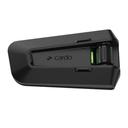
The flagship question — Cardo Packtalk Pro. If you were shopping a Sena 50S and wanted the newest thing rather than the cheapest, this is the direct answer: 2nd Gen Dynamic Mesh Communication connecting up to 31 riders, Live Bluetooth Intercom alongside it, 45 mm JBL speakers (5 mm larger than the Edge and Neo drivers), IP67, Natural Voice Operation and a three-year warranty. It is also the only unit we rank whose maker advertises crash detection, with the caveats above. The honest gaps: Cardo publishes no talk time, no Bluetooth version and no weight for it, and it is listed at $499.95 on Cardo’s own page — the most expensive intercom in our registry.
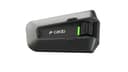
The one most people should buy — Cardo Packtalk Edge. The same second-generation DMC mesh and 31-rider cap as the Pro, 40 mm JBL speakers, “Hey Cardo” natural-voice control, IP67, and the Air Mount magnetic bracket, which is the best mounting system in the category and the single feature Sena owners most often mention after a switch. Crucially it publishes what the Pro does not: 13 hours of talk time. That is still three hours short of the 50S and five short of the 5S, and if you ride all-day distances that gap is the real argument for staying with Sena. We put the two head to head on our Packtalk Edge vs Sena 50S page.
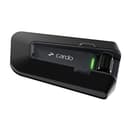
The same mesh for less — Cardo Packtalk Neo. Identical DMC mesh, identical JBL speakers, identical 31-rider cap, identical one-mile claim, identical IP67 and the same 13 hours. What it gives up is the magnet: a traditional clamp mount instead of the Air Mount, and a two-year warranty instead of three. If you are switching for the mesh rather than for the hardware, this is the cheaper way to get the same radio, and our Edge vs Neo comparison is a short read on whether the magnet is worth the difference.
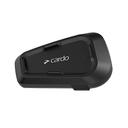
The cheapest way out — Cardo Spirit HD. The budget pick, and the one that needs its label read carefully. It is not a cheap mesh unit — it is a two-rider universal Bluetooth intercom with 40 mm HD speakers, a stated 600 m range under optimal conditions, and fast charging Cardo puts at two hours of talk time from twenty minutes on the cable. It will pair with a Packtalk in Bluetooth, which makes it a sensible pillion unit. What Cardo does not publish for it is a total battery life or an IP code, where the Sena 5S it competes with publishes 18 hours. Compare those two on the live price on the day you buy.
What no alternative here replaces
Harman Kardon. Sena’s 50S carries SOUND BY Harman Kardon speakers and microphone, and no unit on this page does — Cardo’s audio partner is JBL. Both are real audio brands and neither maker publishes a measurement you could use to rank them against each other, so we are not going to pretend one sounds better. What we can say is that if you specifically bought into Harman Kardon, switching does not get it back. Our helmet speaker ranking covers what actually changes audio quality inside a lid, which is mostly placement and seal rather than the badge.
The battery. This is the clearest gap on the page. Sena publishes 16, 17 and 18 hours across the 50S, 30K and 5S. The two Cardo units that publish a figure state 13. If you tour, that difference is a charging stop, and no amount of mesh sophistication makes it up.
Your group’s mesh. If the people you ride with run Sena, a Cardo cannot join their mesh group — only universal Bluetooth works across the brands, and it gives up the auto-reconnection that makes mesh worth paying for. Read can Cardo and Sena connect before you switch alone, because the answer changes the recommendation completely.
If you still want the Sena
Then the question becomes which one, and the answer is less obvious than the model numbers suggest. The 50S is the mesh unit with the Harman Kardon audio and 16 published hours; the 30K is the previous generation, still joins a 50S mesh group, and publishes the longer battery at 17 hours; and the 5S skips mesh entirely for a simple two-way Bluetooth intercom with the longest talk time of anything we rank. Our 50S vs 30K comparison works through the first two, and the full Sena range page covers all three with live prices. One thing worth knowing either way: Sena has moved the 60S in above the 50S, with Mesh 3.0, second-generation Harman Kardon speakers and an IPX7 rating — so the 50S is now the value unit in its own line rather than the top of it.