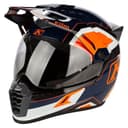
The helmet: Klim Krios Pro
It is the benchmark for a reason that shows up on the scale rather than in the marketing: a full carbon shell at a published 1,450 g in Large, which is remarkable for an adventure helmet carrying a peak, plus DOT and ECE 22.06 and a Koroyd energy-absorbing structure behind the shell. The four ride modes mean one purchase covers street, adventure, dual-sport and dirt, and a photochromic shield is included.
Two honest notes. Klim now ranges the X1 Alpha above it — a hand-laid carbon shell over Koroyd and EPS with more shell sizes and a road-touring bias — for meaningfully more money, so the Krios Pro is no longer Klim’s flagship. And the published weight figures disagree depending on whether you read Klim or RevZilla, which we note in the write-up rather than picking the flattering one. It is also the top pick on our adventure helmet ranking and our carbon helmet ranking, where you can see what it beats.
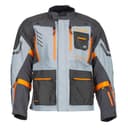
The jacket: Klim Carlsbad
The only piece in this kit that needs nothing added to it. CE AA certified to EN 17092-3, a full class above the Class A textiles most ADV jackets settle for, with Rogue CE Level 2 armor at the shoulders, elbows and back all included — so there is no protector left to buy, which is unusual at any price. The GORE-TEX Performance Shell puts the waterproofing in the outer jacket rather than in a liner you take in and out, and there are six vents including two offset back exhausts.
What it leaves out is a thermal liner. Klim’s feature list does not include one, so the jacket’s cold-weather range is whatever you wear underneath it — which is the modern laminate philosophy and genuinely better if you already own base layers, and annoying if you do not. Klim also prints CE Level 2 for the armor without naming the EN 1621 clause, and publishes no jacket weight. Sizes run SM to 3X only. If you want a thermal liner in the box, the Andes V4 Drystar jacket on our under-$500 ranking is the pick to compare it against.
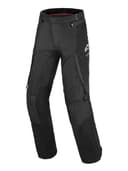
The pants: Alpinestars Andes V4 Drystar
The value slot, deliberately. A fixed Drystar waterproof membrane means you are not carrying a rain shell, a removable full-length thermal liner takes it into cold mornings, and adjustable thigh vents open it back up. Nucleon Flex Plus CE Level 1 knee armor to EN 1621-1:2012 is fitted in three-position adjustable pockets, which matters more on an ADV pant than anywhere else because knee armor that sits wrong when you stand is armor in the wrong place.
The limitations are published and worth knowing: the garment is EN 17092 Class A, not AA, and no hip armor is supplied or published — the knee pads are the only protection in the box. There is a women’s cut, the Stella Andes V4 Drystar, on a women’s-specific pattern rather than a men’s pant in smaller sizes, and it is on our riding pants ranking with the same spec sheet.
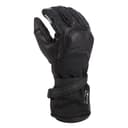
The gloves: Klim Badlands GTX Long
A CE Level 1 KP glove certified to EN 13594 with a GORE-TEX membrane bonded to the shell by GORE Grip technology, which is the detail that matters in a wet gauntlet: the layers cannot slip against each other on the bars. A polycarbonate knuckle guard over XRD impact foam, ceramic print at the knuckles, palm pad and forearm, and a long cuff that seals under a jacket sleeve.
One trade is published clearly and it decides whether this is your glove: Klim insulates only the back of the hand, with 60 g of 3M Thinsulate, and leaves the palm unlined for feel. That makes it the least insulated of the certified cold-weather gloves we rank, and a glove that leans on heated grips in genuine cold. If your bike has no heated grips, look at our winter glove ranking, where the warmer published builds are ranked on insulation instead.
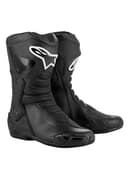
The boots: Alpinestars SMX-6 V3
The pick with the clearest caveat on the page. It is a CE certified boot to EN 13634:2017 with a TPU lateral ankle brace, dual-density ankle protectors, a race-derived shin plate and replaceable toe sliders, and its front-flex and back-flexion zones keep it walkable off the bike — which is exactly what you want at a fuel stop in the middle of a long day.
But it is a sport-touring boot, not an ADV boot: the standard version is not waterproof (Alpinestars sells separate Drystar and GORE-TEX variants), and the upper is microfiber rather than full leather. We are using it here because it is the most protective certified boot in our registry that you can also walk in, and because our registry does not currently carry a dedicated adventure boot. For graded roads it is the right call. For technical dirt, buy a taller ADV or MX boot — and we would rather tell you that than rank a road boot as something it is not. Both boots we rank are on our boots ranking.
The cheapest honest way in
A full Klim-and-Alpinestars kit is a lot of money, and the single biggest saving is the helmet. The Bell MX-9 Adventure MIPS carries DOT, ECE 22.06 and MIPS in a polycarbonate shell at around a third of the Krios Pro’s price, and it is goggle-compatible with the shield removed, so it crosses to real dirt better than the price suggests. It is heavier (a published 1,696 g), has no internal sun visor, and like most ADV lids it buffets at highway speed.
The honest budget route for the rest of the kit is not a cheaper version of each piece — it is to buy fewer pieces, better, in the order in the FAQ above, and to ride in road gear you already own while you save for the laminate. Our how much to spend on gear guide puts real numbers on all three budget levels, and our waterproof gear ranking is the page to read if rain rather than dirt is your actual problem.