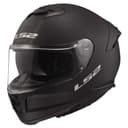
The helmet: LS2 Stream II
The best-value helmet we rank, and the features are commuter features. A drop-down sun visor is the single most useful thing a commuter helmet can have, because you ride into low sun twice a day, every day — and most premium full-faces do not have one. It is Pinlock-ready, which solves the other daily commuter problem: a visor that grays over at every stoplight in autumn. And it carries DOT and ECE 22.06, the newest standard, which almost nothing at this price does — it is the top pick on our ECE 22.06 ranking on price and on our under-$200 ranking outright.
The honest costs: the Kinetic Polymer Alloy shell is heavier than a composite at a published 1,550 g (±50), and the fit and finish are good for the price rather than flagship-grade. If you want a lighter, quieter helmet for a long commute, our commuter helmet ranking carries six, including a modular that converts and one with comms built into the shell.
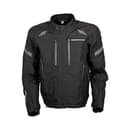
The jacket: Scorpion EXO Optima
The best waterproofing per dollar in our registry. A seam-sealed waterproof laminate shell with waterproof vents means the rain layer is the jacket — nothing to pack, nothing to remember, nothing to put on at the side of the road while already wet. A removable EverHeat thermal liner stretches it into cold mornings, which on a commute is most of the winter. CE Exo-Tec shoulder and elbow armor is included.
The gap is the back: the Optima ships with a back protector pocket and no protector in it, so budget $40 to $90 for a CE Level 2 insert. That is true of most jackets at this price — our under-$500 jacket ranking shows which ones include a spine pad and which do not, and our CE Level 2 ranking covers the gear that ships with Level 2 from the box.
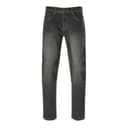
The pants: Scorpion EXO Covert Pro II
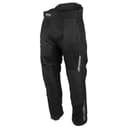
The pick that makes the whole kit workable, because it is the only protective legwear you can keep on at a desk. Scorpion certifies it CE AA to EN 17092-3:2020 — the middle abrasion class, one above the Class A most textile pants reach — and it publishes the specification that riding denim usually hides: the Rheon knee and hip armor it includes is stated as CE Level 1, with Level 2 available as an upgrade. The chassis is a 13.5–14 oz high-stretch Nyco denim with a perforated Coolmax lining, which is the more comfortable spec sheet of the two AA jeans we rank.
It is a cotton-blend jean, not a laminate: no waterproofing and no thermal layer. On a commute that is a real limitation and the reason the jacket pick carries the weather duty. If you want the legwear waterproof instead, the riding pants ranking has the membrane options, and the Klim K Fifty 2 is the more expensive AA jean with D3O armor and a tailbone pad.
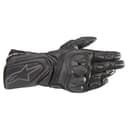
The gloves: Alpinestars SP-8 V3
The default do-everything leather glove, and the certification is published properly: CE Level 1 KP certified to EN 13594:2015 with a MotoGP-derived dual-density hard knuckle. Full-grain goat leather, a gauntlet cuff that covers the wrist a short glove leaves exposed, and touchscreen fingertips at the index finger and thumb — which on a commute means you are not removing a glove at every stop.
Two trades. There is no waterproof membrane, so this is not the glove for riding home in rain — the cheapest certified waterproof glove we rank is about $130, and that money is well spent if your commute is wet. And a gauntlet takes a moment longer to get on and off than a short glove, which matters more here than anywhere else. If you want the short-cuff version of this decision, our under-$100 glove ranking has the commuting pick at under half the price.
The boots: Alpinestars SMX-1 R V2
A lot of protection in something you can walk in. TPU medial and lateral protectors, a heel counter, a double-density medial ankle protector and a replaceable screw-in forefoot slider, on an advanced microfiber upper, CE certified to Category 2. The low-top design with accordion flex zones is the reason it is here rather than the taller SMX-6 V3 we pick for adventure riding: this is a boot you can wear into a building without changing.
It gives up shin coverage to a tall sport-touring boot, and the standard version is not waterproof. Both boots we rank are on our boots ranking with their full spec tables, and it is worth saying plainly that two boots is a thin category for us — if neither fits, buy on the EN 13634 certification and the ankle structure rather than on the brand.
The comms: Sena 5S
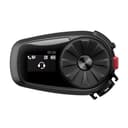
The most underrated commuter purchase on the page. Turn-by-turn navigation in your ear instead of a phone you are glancing at in traffic, plus calls and music, from a simple two-way Bluetooth intercom with 18 hours of talk time — among the longest of anything we rank — redesigned HD speakers and a backlit LCD that makes pre-ride setup something you can do in gloves.
It skips mesh entirely, and for a commute that costs you nothing. Mesh exists to hold a large group together across distance; its two-rider cap and 0.4-mile range are irrelevant if you ride alone or two-up. If you also do group weekend rides, read our Bluetooth vs mesh guide before buying, because that is the one scenario where the extra money is the point.
The cheapest way in
The Tourmaster Draft Air 2.0 is the piece that gets riders out of unarmored jeans fastest, because it does not ask you to change clothes: it is an overpant you pull on over what you are already wearing. Armor-Link mesh panels flow air, 1000 denier ripstop backs the knees and seat, and the Armanox knee armor is CE certified to EN 1621-1 Level 1 and adjustable to three heights. Tourmaster states a four-year workmanship and materials warranty.
Be clear on the limits: no hip armor is published or supplied, and the garment is published as CE class A — a class below the jean. It is a hot-weather overpant rather than an all-season one. But at roughly a hundred dollars less than the jean, and worn over office clothes in sixty seconds, it is the pick most likely to actually be on your legs — which is the only protection that counts. Our budget gear setup builds a whole kit on that logic.