How we built this list
The price gate is the live price, not an MSRP. Every helmet on this page qualified on the number our daily Amazon check returned, not on a manufacturer’s suggested price. That distinction matters more than it sounds: helmet MSRPs are sticky and street prices are not, and a page built on MSRPs would have given you a completely different and much less useful list.
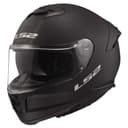
Certification first, then features.Among helmets we have already price-gated, the ranking is what the maker publishes about certification — ECE 22.06 above Snell M2025 above DOT alone — and then what you actually get for the money. That is how the Stream II beats a Snell-rated helmet here: 22.06 tests more than Snell’s impact protocol does, and the Stream II adds the sun visor and Pinlock readiness on top.
Published weight, with the reference size if there is one. Nothing on this page is light, because light shells cost money. The full-faces here run 1,550–1,642 g, which you will notice against a 1,255 g carbon flagship on a long day. If weight is your priority rather than price, our lightest-helmet ranking is the honest page to read instead, and it will cost you more.
Shell sizes, because fit beats everything. Budget helmets are usually built from two shell sizes, which means the smallest and largest sizes carry more EPS than shell and sit higher on the head. The Bell Pit Boss and LS2 Bagger are both two-shell helmets across a very wide size run, and we say so in their write-ups. No price is cheap enough to make a helmet in the wrong head shape worth buying.
What $200 does and does not buy
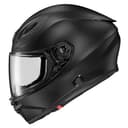
Start with what it does. It buys a certified shell, and that is not a technicality — it is the whole protective argument. It buys a removable, washable liner, which is the difference between a helmet you keep for five years and one you want to throw away after two summers. It buys a sun visor on four of these seven, the single most useful convenience feature a helmet has. And at the top of the band it buys a genuine certification upgrade: 22.06 on the LS2, M2025 on the Scorpion, MIPS on the Bell.
Now the honest half. It does not buy a quiet helmet. Noise is aerodynamics, neck-roll seal and shield gasket engineering, and all three cost money — the helmets on our quietest ranking are there because somebody spent it. It does not buy a light helmet, for the reason above. It does not buy many shell sizes. And it does not buy flagship fit and finish: the padding is thinner, the vents are stiffer, the shield mechanism is louder. None of that is a safety compromise. All of it is a comfort one, and comfort is what makes you wear the thing.
Match the pick to your riding
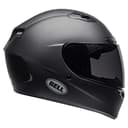
Buying your first helmet? The Bell Qualifier DLX MIPS is the easiest recommendation on this page: MIPS addresses rotational forces the DOT test does not look at, and the ProTint photochromic shield means you never own the wrong tint. The LS2 Stream II is the better helmet on paper and the better buy for most people; the Bell wins if the self-tinting shield is worth more to you than the ECE rating. Either way, read our beginner helmet ranking before you commit.
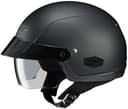
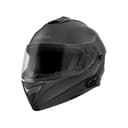
Commuting in traffic and low sun? Sun visor, every time — the Stream II for a full-face, the HJC IS-Cruiser if you ride a cruiser and want the minimum lid with a shield you can pull down in gloves. If you want music and calls in the deal without clamping a unit to the side of your head, the Sena OutForce is the only helmet under $200 with comms engineered into the shell.
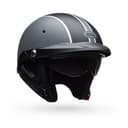
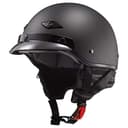
Riding a cruiser or a bagger in warm weather? The Bell Pit Boss is the best-specified three-quarter helmet here — a TriMatrix composite shell and a drop-down sun shade at a polycarbonate price — and the LS2 Bagger is the cheapest honest way onto this list at a published 1,012 g with a fiberglass-composite shell. Both ask you to bring your own eye protection, and both give up the chin bar, which is where a large share of impacts land. Our open-face vs full-face comparison lays out what that trade actually costs.
Who we left off, and why
The Bell Custom 500 was under the ceiling at our last check ($179.95) and is in some ways the best-engineered open-face we rank — a fiberglass shell in five shell and EPS sizes, which almost nothing at any price offers. It is left off because it ships with no shield and no sun visor at all, so the real cost of wearing it is higher than the price suggests, and because the US listing notes it runs small. If you want it for the styling and the fit, it is a good helmet and it is on our open-face ranking.
Two helmets we would otherwise have considered were excluded by the price gate rather than by judgment: the Bell MX-9 Adventure MIPS ($249.95) and the Scorpion EXO-GT930 Transformer ($279.95). Both are genuinely good value, both are on our budget helmet ranking, and neither is under $200. A page with a number in its title has to mean it.