What a sun visor costs you, in two numbers
Every feature on a helmet is a trade, and the honest way to rank this one is to name the trade before ranking anything. A drop-down visor needs a cavity for the panel to retract into, a mechanism to move it, and a lever or slider through the shell to operate it. All three live in the space between the outer shell and the impact-absorbing liner. Here is what that shows up as in our data.
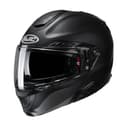
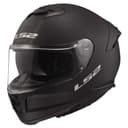
One: weight. Every closed helmet in our registry that weighs under 1,500 g publishes no sun visor — the AGV K6 S at 1,255 g, the HJC RPHA 11 Pro at 1,417 g and the Klim Krios Pro at 1,450 g. The lightest full-face we list with one is the LS2 Stream II at 1,550 g, and every modular on this page sits at 1,700 g or above. If you are shopping for the lightest helmet you can get, this feature is not on the menu. A hundred and fifty grams does not sound like much until hour six.
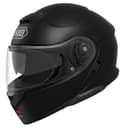
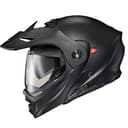
Two: certification. Of the sixteen helmets we list with a sun visor, zero carry a Snell rating and only three state ECE 22.06 — the Neotec 3, the Stream II and the Scorpion EXO-AT960, all three on this page. The remaining thirteen publish DOT alone, or DOT plus the superseded ECE 22.05. That is not a coincidence of our sampling: Snell-rated helmets in our registry skew toward race-derived full-face shells, which is exactly the category that does not build the cavity. Our guide to what DOT, ECE and Snell actually test explains what each badge covers, and ECE 22.06 vs 22.05 covers the revision that added oblique-impact testing — which is the specific thing most of the helmets in this category do not have behind them.
Neither trade is a reason not to buy one. They are reasons to buy one deliberately, which is what the ranking below is built around.
How this page is ranked
Sixteen helmets publish the feature; seven are on this page. We did not rank by how dark the panel is, because not one maker in our registry publishes a light-transmission figure for its internal visor — so any ranking on tint density would be invented, and we do not invent specs. The order is built on four things that are published:
One: what the helmet is certified to. Three of the sixteen state ECE 22.06, which is the only current standard in this group that was type-approved by an authority rather than self-certified by the manufacturer. All three made the page.
Two: what the shell is made of. A sun visor on a composite shell is a different purchase from a sun visor on polycarbonate, and at the top of this page you can have both. Helmet shell materials explains what each construction actually does for you.
Three: does the shield in front of the visor work? A sun visor does nothing about fog, and fog is the failure mode that ends rides. Six of our seven picks are Pinlock-ready and one of them ships with the insert already fitted. The Scorpion EXO-AT960 is the only exception on this page, and we say so on its card.
Four: one pick per helmet type. The reason “best helmet with a sun visor” is a hard query to answer well is that the feature spans five categories that are not substitutes for each other. A touring rider wanting a modular and a cruiser rider wanting a three-quarter helmet should not be handed the same answer, so they are not.
Why almost no premium full-face has one
This is the single most common frustration behind the search, and it has a concrete answer. Of our ten full-face helmets, only the LS2 Stream II and the Schuberth S3 publish an internal sun visor. The Shoei RF-1400, the Shoei X-Fifteen, the Arai Contour-X, the Arai Regent-X, the HJC RPHA 11 Pro, the Scorpion EXO-R430 and the Bell Qualifier DLX all publish none.
Arai is the clearest case because it says so in its own listings: the brand does not build internal sun visors, and its pages direct you to a tinted or photochromic shield instead. For a maker whose entire design argument is a smooth, uninterrupted shell designed to glance off an impact rather than catch on it, a lever through the side of that shell is a philosophical problem, not a cost one. Our Arai brand page covers that philosophy properly.
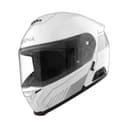
The practical consequence is simple: if you want a sun visor and a premium closed helmet, you are shopping for a modular, not a full-face. Five of our seven picks here are modular or convertible. That is not us steering you — it is where the feature exists.
If no helmet here fits you: the photochromic route
A drop-down visor is not the only way to solve changing light, and for two groups of riders it is the wrong way. If you need a Snell rating, or you need a helmet under 1,500 g, buy the helmet you actually want and solve the light with the shield instead.
A photochromic shield darkens in sunlight and clears in low light, which means one shield covers a whole day with nothing to operate and no second panel to add weight. Two helmets in our registry include one in the box rather than selling it as an accessory: the Bell Qualifier DLX, whose ProTint shield is the reason it is a standing recommendation on our beginner ranking, and the Klim Krios Pro, which states plainly that the photochromic shield does the sun visor’s job instead. On the Krios Pro that trade buys you a full carbon shell at 1,450 g — a weight no helmet on this page gets close to.
The honest comparison between the two approaches: a drop-down visor works instantly, costs nothing extra, and lets you ride into a tunnel without waiting for a lens to react. A photochromic shield adds no weight, keeps the shell uninterrupted, is available on Snell-rated helmets, and gives you one optical surface to look through instead of two. Riders who wear glasses often prefer the photochromic route for exactly that reason, and our ranking for riders in glasses goes into why. Neither is wrong. The trap is buying a premium full-face on the assumption it has a sun visor, discovering it does not, and then riding squinting for a season rather than spending on a shield.
The thing a sun visor does not do
It does not stop fog, and it makes fog slightly more likely to go unnoticed. The panel you drop sits inside the outer shield, in the same airspace as your breath. Fog forms on the inner surface of the outer shield, which is the surface a Pinlock insert protects by creating a sealed double-glazed air gap in front of it. A sun visor is not a Pinlock, it does not replace one, and on a cold morning it can sit behind a fogged shield looking like the problem when it is not.
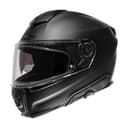
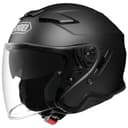
That is why Pinlock readiness is a ranking criterion here rather than a footnote. The Neotec 3 pairs a Pinlock-ready CNS-3C shield with a defogger; the Schuberth S3 arrives with a Pinlock 120 already installed, which is rare at any price; the Stream II, the RPHA 91, the J-Cruise II and the Specter are Pinlock-ready with the insert sold separately on the version sold here. The Scorpion EXO-AT960 is not Pinlock-ready at all — it uses its own EverClear treated shield instead, which is a coating rather than a sealed second lens. If you ride in the cold, budget for the insert on the five helmets that take one, and know what you are accepting on the sixth.
The other nine, and why they are not picks
For completeness, since the whole premise of this page is our own registry: the nine helmets we list with a sun visor that did not make the seven are the Schuberth C5 and Schuberth E2 (both excellent, both discussed on our Schuberth page — the C5 had no live listing price when we built this page, and the E2 is an adventure helmet the AT960 undercuts by a wide margin), the Scorpion EXO-GT930 (a genuinely good cheap convertible modular, but on ECE 22.05 where the AT960 is on 22.06), the Sena Outrush R and Sena Outforce (both covered on our Bluetooth helmet ranking, both out-specified by the Specter), the Sena Stryker (the previous-generation radio), the Scorpion EXO-Covert-X and Bell Pit Boss (both on our open-face ranking, both beaten here by the J-Cruise II on shield hardware), and the HJC IS-Cruiser (a half helmet, covered in the same place).
If you are earlier in the process than picking a model, start with how to choose a motorcycle helmet, which puts this feature where it belongs in the order of decisions — which is to say, after the type, the fit and the certification, not before them.