Alpinestars Tech-Air 5 Plasma Review
An airbag that answers the only objection that has ever mattered: bulk. At a published 1,530 g it wears under the jacket you already own, it arms itself when you zip it, and it covers chest, ribs, back and shoulders. Here is the certification line that costs it a higher score, and the ownership math nobody quotes at the till.
How this is funded: we earn a commission if you buy through our links, at no extra cost to you. It never changes which helmet we recommend, and we’ll tell you plainly when a cheaper or lighter one is the better buy. Full disclosure.
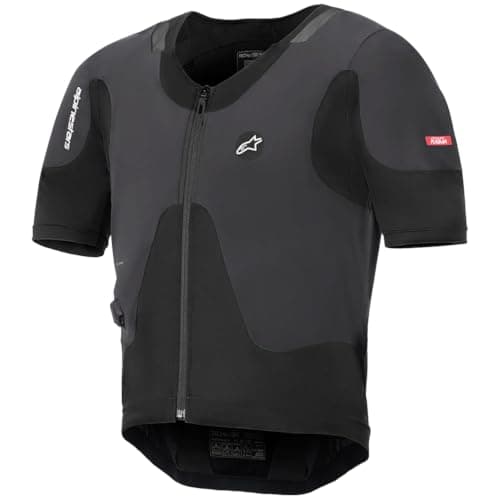
Product image supplied by Amazon
The airbag that answers the reason most riders never buy one: bulk. At a published 1,530 g it is more than 25% lighter than the Tech-Air 5 it replaces, it wears under a normal jacket, it arms itself when you zip it, and it covers chest, ribs, back and shoulders — the widest zone list of any electronic vest here. You also reset it yourself instead of booking a dealer visit.
Best for: Street and sport riders who want an airbag they will actually wear under their existing jacket
Price as of November 11, 2026. #ad How we’re funded
Strengths
- Widest published coverage of the electronic vests here — chest, ribs, back and shoulders, not chest and back alone
- 1,530 g published system weight, roughly half what the over-jacket Tech-Air 3 systems weigh
- User-replaceable single gas inflator through a quick-release service cover (where legally permitted), so a deployment does not mean a dealer visit
- Arms automatically when zipped via an internal magnetic sensor, with haptic confirmation — nothing to remember before pulling away
- Eight sizes, XS-4XL, and no subscription: Alpinestars publishes no ongoing fee to keep the system working
Trade-offs
- Alpinestars certifies the bag to EN 1621-4:2013 Level 1 — the Tech-Air 3 V2, which costs less, publishes Level 2 for chest and back
- The airbag is certified for up to six deployments before it has to be replaced, which is a real long-term cost nobody quotes at the till
- Under-jacket wear means the jacket has to have room for it — a close-fitting sport jacket may not
- Alpinestars does not publish a charge time for the 30-hour battery on this page
The spec sheet
| Material | Not published |
|---|---|
| Armor | Not published |
| Waterproof | Not published |
Specs read from the manufacturer / retailer listing, on September 7, 2026. “Not published” means the maker does not state that figure.
Every airbag vest on the market solves the same problem and almost all of them lose to the same objection. Not price — bulk. Riders try an over-jacket airbag, notice they look like they are wearing a life preserver, and leave it in the garage. The Tech-Air 5 Plasma is the first system in our registry built primarily to defeat that objection rather than to win a spec sheet, and the number that matters is 1,530 g: roughly half what Alpinestars’ own over-jacket Tech-Air 3 systems weigh, and more than 25% lighter than the original Tech-Air 5 it replaces.
That is the whole argument, and it is a good one. An airbag you will actually put on every ride beats a better-certified airbag you wear twice. But there is a certification line on this vest that costs it a point, and there is an ownership cost that nobody quotes at the till, so let us do both honestly.
What Alpinestars publishes
Everything below is read off Alpinestars’ own product page on November 4, 2026 — the same page we first recorded these specs from when we built the airbag vest ranking, read again for this review.
Coverage: full chest, ribs, back and shoulders. This is the widest published zone list of any electronic vest we rank. Most publish chest and back and stop there. The rib coverage is the one worth pausing on, because ribs are among the most common and most miserable motorcycle injuries, they take months rather than weeks, and they are precisely the zone a conventional CE back protector does nothing about. Underneath the bag there is also a passive back protector certified to EN 1621-2:2014 Level 1 for the full back, so the spine has armor behind it whether or not the system ever fires.
Certification: EN 1621-4:2013 Level 1, full back. That is the airbag standard, and Level 1 is the lower of its two levels. Alpinestars also certifies the garment itself to EN 17092-6:2020 as a Class C undergarment and the whole system as Category II PPE. Taken together that is a complete and verifiable certification picture, which is more than several competitors publish — but Level 1 is still the ceiling here, and we come back to that below because it is the one thing we mark the vest down for.
Arming: automatic, on the zip. Alpinestars publishes that “when the activation zip has been fully zipped to the top, the system will automatically turn on”, through an internal magnetic sensor, with haptic confirmation that it has armed. This is a genuinely good piece of design thinking and it deserves more credit than a spec line gives it. Every protective device that depends on a rider remembering a step eventually gets skipped. Zipping your vest is not a step you forget, because the alternative is riding with it hanging open.
Power: up to 30 hours of ride time per charge. Charge time is not published, and we are not going to estimate it. Thirty hours covers a long riding weekend or a fortnight of commuting, which is the right side of the line where a device becomes a chore.
Fit: eight sizes, XS to 4XL, worn under a jacket. Eight sizes is a serious size range for a protective garment and it matters more for an airbag than for anything else you own: a vest that sits loose has air gaps where it needs contact, and a vest that is too tight will not inflate into the space it needs.
The certification line that costs it a point
Here is the uncomfortable fact, and we would rather you read it here than find it after you have paid. Alpinestars’ own cheaper Tech-Air 3 V2 publishes EN 1621-4 Level 2 for chest and back. This vest, the more expensive and more sophisticated one, publishes Level 1. On the standard that exists specifically to measure airbags, you can buy a less expensive Alpinestars system that tests higher.
We are not going to pretend that away, and it is why this vest does not score higher than it does. But the trade behind it is real and it is worth understanding rather than just scoring. The Tech-Air 3 systems are worn over a jacket and weigh roughly double. They are visible, they change how you look, and they are the systems riders most often describe leaving at home. The Plasma’s entire design brief was to be unobtrusive enough that it goes on every time, and getting there cost inflated volume, which is what the standard’s levels are largely measuring.
So the honest framing is a question rather than a verdict: would you rather have Level 2 protection some of the time, or Level 1 every time? For a rider who will genuinely wear an over-jacket system — a track rider, a commuter who does not care how it looks — the Tech-Air 3 V2 is the better buy and we say so on the roundup. For everyone who has ever quietly stopped wearing a piece of gear because of how it felt, the Plasma is the one that will be on you when it matters. Neither answer is wrong. Only one of them is yours.
The ownership cost nobody quotes
This is the part the category is cagey about, and Alpinestars deserves credit for printing it. There are two numbers.
Six deployments. The airbag is certified for up to six inflations before it has to be replaced — not re-serviced, replaced. For a street rider that is a ceiling you will almost certainly never reach. For a track rider who goes down a couple of times a season, it is a genuine and quotable lifespan on a premium piece of kit, and it belongs in the purchase decision rather than in the small print.
The canister. Alpinestars lists a replacement gas canister at $139.95 on the same page as the system, and publishes a “quick-release service cover” that “allows user-replaceable gas inflator (where legally permitted)”. Two things follow. First, a deployment does not automatically mean shipping the vest to a dealer and riding unprotected for three weeks, which is how rearming works on some competing systems and is a real cost in time even when it is free in money. Second, that “where legally permitted” is Alpinestars’ own caveat about compressed-gas rules, which vary by jurisdiction — check yours rather than assuming.
We quote the canister price here because Alpinestars published it as a list price on its own page, which is a fact about the product rather than a street price that moves. For the system itself, use the live price on the buy button above: that is the only number on this site that is checked rather than quoted.
What is still not published
Four things, and they go here because a review that only lists what a maker chose to tell you is an advertisement.
Charge time. Alpinestars publishes 30 hours of ride time and not a word about how long it takes to put those hours back. For a device you charge between rides that is a small omission, but it is an omission. Box contents. The page describes “all included protective parts” without itemizing them, so you cannot confirm what arrives in the box before it arrives. App and connectivity. Nothing is published about whether the system pairs with a phone, logs deployments, or reports its own state beyond the haptic arming confirmation. Subscription terms. Nothing is published, which in this case we read as good news — Alpinestars names no fee anywhere — but “no subscription mentioned” is strictly a different statement from “no subscription, guaranteed in writing”, and we will not upgrade one into the other.
Who should buy it
Buy it if you ride a street or sport bike in gear you already like, and the reason you do not own an airbag is that every one you have tried felt like wearing furniture. That is the rider this vest was designed for and it answers them completely: it disappears under a jacket, it arms itself, it covers more zones than anything else we rank, and it does not ask for a monthly fee.
Do not buy it if your jacket has no room — a close-cut leather sport jacket is the common failure, and the fix is a different jacket, not a different airbag. Check our sport jacket ranking if that is where you are. Do not buy it if a Level 2 certification is the thing you are optimizing for, because Alpinestars sells a cheaper system that publishes one. And do not buy it as your first upgrade if you are still riding without a back protector at all: the airbag vest versus back protector comparison lays out what a $90 CE Level 2 pad covers, and for a rider on a budget the correct order is armor first, airbag second. Our armored base layer picks are the cheapest way to wear protection the same way this vest does.
One closing note on honesty, because it governs everything on this site. We have not tested this vest, we have not deployed one, and we own no lab. We have read what Alpinestars publishes, recorded what it does not, and told you which of its own products beats it on the standard that matters. Our review method explains exactly what our score is and is not.
Frequently asked questions
Does the Alpinestars Tech-Air 5 Plasma need a subscription?
No. Alpinestars publishes no subscription, no activation fee and no ongoing charge anywhere on the product page — you buy the system and it works. That is worth stating plainly because the airbag category has a history of subscription models, and the question is the first one most riders ask. What the system does cost over time is deployments: it is certified for up to six before it has to be replaced, and Alpinestars lists a replacement gas canister at $139.95 on the same page as the system.
How does the Tech-Air 5 Plasma know to inflate?
It is a fully self-contained electronic system: the sensors, the processing and the inflator all live in the vest, with no connection to the motorcycle and no tether to pull. Alpinestars publishes that the system arms itself automatically — 'when the activation zip has been fully zipped to the top, the system will automatically turn on', via an internal magnetic sensor, with haptic confirmation. That matters more than it sounds. A rider who has to remember to switch an airbag on is a rider who will one day forget.
What does the Tech-Air 5 Plasma actually cover?
Alpinestars publishes 'full chest, ribs, back and shoulder coverage', which is the widest published zone list of any electronic vest in our registry — most publish chest and back alone. The rib coverage is the one worth noticing: ribs are a common and genuinely miserable motorcycle injury, and they are the zone a conventional back protector does nothing for. The system also includes a passive back protector certified to EN 1621-2:2014 Level 1, so the back is protected before the bag ever fires.
Is EN 1621-4 Level 1 good enough?
It is the lower of the two levels in the airbag standard, and it is the single thing holding this vest's score down. Alpinestars certifies the inflatable protector to EN 1621-4:2013 Level 1 for the full back, and its own cheaper Tech-Air 3 V2 publishes Level 2 for chest and back. So you can buy a less expensive Alpinestars airbag that tests to a higher level on paper. The counter-argument is real, though: the Tech-Air 3 systems wear over a jacket and weigh roughly double, and an airbag you leave at home scores zero. Our CE armor guide explains what the levels are measuring.
How much does it weigh, and will it fit under my jacket?
Alpinestars publishes a system weight of 1,530 g, which is roughly half what its over-jacket Tech-Air 3 systems weigh and more than 25% lighter than the original Tech-Air 5. It is designed to be worn under a jacket and is certified as an EN 17092-6:2020 Class C undergarment, in eight sizes from XS to 4XL. Whether it fits under your jacket is the real question and nobody can answer it for you: a touring or adventure jacket almost certainly has the room, a close-fitting leather sport jacket may not. Size the jacket, not the vest.
What happens after it goes off? Can I rearm it myself?
Alpinestars publishes a 'quick-release service cover' that 'allows user-replaceable gas inflator (where legally permitted)' — so in principle you swap the canister yourself rather than booking a dealer visit, and that caveat about local law is Alpinestars', not ours. A replacement canister is listed at $139.95. The harder limit is that the airbag itself is certified for up to six deployments before it must be replaced, which is the number to plan around: six is a lot of crashes for most riders and not many for a track rider.
How long does the battery last?
Up to 30 hours of ride time per charge, per Alpinestars. Charge time is not published, which we record as not published rather than estimating it. Thirty hours is a sensible real-world figure — it covers a long weekend of riding or a couple of weeks of commuting before the vest joins the charging pile — and because the system arms on the zip rather than on a button, there is no scenario where you ride with it switched off by accident. There is no scenario where a flat battery inflates it either, which is the trade with every electronic airbag.
Tech-Air 5 Plasma or Tech-Air 7x?
They answer different questions and the honest comparison is about where you ride rather than which is better. The Plasma is the street and sport answer: lighter, under-jacket, chest-rib-back-shoulder coverage, and the broadest jacket compatibility. Alpinestars positions the 7x for off-road and adventure use with a different coverage and construction brief. Our airbag vest roundup ranks the field on what each maker actually publishes, which is the only way to compare them without guessing — and if the decision is really airbag versus no airbag, start with the back protector comparison instead.
Sources
- Alpinestars — Tech-Air 5 Plasma System (re-read for the review) — The same maker page read again on this date for the single-model review. Confirmed unchanged: "System weight: 1,530 g", "full chest, ribs, back and shoulder coverage", "EN 1621-4:2013 Level 1 (Full Back)" for the inflatable protector, "EN 1621-2:2014 Level 1 (Full Back)" for the passive back protector, "EN 17092-6:2020 as a Class C undergarment", "Category II certified PPE", "up to 30 hours of ride time per charge", "certified for up to six deployments before requiring replacement", automatic arming when "the activation zip has been fully zipped to the top", a "Quick-release service cover" that "allows user-replaceable gas inflator (where legally permitted)", and "eight sizes (XS–4XL)". NEW on this read and the number the review leads its ownership-cost section on: Alpinestars lists the replacement canister at "$139.95", and the system itself at "$869.95". Still NOT published: charge time, box contents, any app or connectivity detail, and any subscription terms (accessed November 4, 2026)
- Alpinestars — Tech-Air 5 Plasma System — The maker's own spec page: EN 1621-4:2013 Level 1, chest/rib/back/shoulder coverage, 1,530 g, 30-hour battery and six certified deployments (accessed September 7, 2026)
- Alpinestars — The maker behind most of our gear picks — published materials, CE armor and garment certifications (accessed July 19, 2026)
- SATRA — EN 17092:2020 Parts 1-6, protective clothing for motorcycle riders — The test house's breakdown of the garment standard: "Class C garments are designed to provide impact protection for areas covered by the impact protector(s) only, and they do not offer minimum abrasion protection" (accessed September 10, 2026)
- Hit-Air — EN 1621-4 declaration of conformity — Mugen Denko's published declaration: which Hit-Air models are certified to EN 1621-4:2013 and which body zones they cover (accessed September 7, 2026)
- Dainese — How do protection certifications work? — A maker's explainer of the CE levels: under EN 1621-4 the force transmitted to the body cannot exceed 4.5 kN for Level 1 or 2.5 kN for Level 2 (accessed September 7, 2026)
- Helite Moto (US) — Turtle 2 airbag vest — A tethered airbag sold direct in the US rather than through Amazon: 100 ms inflation and cervical, back, pelvis, sacrum and thorax coverage (accessed September 7, 2026)
Compare it against
Best motorcycle airbag vests
The whole category ranked on published coverage, certification level and what rearming actually costs you.
See the rankingAirbag vest vs back protector
Whether you need an airbag at all, and what a $90 CE Level 2 back protector does that this does not.
Read the comparisonCE armor levels explained
What EN 1621-4 Level 1 means, how it differs from EN 1621-2, and why a Level 1 airbag is not a weaker Level 1 pad.
Read the guideTrack day gear
Where this vest is close to mandatory — and where some organizers now require one.
See the kit listArmored base layers
The passive alternative that wears the same way, for a tenth of the money.
See the picksBest sport motorcycle jackets
The jackets most likely to have the room this vest needs, and the ones that will not.
See the ranking