Shoei X-Fifteen Review
Shoei's race flagship — the Marquez lid — with triple certification, wind-tunnel aerodynamics and seven closable intakes. It is built for a tucked track position, which is exactly why it is not the helmet to buy for upright commuting.
How this is funded: we earn a commission if you buy through our links, at no extra cost to you. It never changes which helmet we recommend, and we’ll tell you plainly when a cheaper or lighter one is the better buy. Full disclosure.
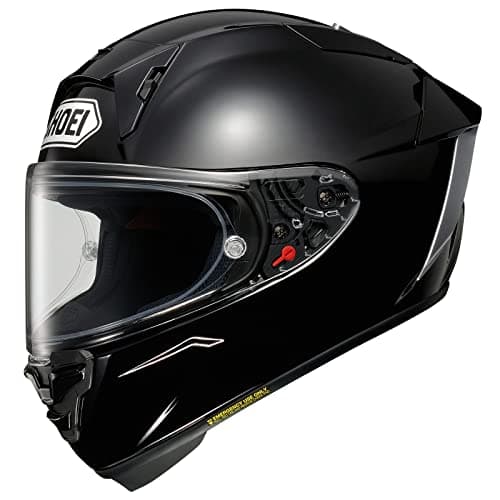
Product image supplied by Amazon
Shoei's race flagship — the Marquez lid — with DOT, ECE 22.06 and Snell M2025R, wind-tunnel aero and seven closable intakes. It is built for a tucked track position, which is exactly why it is not the one to buy for upright commuting.
Best for: Track-day and sport riders in a committed, tucked riding position
Price as of September 21, 2026. #ad How we’re funded
Strengths
- Triple-certified: DOT, ECE 22.06 and the race-specific Snell M2025R
- Wind-tunnel aero — Shoei cites a 6.1% drag reduction over the X-14 — with 7 intakes and 6 exhausts
- Adjustable, replaceable interior and E.Q.R.S. emergency cheek-pad release
Trade-offs
- Aero and airflow are tuned for a tucked posture; less ideal fully upright
- One of the most expensive helmets here — you're paying for the race pedigree
The spec sheet
| Certifications | DOT, ECE 22.06, Snell M2025R |
|---|---|
| Weight | 1624 g |
| Shell | AIM+ six-ply matrix (fiberglass with organic and high-performance fibers) |
| Head shape | Intermediate oval |
| Sizes | XS-2XL |
| Internal sun visor | No |
| Pinlock-ready | Yes |
Specs read from the manufacturer / retailer listing, on July 19, 2026. “Not published” means the maker does not state that figure.
Shoei’s halo helmet, and what it’s for
The X-Fifteen sits at the top of Shoei’s range as its dedicated race helmet — the lid you see on MotoGP grids. Everything about it is aimed at a rider in a committed tuck at high speed, and understanding that is the whole review, because it’s a superb helmet aimed at a narrow job. If your riding is that job, few helmets are better. If it isn’t, you can get most of what makes a Shoei great for a lot less money in the RF-1400.
Triple certification, and why it matters here
The X-Fifteen carries DOT, ECE 22.06 and Snell M2025R. That last one is the point: Snell’s race-specific protocol is a stricter, independent impact standard on top of the legal minimum, and the “R” denotes the racing variant. Stacking all three means the shell has been vetted by the US regulator, the newest European standard with its rotational testing, and the toughest independent body — the kind of paperwork that matters when you’re actually on a circuit. Our safety-ratings guide explains what each of those stamps tests and who verifies it.
The aerodynamics are the headline
Shoei cites a 6.1% drag reduction over the outgoing X-Fourteen, achieved in the wind tunnel and with rear stabilizers that keep the helmet planted at speed. In a tuck, that translates to less buffeting, less neck load and a more stable head at the kind of speeds where those things stop being comfort features and start being control features. It’s genuinely engineered, not marketing — but it’s engineered for a posture most street riders don’t hold. Sitting upright on a commute, you don’t present the helmet to the wind the way it’s designed for, so you pay for aero you can’t fully use.
Airflow and the race-position interior
Seven intakes and six exhausts give the X-Fifteen aggressive, adjustable ventilation, all closable for cold or wet weather — a track rider working hard generates a lot of heat, and this shell is built to move it. The interior is fully adjustable and replaceable, with Shoei’s system for tuning the fit by swapping cheek pads and crown-liner pieces, and the shape is oriented for a forward, tucked head position. Shoei’s E.Q.R.S. emergency cheek-pad release lets first responders remove the pads to slide the helmet off with less neck movement — a serious-rider feature that fits the helmet’s purpose.
The honest trade-offs
Two things keep the X-Fifteen from being a universal recommendation, and both are in our spec-firstread rather than a comfort score we invented. First, the posture problem: the aero and airflow are tuned for a tuck, so upright the helmet is less settled and its ventilation is overkill. Second, the price — it’s one of the most expensive helmets we cover, and you’re paying for a race pedigree that a road rider won’t cash in. There’s no internal sun visor either, which is normal for a race lid but worth noting if you expected one.
Who should buy it — and who shouldn’t
Buy the X-Fifteen if you do track days or ride sport bikes hard in a committed position and want the most aerodynamic, most thoroughly certified helmet Shoei makes. You’ll feel the aero work exactly where it’s meant to. Skip it if you commute, tour or ride upright most of the time: the RF-1400gives you Shoei’s shell quality, quiet and finish in a road-tuned package for meaningfully less, and the AGV K6 Sis lighter still if outright weight is your priority. The X-Fifteen isn’t better or worse than those — it’s pointed at a different rider. Match the helmet to the job and it earns every dollar; buy it for the badge and you’ll wonder where the money went. See where it lands in our full-face ranking.
Frequently asked questions
Is the Shoei X-Fifteen worth it over the RF-1400?
Only if you ride in a committed, tucked track or sport position. The X-Fifteen's wind-tunnel aerodynamics, seven closable intakes and adjustable race-position interior are tuned for a rider hanging off in a tuck; upright, you don't get the aero benefit and you pay a lot more. For street and sport-touring riding, the RF-1400 is quieter, lighter on the wallet and the smarter buy. Buy the X-Fifteen for track days and aggressive sport riding.
What certifications does the Shoei X-Fifteen carry?
It's triple-certified: DOT (the US legal standard), ECE 22.06 (the newest European standard with rotational and multi-point impact testing), and Snell M2025R — the race-specific Snell protocol. That combination is about as thoroughly vetted as a street-legal helmet gets, which is part of what you're paying for.
Is the X-Fifteen good for touring or commuting?
Not really its job. The aerodynamics and airflow are optimized for a tucked posture, and fully upright the helmet is less settled and its aggressive ventilation is less useful. For touring or commuting you want a road-tuned helmet like the RF-1400 or a modular like the Neotec 3. The X-Fifteen is a specialist, and buying it for the wrong use is how you overpay for the wrong thing.
How heavy is the Shoei X-Fifteen?
RevZilla lists it at about 3.58 lb (roughly 1,624 g), while Shoei's own page states 3.78 lb; neither states the test size, so we publish both rather than pick one. That's light for a triple-certified race shell but not the outright lightest full-face — a carbon-aramid helmet like the AGV K6 S is lighter on paper.
Sources
- Shoei Helmets (USA) — Shoei's official US site — model lineup and published specifications (accessed July 19, 2026)
- Snell Memorial Foundation — The independent nonprofit that writes and certifies the Snell helmet standards (M2025, etc.) (accessed July 19, 2026)
- UNECE — Vehicle Regulations — The UN body behind ECE Regulation 22.06, the European helmet standard (accessed July 19, 2026)
Compare it against
Shoei RF-1400 review
The road-focused Shoei most riders should buy instead — quieter, cheaper, upright-friendly.
Read the reviewBest full-face helmets
See how the X-Fifteen ranks as our track pick against the road flagships.
See the rankingAGV K6 S review
A lighter, cheaper sport full-face for riders who don't need race-grade aero.
Read the reviewRF-1400 vs X-Fifteen
Road helmet or race flagship? Why most riders should buy the cheaper Shoei.
Read the comparison