Schuberth C5 Review
The touring modular engineered around two things almost nobody else treats as engineering: wind noise and where the intercom goes. Here is what Schuberth's own US paperwork actually claims, what it quietly leaves blank, and the one purchase you have to make before the helmet is the helmet it is sold as.
How this is funded: we earn a commission if you buy through our links, at no extra cost to you. It never changes which helmet we recommend, and we’ll tell you plainly when a cheaper or lighter one is the better buy. Full disclosure.
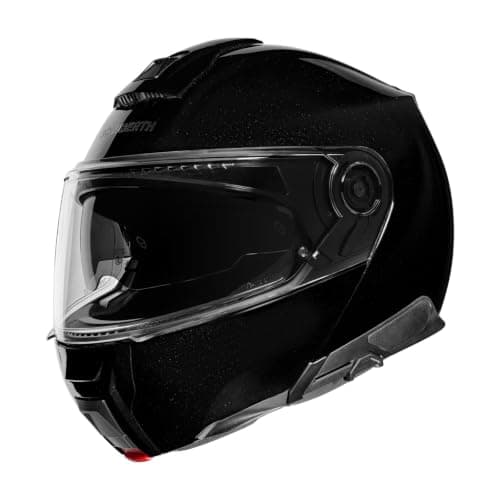
Product image supplied by Amazon
The touring modular that treats wind noise and comms as engineering problems rather than marketing. Schuberth's own US data sheet claims P/J DOT homologation — approved to ride with the chin bar up or down — a Pinlock 120 already fitted, three comms antennas laid into the shell, and 85 dB(A) at 62 mph on a naked bike. It is also the heaviest premium modular we list, and it is flagship money.
Best for: Long-distance touring riders who want the quietest, most integrated flip-up and will pay for it
Price as of September 19, 2026. #ad How we’re funded
Strengths
- Schuberth publishes P/J DOT FMVSS 218 homologation — the helmet is approved to ride with the chin bar open as well as closed, where most modulars are approved closed only
- Pinlock 120 comes preinstalled on a distortion-free class 1 visor, and the V-lock drop-down sun visor is standard
- Speakers plus separate Mesh, FM radio and Bluetooth antennas are built into the shell for the SC2 or SC EDGE, so nothing clamps to the outside
- Two shell sizes cover eight head sizes from 51 to 65 cm — genuinely small and genuinely large heads are both catered for
- A.R.O.S. anti-roll-off chin strap geometry, and an exchangeable filter in the double chin intake
Trade-offs
- Heavy: Schuberth's own figures run 1,780-1,910 g depending on size, roughly 90-210 g more than a Shoei Neotec 3
- The US data sheet claims DOT only — no ECE 22.06 and no Snell for the version sold here
- Flagship money, and the SC2 comms unit is a separate purchase on top of it
- The 85 dB(A) figure is Schuberth's own wind-tunnel claim on a naked bike; no independent body verifies helmet noise, so treat it as a design intent rather than a measurement you can compare across brands
The spec sheet
| Certifications | DOT |
|---|---|
| Weight | 1790 g |
| Shell | DFP (Direct Fiber Processing) fiberglass reinforced with basalt |
| Head shape | Intermediate oval |
| Sizes | XXS-3XL (51-65 cm) |
| Internal sun visor | Yes |
| Pinlock-ready | Yes |
Specs read from the manufacturer / retailer listing, on August 30, 2026. “Not published” means the maker does not state that figure.
What the C5 is actually built to do
Most flagship modulars are a full-face helmet with a hinge added and the resulting compromises managed. The C5 reads like the opposite: a helmet designed backwards from two specific annoyances of long-distance riding, and then made to flip. The first is wind noise, which Schuberth treats as an aerodynamic and sealing problem rather than a padding problem. The second is where the intercom lives — and the C5’s answer is that it lives inside the shell, with speakers and three separate antennas already laid in at the factory, so nothing clamps to the outside.
That focus explains almost every number on the spec sheet, including the unflattering ones. It also means the C5 is a narrower recommendation than its price suggests. This is not the modular for everyone who can afford a modular. It is the modular for someone doing four hundred miles in a day on a naked or lightly-faired bike, talking to a pillion or a group the whole way.
Certification: what Schuberth’s US paperwork says, and what it does not
Schuberth’s own US data sheet for the C5 states P/J DOT FMVSS 218 homologation. That P/J part is worth more than it looks. It is a double homologation meaning the helmet is approved both with the chin bar locked down and with it flipped up — where the majority of modulars are homologated closed only, leaving riding with the chin bar up in a grey area that makers rarely address head-on. If you bought a flip-up so you could ride through town with your face out, the C5 is one of the few that is explicitly certified for it.
What the US paperwork does notsay is equally important, because it is the thing riders argue about most. Neither Schuberth’s US data sheet nor RevZilla’s US listing states ECE 22.06, and neither states Snell. ECE 22.06 for the C5 appears in Schuberth’s Europeanmaterial, for the same model name. We record the US value as not published rather than borrowing the European one, and the spec table above reflects that. The practical reading: this is a market difference, not a different helmet, and it cuts both ways — the Shoei Neotec 3 is in exactly the same position, DOT-only on its US listing and ECE 22/06 with P/J on Shoei’s European page. We walk through both sides of that in the Neotec 3 versus C5 comparison. If certification stack is your deciding criterion, our safest helmets ranking sorts on exactly that and the C5 is not on it.
The shell, and the weight it costs you
The C5 uses Schuberth’s DFP — Direct Fiber Processing — fiberglass shell, reinforced with basalt, over a dual-density EPS liner. Two outer shell sizes cover eight head sizes from 51 to 65 cm: shell one runs XXS through L, shell two picks up at XL and runs to 3XL. Two shells across eight sizes is a middling count for a flagship — Shoei uses three on the Neotec 3 and Arai famously uses more — but it does mean a genuinely small head and a genuinely large head are both catered for, which is not true of every premium lid. If you are at either end of that range, our big-head helmet ranking and the sizing guide are the places to start before you commit to a size.
Now the number that will decide this for some people. Schuberth publishes weight per size, which is more transparency than most makers offer, and the figures are high: 1,780 g in 51/53, 1,790 g in 55/57/59, 1,910 g in 61/63 and 1,900 gin 65, each about 30 g more with accessories fitted. That puts the C5 roughly 90 to 210 g above a Shoei Neotec 3 on the makers’ own figures. It is the heaviest premium modular in our modular ranking, and on a long day the difference is real rather than theoretical.
One honest wrinkle: RevZilla’s US listing states 3.8 lb, which works out to about 1,724 g — lighter than anything on Schuberth’s own sheet. We have not weighed a C5 and we are not going to pretend to have resolved it. We record the maker’s per-size figures because they are the more specific source, and we print the discrepancy instead of quietly averaging two numbers that were almost certainly not measured the same way, in the same size, with the same parts fitted. If you want the lightest lid in the class instead, the lightweight ranking is the page for that.
The noise claim, read properly
Schuberth publishes 85 dB(A) at 62 mph on a naked bike for the C5. It is the headline the brand is built on, and it deserves a careful answer rather than either a dismissal or a repeat.
It is a real figure from a real wind tunnel, and Schuberth is one of very few helmet makers with its own. It is also, across our entire product registry, the onlymanufacturer noise number in existence: Shoei, Arai, AGV, HJC, Bell, Scorpion, LS2, Klim and Sena publish nothing comparable for any model we list. That sounds like a point in Schuberth’s favor, and in one sense it is — publishing a number you can be held to is better than publishing nothing. But it also means the number cannot be ranked. One self-measured figure against nine blanks is not a comparison, and unlike impact performance, where SHARP independently rates helmets, no independent body verifies helmet noise at all. That is why the C5 is deliberately absent from our quietest helmets ranking: putting it first on the strength of its own marketing figure would contradict the position that page takes on self-measured claims.
The other thing worth saying plainly is that no helmet gets you below the threshold where sustained highway wind noise damages hearing. Earplugs do more for your ears than any helmet upgrade on the market, which is the whole argument of our wind noise guide.
Visor, sun visor and the everyday stuff
The C5 ships with a Pinlock 120insert already fitted to a distortion-free class 1 anti-scratch visor. Pinlock 120 is the highest-clarity tier of the anti-fog range, and “already fitted” matters more than it sounds — on a lot of premium helmets the Pinlock is a box you tick at checkout for extra money. The visor mechanism is patented, tool-less and carries a memory function, and there is a City Position detent for riding with the visor cracked at low speed. If fogging is your main complaint about your current lid, our anti-fog guide covers what actually works and what does not.
The drop-down sun visor uses Schuberth’s V-lock mechanism and is standard, not an option. Ventilation runs through a double chin intake with a washable, exchangeable filter — a genuinely unusual touch — plus a back spoiler that acts as an air extractor. Retention is via an A.R.O.S.anti-roll-off chin strap geometry, which is aimed at the failure mode where a helmet rotates off the head in a crash rather than at impact absorption. The linings are OEKO-TEX 100 certified, which is a textile safety standard about what is in the fabric, not a protection rating — worth knowing so you do not read it as one.
The comms system, which is the whole point — and the catch
Everything above is a good touring modular. This section is why someone pays C5 money for it.
The helmet arrives with speakers already installed and three separate antennas — Mesh, FM radio and Bluetooth — laid into the shell during manufacture. Schuberth’s data sheet describes the arrangement as “powered by CARDO & SENA,” and that phrase is doing real work: Schuberth is, as far as we can tell, the only helmet maker that lets you choose which intercom brand goes into its proprietary nacelle. The SC2is the Sena-based module — Bluetooth 5.0, Mesh 2.0, intercom for up to eight riders on mesh, around eight hours of mesh talk time. The SC Edgeis the Cardo-based one, built on Packtalk Edge technology — Bluetooth 5.2, second-generation DMC, a stated range of up to one mile in open terrain, and up to thirteen hours of talk time. If you have a strong opinion about which of those two companies makes the better intercom — and our Cardo versus Sena comparisonexists because plenty of riders do — the C5 is the rare helmet that lets you act on it without a clamp hanging off the side.
Here is the catch, and it is the reason this section is long. The C5 ships with no electronics. The antennas and speakers do nothing until you buy a module, and the module is a separate, Schuberth-specific purchase. On our check of RevZilla’s US listings on September 15, 2026, both the SC2 and the SC Edge were priced at $359.00, and both were unavailable— the SC2 on backorder, the SC Edge out of stock with a single blemished unit offered at a discount. We could not find an Amazon listing for either module. So the realistic entry cost of a C5 as the integrated comms helmet it is sold as is the helmet plus a few hundred dollars more, and the second half of that purchase may take some hunting.
That is not a reason to avoid the helmet. It is a reason to price the whole system before you start, exactly as you would with an airbag vest whose sticker price is not its system price. And it is a straightforward reason to look elsewhere if you already own a Packtalk or a 50S: bolting your existing unit to a C5 means paying for integration you will never switch on. Our intercom ranking covers the standalone route.
Availability, and a note on how it is sold
The C5 is currently purchasable in the US, but thinly. On our September 15, 2026 check, every C5 listing we could surface — gloss black, matte black, matte blue, Zenith black, and the carbon version at a considerably higher price — showed single-unit availability for its specific size and color combination. That is normal for a premium helmet distributed one variant per listing rather than a sign the model is going away, but it does mean the buy button lands on one size in one finish. Check that the listing you land on is your size before anything else, and use the sizing guide to work out what that is.
Who should buy it
Buy the C5 if you tour long distances, you want the intercom inside the helmet rather than stuck to it, and you want to choose whether that intercom is a Cardo or a Sena. On that specific brief there is no real competition: the built-in speakers, the three shell antennas, the factory Pinlock 120, the P/J homologation and the filtered chin intake add up to a helmet that was clearly designed by people who ride all day and talk while they do it. The Schuberth lineup page covers the S3 and E2 if you want the same engineering in a full-face or an adventure shell.
Skip it if any one of three things is true. If you want the lightest premium modular, this is the heaviest one we list and the gap is not small. If your buying criterion is the certification stack, the US-market C5 claims DOT and nothing above it, and there are helmets that claim more. And if you already own an intercom you like, you are paying a premium for integration you have already solved — in which case the modular ranking has flip-ups that get you most of the experience for materially less money.
Frequently asked questions
Is the Schuberth C5 ECE 22.06 certified?
Not on the paperwork for the helmet sold in the United States. Schuberth's own US data sheet states P/J DOT FMVSS 218 homologation and does not state ECE or Snell, and RevZilla's US listing likewise states DOT only. ECE 22.06 does appear in Schuberth's European material for the same model name, which is why the internet argues about this — but the certification you actually buy in the US is DOT. That is a market difference rather than a different helmet, and it works exactly the same way for the Shoei Neotec 3, whose US listing is also DOT-only while its European page states ECE 22/06.
What does P/J homologation mean on the C5?
P/J is a double homologation: the helmet is approved to be ridden with the chin bar locked down (P, for protective) and also with it flipped up (J, for jet). Most modulars are homologated closed only, which makes riding with the chin bar up a legal and safety grey area rather than a designed use. Schuberth states P/J on its US C5 data sheet. It is one of the genuinely useful things on that sheet, because riding a modular open at low speed is the reason a lot of people buy one in the first place.
How heavy is the Schuberth C5?
Heavier than its rivals, and the two available sources disagree about by how much. Schuberth's US data sheet publishes weight per size: 1,780 g in 51/53, 1,790 g in 55/57/59, 1,900 g in 65 and 1,910 g in 61/63, each roughly 30 g more with accessories fitted. RevZilla's US listing states 3.8 lb, which is about 1,724 g. We record the maker's figure because it is the more specific one, and we flag the gap rather than averaging two numbers that were not measured the same way.
Is the Schuberth C5 really the quietest helmet you can buy?
Schuberth publishes 85 dB(A) at 62 mph on a naked bike, which is its own wind-tunnel figure. It is the only manufacturer noise number in our entire product registry — Shoei, Arai, AGV, HJC, Bell, Scorpion and LS2 publish nothing comparable — and that is precisely the problem. A single self-measured number cannot be ranked against seven blanks, and no independent body verifies helmet noise the way SHARP verifies impact. Treat 85 dB(A) as a statement of design intent, and treat earplugs as the thing that actually reduces your exposure.
Do you need the SC2 or SC Edge to use the C5's built-in comms?
Yes, and it is the single most important thing to understand before buying. The C5 ships with speakers and separate Mesh, FM and Bluetooth antennas laid into the shell, but no electronics — the module that drives them is a separate purchase. Schuberth offers two: the Sena-based SC2 and the Cardo-based SC Edge, both listed at $359.00 at RevZilla on our September 15, 2026 check, and both out of stock or on backorder there that day. Neither has an Amazon listing we could find. Budget for it, and check availability before you commit to the helmet.
Can you fit a normal Cardo or Sena intercom to a Schuberth C5?
You can run a standard clamp-on unit on any helmet, but doing it on a C5 means paying for integration you then do not use — the built-in speakers and the three shell antennas are designed for Schuberth's own modules. If you already own a Packtalk or a 50S and intend to keep using it, a helmet with ordinary speaker pockets will serve you just as well for less money. The integration is a real part of what the C5 costs.
Who should not buy the Schuberth C5?
Riders who want the lightest premium modular, riders shopping on certification stack, and riders who already own an intercom. It is the heaviest premium flip-up we list, its US paperwork claims DOT and nothing above it, and a large slice of its price is comms integration that is wasted if you bring your own unit. It is a specialist tool: if long days on a touring bike with a helmet-integrated intercom is not your use case, the money goes further elsewhere.
Sources
- SCHUBERTH — C5 US data sheet (PDF) — The maker's own US data sheet: P/J DOT FMVSS 218 homologation, per-size weights, shell construction and the 85 dB(A) claim (accessed August 30, 2026)
- RevZilla — Schuberth C5 listing (US) — US retail listing: DOT certification, a published 3.8 lb, two shell sizes covering XS-3XL, SC2-prepared (accessed September 3, 2026)
- RevZilla — Schuberth SC Edge Cardo comm unit (US) — The Cardo-based unit for the C5's built-in nacelle: $359.00, "Specific for C5 Carbon, C5, E2 Carbon, E2, S3 and J2 helmets", Bluetooth 5.2, 2nd gen DMC "up to 1 mile in open terrain", 13 hours talk time — out of stock at our check (accessed September 15, 2026)
- RevZilla — Schuberth SC2 communication system (US) — The Sena-based unit for the same nacelle: $359.00, "Specific for Schuberth C5, C5 Carbon, E2 and S3", Bluetooth 5.0, Mesh 2.0, up to 8 riders, 8 hours Mesh talk time — backorder at our check (accessed September 15, 2026)
- SCHUBERTH (US) — Schuberth's official US site — the C5, S3 and E2 lineup, homologation and published weights (accessed August 30, 2026)
- NHTSA — Motorcycle Safety — The US regulator behind the DOT FMVSS 218 helmet standard (accessed July 19, 2026)
- UNECE — Vehicle Regulations — The UN body behind ECE Regulation 22.06, the European helmet standard (accessed July 19, 2026)
Compare it against
Shoei Neotec 3 vs Schuberth C5
The two flagship touring modulars head to head — and why the ECE-versus-DOT argument people have about them is a market difference, not a helmet difference.
Read the comparisonSchuberth helmets explained
The full US lineup — C5, S3 and E2 — and what the brand's shared engineering actually buys you.
See the lineupBest modular helmets
Where the C5 lands against the Neotec 3 and the value flip-ups, plus the published weight-and-noise table for all five picks.
See the rankingQuietest motorcycle helmets
Why the C5's 85 dB(A) claim does not put it on this list, and what the whole industry does and does not publish about noise.
See the ranking