Sena Specter Review
Sena's flip-up flagship: an aramid-reinforced shell, a built-in sun visor, Mesh Intercom 3.0 on Bluetooth 5.3 and thirty hours of talk time, in a helmet that is one purchase instead of two. Here is what the European P/J homologation does not buy you in the US, and the one box-contents line that costs you money.
How this is funded: we earn a commission if you buy through our links, at no extra cost to you. It never changes which helmet we recommend, and we’ll tell you plainly when a cheaper or lighter one is the better buy. Full disclosure.
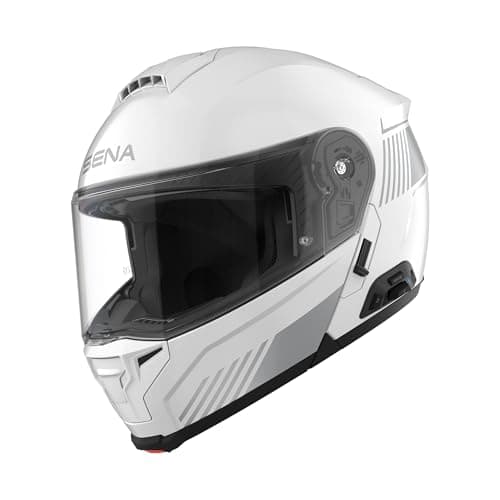
Product image supplied by Amazon
The flip-up version of the Phantom's electronics, in the best shell Sena publishes: fiberglass with DuPont Kevlar fiber, a built-in sun visor and a Pinlock 120XLT-ready shield. It is the only helmet in Sena's smart-helmet range whose European twin carries P/J dual homologation, and the only one in that range that pairs a sun visor with a current radio.
Best for: Touring and commuting riders who want a flip-up, a sun visor and mesh in one helmet
Price as of November 11, 2026. #ad How we’re funded
Strengths
- Fiberglass and DuPont Kevlar fiber shell — the only aramid-reinforced layup Sena publishes across this range
- Built-in internal sun visor, which the Phantom's spec sheet does not state
- Mesh Intercom 3.0 with Bluetooth 5.3, 2 km (1.2 mi) quoted range, Group Mesh for 24 and Open Mesh participants Sena calls unlimited
- 30 hours of quoted talk time, and a Pinlock 120XLT-ready shield on the DOT version
- Second-generation Harman Kardon speaker, and the European version is P/J dual homologated — rated to ride with the chin bar up as well as down
Trade-offs
- The P/J homologation belongs to the ECE version; the US helmet is DOT, and DOT has no equivalent chin-bar-up rating
- The most expensive helmet in Sena's range, and the flip mechanism buys convenience rather than protection
- 1,700 ±50 g in a size Medium — heavier than the Phantom and the whole flip-up mechanism is the reason, so it is convenience you are carrying rather than shell
- Same lock-in as the rest: the intercom generation is the helmet's generation
The spec sheet
| Certifications | DOT |
|---|---|
| Weight | 1700 g |
| Shell | Fiberglass with DuPont Kevlar fiber |
| Head shape | Not published |
| Sizes | S-XXL |
| Internal sun visor | Yes |
| Pinlock-ready | Yes |
Specs read from the manufacturer / retailer listing, on September 24, 2026. “Not published” means the maker does not state that figure.
The Sena Specter is the most complete argument anyone has made for the smart helmet so far, and it is worth being specific about why, because “helmet with Bluetooth in it” describes about fifteen products and most of them are compromises. The Specter is the one where Sena stopped treating the shell as a housing for the radio. It is a flip-up, it has a built-in sun visor, and it is the only helmet in Sena’s range built on fiberglass reinforced with DuPont Kevlar fiber rather than plain composite fiberglass. Those three things together make it the first helmet in this category you could recommend to a touring rider on the helmet’s own merits rather than on the convenience of the electronics.
It is also the most expensive helmet Sena sells, it carries DOT alone in the United States, and there is one line on the spec sheet — about Pinlock — that costs American buyers money their European counterparts do not spend. Everything below was read from Sena’s own product page on October 28, 2026.
What you are actually buying
The shell is fiberglass with DuPont Kevlar fiber, published at 1,700 ±50 g (58.2 ±1.8 oz) in a size Medium. That reference size matters and it is new information: when we first recorded this spec in September, Sena published the weight with no size attached, which made it uncomparable against a range where everything else is quoted in Medium. It now states it, so the comparison is real — the Phantom full-face is 1,690 ±50 g and the older Stryker is 1,750 ±50 g, both in the same reference size. The Specter therefore carries a whole flip-up mechanism for about ten grams over the fixed-chin flagship, which is genuinely good engineering.
Sizes run S to XXL, charted from 55–56 cm at the small end to 63–64 cm at the top. There is a built-in internal sun visor, which is the feature Sena’s newer and cheaper Phantom does not publish at all, and the reason this helmet appears on our sun-visor ranking alongside helmets from makers who have been building modular lids for decades.
Inside the shell: Mesh Intercom 3.0 running on Bluetooth 5.3, Open Mesh across six channels with participants Sena describes as unlimited, Group Mesh for up to 24, and Wave Intercom — Sena’s phone-mediated system with unlimited participants and AI-based noise cancellation, which is a different thing from the radio and worth understanding as such. Second-generation Harman Kardon speakers handle the audio. Talk time is published at 30 hours from a 2.5-hour charge; Sena does not publish the battery capacity for this model, and we record that as not published rather than guessing at it. The operating and storage range is −20 to 55 °C (−4 to 131 °F).
In the box: the helmet, a pouch, a USB-C charging cable, two microphone sponges and a quick start guide. Sena publishes a five-year warranty, which is longer than most of this category and a reasonable answer to the obvious objection about buying a radio you cannot replace. Colors are Matte Black, Glossy White and Hi-Vis.
The Pinlock line worth reading twice
Here is the detail that will annoy you after purchase if nobody tells you before it. Sena’s spec sheet splits the anti-fog insert by region in a single line: “ECE: Pinlock 120XLT included” against “DOT: Pinlock 120XLT ready”. The helmet sold in the United States has a shield prepared for the insert and does not come with it. The identical-looking helmet sold in Europe ships with it fitted.
That is not a scandal — plenty of makers do the same thing, and the reason is usually that ECE 22.06 approval covers the shield-and-insert combination as a unit while DOT does not. But it is a real cost, it is invisible on a US listing that proudly says “Pinlock ready,” and a sun visor does nothing about fog: the panel you drop sits inside the outer shield, in the same airspace as your breath. Fog forms on the inner face of the outer shield, and only a sealed second lens with an air gap prevents it. Our guide to stopping a helmet fogging explains why a coating is not the same thing. Buy the insert with the helmet.
P/J homologation: what it is, and what you do not get
Sena’s certification table reads “USA: DOT – Europe: ECE R22.06 P/J Dual homologation”, and the P/J part is the most interesting claim on the page — precisely because it does not apply to the helmet sold here.
Under ECE 22.06, a P homologation is protective (full-face) and a J homologation is jet (open-face). A modular approved as P/J was tested and approved in both configurations, which is the formal version of “you may legally and sensibly ride this with the chin bar up.” Most flip-ups are approved as P only, meaning the open position is for standing still. The European Specter carries the dual approval, and that is a genuine engineering achievement rather than a marketing line.
The US helmet is DOT. FMVSS 218 has no chin-bar-up category whatsoever, so there is no American certification that says anything about riding this helmet open, in either direction. If you are buying the Specter in the States, buy it as a modular you flip at stoplights and gas stations, which is how almost everyone uses one anyway. Our guide to modular helmet safety goes through the P, J and P/J markings and is careful not to assert P/J status for models whose makers do not publish it — which is most of them.
The broader certification picture is the honest weak point of this helmet and of the whole category. There is no Snell rating, and the US version does not claim ECE either. At this price a conventional helmet buys you a more thoroughly tested shell: Snell-rated helmets exist for a fraction of it, and our modular ranking includes flip-ups that publish DOT and ECE 22.06 together. What none of them include is the radio. That is the trade, stated plainly, and our safety ratings guide explains what each mark actually tests.
Where it sits against the rest of Sena’s range
Three helmets matter in this comparison and the differences are well-published, which is unusual and to Sena’s credit.
Against the Phantom, Sena’s full-face flagship: the Specter gives you the flip-up chin bar, the sun visor the Phantom does not publish at all, the Kevlar-reinforced layup, and the European P/J approval. The Phantom answers with 35 hours of talk time against 30, 1,690 g against 1,700, and front and rear LED lighting — a flashlight and rear running and brake lights wired into the shell — which the Specter does not have. Both run Mesh Intercom 3.0 on Bluetooth 5.3 with second-generation Harman Kardon audio, so the radio generation is not the deciding factor between them. Pick on body style and sun visor.
Against the Stryker, the previous generation: this is a clean win on paper and the money is the only argument for the older helmet. The Stryker runs Bluetooth 5.0, publishes up to 13 hours on mesh against the Specter’s 30, weighs more at 1,750 ±50 g, and uses first-generation Harman Kardon speakers. It does have a retractable sun visor and integrated LED taillights, and it is substantially cheaper. Our Stryker review makes the case for it properly, including the range figure Sena publishes twice on that helmet’s page but not on this one.
Against the cheaper Outrush R and Outforce, both of which also carry a sun visor: those are Bluetooth helmets rather than mesh flagships, and our Bluetooth helmet ranking is where they belong. If a group ride is why you are buying, the mesh hardware is the reason to be on this page instead.
Who should buy it
The Specter is the right purchase for a touring or commuting rider who wants a flip-up, rides in a group, and would rather make one decision than four. Thirty hours of talk time survives a multi-day trip. The sun visor handles the light without a shield swap. The shell is better than the category norm and better than anything else Sena publishes. The five-year warranty is a real answer to the integration objection, and the whole package arrives in one box with one charging cable.
It is the wrong purchase in two cases, and they are the same two as for every smart helmet. If your head shape only works with one specific helmet, buy that helmet and clamp on a mesh intercom — the shell has to fit before anything else matters, and Sena’s range is small. And if certification is the axis you are shopping on, the DOT-only US version is behind what conventional helmets at this money publish, and you should buy the certification and add the radio separately. If you are still deciding between those two routes at all, how to choose a motorcycle helmet puts the question in the order it should be answered.
We have not worn this helmet and we do not own it. Here is what we do instead — every figure above was read from Sena’s own product page on the date recorded in the sources below, anything Sena does not publish is recorded as not published rather than estimated, and the price on the buy button is live and carries its own date.
Frequently asked questions
Is the Sena Specter DOT approved?
Yes. Sena's certification table reads 'USA: DOT - Europe: ECE R22.06 P/J Dual homologation', so the helmet sold in the United States carries DOT under FMVSS 218 and nothing else. There is no Snell rating. The electronics separately carry CE, FCC, IC and KC approvals, which govern the radio rather than the shell. That is the standing trade of the smart-helmet category: at this money a conventional helmet would give you a more thoroughly tested shell, and you are paying for integration instead.
What does P/J dual homologation mean, and does the US helmet have it?
It means the helmet was type-approved to be ridden with the chin bar both down and up. Under ECE 22.06, P is a protective (full-face) homologation and J is a jet (open-face) one; a modular approved as P/J passed both, which is the formal version of 'you may legally ride it open'. The European Specter carries it. The US helmet does not — DOT FMVSS 218 has no equivalent chin-bar-up category at all, so there is no American certification that says anything either way about riding this helmet open. Sena's own table is clear that the P/J claim belongs to the ECE version. Our guide to modular helmet safety explains the markings properly.
Does the Sena Specter come with a Pinlock insert?
In Europe yes, in the United States no, and Sena's spec sheet splits it by region in one line: 'ECE: Pinlock 120XLT included' against 'DOT: Pinlock 120XLT ready'. So the shield on the helmet sold here is prepared for the insert and does not include it, while the identical-looking European helmet ships with it. Sena also lists a Pinlock antifog insert lens and a tinted shield separately under 'What's more'. Budget for the insert on day one if you ride in the cold or the wet — on a helmet at this price it is a small addition and it is the difference between a shield that fogs and one that does not.
How much does the Sena Specter weigh?
1,700 g (58.2 oz) with a ±50 g tolerance, in a size Medium. That reference size is worth noting because Sena did not state it when we first recorded this spec in September and now does, which makes the number comparable rather than loose. For context inside Sena's own range: the Phantom full-face is 1,690 ±50 g and the older Stryker is 1,750 ±50 g, both in the same reference size. So the Specter is heavier than the full-face flagship by a trivial margin and carries a flip-up mechanism for it, which is a good trade. Against conventional helmets it is simply heavy — our registry has full-face helmets more than 400 g lighter, none of which contain a radio.
How long does the Sena Specter battery last?
Thirty hours of talk time from a 2.5-hour charge, per Sena's spec sheet. Sena does not publish the battery capacity for this model, which it does for some others in the range, so we record that as not published rather than estimating it. Thirty hours is the figure that makes this helmet viable on a tour: it covers several long days of group riding before the helmet has to join the nightly charging pile, where the previous-generation Stryker publishes up to 13 hours on mesh and realistically needs charging every night. If you ride in a group regularly, that gap is the clearest thing the newer radio buys you.
What is the Sena Specter's mesh range?
Up to 2 km (1.2 mi) in open terrain for Mesh Intercom 3.0, per Sena's spec sheet — and unlike the Stryker's page, which publishes two contradictory range figures, the Specter's states one number and sticks to it. Open Mesh runs across six channels with participants Sena describes as unlimited; Group Mesh handles up to 24. The helmet also supports Wave Intercom, Sena's app-mediated system, with unlimited participants and AI-based noise cancellation, which is not range-limited in the same way because it runs over your phone's data connection rather than radio-to-radio.
Sena Specter or Sena Phantom?
The Specter if you want a flip-up, a sun visor or the better shell; the Phantom if you want the lightest full-face in the range with the longest published talk time and lights built in. The specifics: the Specter is the only helmet Sena publishes with a fiberglass and DuPont Kevlar fiber layup rather than plain composite fiberglass, it states a built-in sun visor where Sena publishes none at all for the Phantom, and its European twin carries P/J dual homologation. The Phantom answers with 35 hours of talk time against 30, 1,690 g against 1,700, and front and rear LED lighting the Specter does not have. Both are DOT-only in the US with no Snell. It is a features decision, not a safety one.
Is the Sena Specter worth it over a helmet plus a mesh intercom?
It depends on one thing: whether several helmet shapes fit your head or only one does. A built-in system has no clamp, no boom and no speaker pocket that might be too shallow, and the whole package is one purchase, one charge and one warranty — Sena publishes five years on this helmet. What you give up is choice and upgrade path. You are picking a shell from one maker's small range rather than from every modular that fits you, the radio cannot be replaced when a generation passes, and a DOT-only shell is what the category offers at this price. Our honest default has not changed: if one specific helmet fits your head and nothing else does, buy that helmet and clamp a mesh unit to it. If several shapes work for you, this is a legitimate way to buy the whole thing once.
Sources
- Sena — Specter — The maker's own spec sheet: "USA: DOT - Europe: ECE R22.06 P/J Dual homologation", fiberglass with DuPont Kevlar fiber, 1,700 ±50 g (reference size not stated), built-in internal sun visor, "DOT: Pinlock 120XLT ready", Mesh Intercom 3.0 with Bluetooth 5.3, 30 hours talk time (accessed September 24, 2026)
- Sena — Specter (re-read for the review) — The same maker page read again on this date for the single-model review. Confirmed and extended: "Helmet Certifications - USA: DOT - Europe: ECE R22.06 P/J Dual homologation" with CE/FCC/IC/KC certified electronics; fiberglass and DuPont Kevlar fiber shell; 1,700 ±50 g (58.2 ±1.8 oz) in size M — the reference size Sena did NOT state when we first read this page; S-XXL covering 55-56 cm to 63-64 cm; built-in internal sun visor; "ECE: Pinlock 120XLT included" against "DOT: Pinlock 120XLT ready", so the US helmet does not ship with the insert; Mesh Intercom 3.0 on Bluetooth 5.3 at "up to 2 km (1.2 mi) in open terrain", Open Mesh across 6 channels with participants described as unlimited and Group Mesh for up to 24; Wave Intercom with unlimited participants and AI-based noise cancellation; 30 hours of talk time from a 2.5-hour charge with no battery capacity published; operating and storage range -20 to 55 °C (-4 to 131 °F); 2nd-generation Harman Kardon speakers; a 5-year warranty; Matte Black, Glossy White and Hi-Vis; and a box containing the helmet, a pouch, a USB-C charging cable, two microphone sponges and a quick start guide, with the Pinlock antifog insert lens and the tinted shield listed separately under "What's more" (accessed October 28, 2026)
- Sena — Phantom — The maker's own spec sheet: "USA: DOT" / "Europe: ECE R22.06", composite fiberglass shell, 1,690 ±50 g in a Medium, Mesh Intercom 3.0 with Bluetooth 5.3, 2 km quoted range, Group Mesh for 24, 35 hours talk time, 2nd-generation Harman Kardon speakers, front flashlight and rear running/brake LEDs (accessed September 24, 2026)
- Sena — Stryker — The maker's own spec sheet: DOT (US) / ECE 22.05 (Europe), composite fiberglass shell, 1,750 ±50 g in a Medium, retractable sun visor, Mesh Intercom 3.0 with Bluetooth 5.0, up to 20 hours Bluetooth and 13 hours Mesh talk time, Harman Kardon speakers, integrated LED taillights, Pinlock insert listed as an accessory (accessed September 24, 2026)
- Sena — Sena's official site — mesh and Bluetooth intercom specifications (accessed July 19, 2026)
- NHTSA — Motorcycle Safety — The US regulator behind the DOT FMVSS 218 helmet standard (accessed July 19, 2026)
- UNECE — Vehicle Regulations — The UN body behind ECE Regulation 22.06, the European helmet standard (accessed July 19, 2026)
- Pinlock — Anti-fog technology — The maker of the Pinlock anti-fog insert most premium shields are prepared for (accessed July 19, 2026)
Compare it against
Best smart motorcycle helmets
The whole category ranked on what the built-in hardware actually does, and honest about the lock-in that comes with it.
See the rankingSena Stryker review
The cheaper full-face with a sun visor and a previous-generation radio — the helmet most Specter shoppers are also considering.
Read the reviewBest helmets with a sun visor
Where this helmet sits against sixteen others that publish the feature, including every modular worth buying.
See the rankingBest modular motorcycle helmets
The flip-up ranking without the radio — what the same money buys in a conventional modular, which is the honest alternative.
See the picksBest mesh intercoms
The other route: a clamp-on mesh unit on whichever helmet actually fits your head, upgradeable on its own schedule.
See the rankingAre modular helmets safe?
What ECE's P, J and P/J markings mean — the specific thing the European Specter carries and the US one cannot.
Read the guideHow to stop a helmet fogging
Worth reading before you buy, because the US Specter is Pinlock-ready and the European one ships with the insert.
Read the guide