The yardstick: what Sena publishes
Sena is unusually forthcoming on the radio and unusually quiet on the helmet. On the radio side it publishes the intercom protocol and generation (Mesh Intercom 3.0, Wave Intercom, Bluetooth version), a claimed range, a group size, a talk time in hours, and often the speaker brand. Those are the four numbers a comms buyer actually compares, and the three longest talk times in our registry — 16, 17 and 18 hours — are all Sena’s.
On the helmet side it publishes a shell material, a weight and DOT. It does not publish a head shape for any helmet we list, and it prints the US and European certifications together, which is why we record no ECE rating for the US versions. Our smart helmet ranking carries the same caveat.
The finding: the radio ages with the helmet
Lay the registry out by generation and the pattern is impossible to miss. The Phantom (Bluetooth 5.3, Mesh 3.0, 35 h) and the Specter (Bluetooth 5.3, Mesh 3.0, 30 h) are current. The Outrush 2 (Bluetooth 5.2, Mesh 3.0 plus Wave, 20 h) is close behind at a much lower price. The Stryker — which costs more than the Outrush 2 — publishes Bluetooth 5.0 and 13 hours. The Outrush R publishes Bluetooth 5.1 and no mesh at all.
That is not a scandal; it is what happens when a helmet has a three-year product cycle and a radio has an eighteen-month one. It is, however, the single most useful thing to know before spending $500 on a helmet for its electronics, because you cannot upgrade the radio without replacing the helmet, and you cannot carry it to the helmet you buy next. Buy the smart helmet for the integration and the absence of a clamp, not because it is the newest radio Sena sells — it usually is not.
The picks
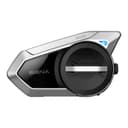
The intercom: Sena 50S. Harman Kardon speakers and microphone, multi-channel Open Mesh with a claimed five-mile chain range, Advanced Noise Control, 16 hours of talk time. It fits the helmet you own and the one after it. Sena publishes no IP rating for it, which the table states.
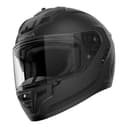
The smart helmet: Sena Phantom. A composite fiberglass shell at a published 1,690 g, S to XXL, Pinlock-ready, with Mesh Intercom 3.0 on Bluetooth 5.3, a claimed 2 km open terrain range, Group Mesh for 24 riders, 35 hours of talk time, a front LED flashlight and rear LED running and brake lights, with over-the-air updates. If a helmet with the radio inside is what you want, this is the one with the fewest compromises.
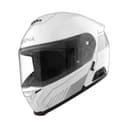
The flip-up: Sena Specter. A fiberglass and DuPont Kevlar flip-up at 1,700 g with a built-in sun visor, a Pinlock 120XLT-ready shield, Mesh Intercom 3.0 and Bluetooth 5.3, and 30 hours of talk time. It is the most expensive helmet on this page and the most complete.
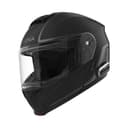
The cheapest mesh flip-up: Sena Outrush 2. An ABS polycarbonate flip-up at 1,800 g, Pinlock 70-ready, with Mesh Intercom 3.0 and Wave Intercom over cellular data, Bluetooth 5.2 and 20 hours of talk time — for substantially less than the Stryker, with a newer radio. It is the clearest illustration of this page’s central point. Sena publishes no speaker brand for it.
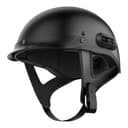
The half helmet: Sena Cavalry 2. A composite fiberglass shell over EPS at a published 950 g — the lightest helmet in our entire registry — with Mesh Intercom 3.0 and Wave, Bluetooth 5.2, 18 hours of talk time, premium speakers and a mic, and a double D-ring chinstrap, in 55–64 cm. It is the answer for a cruiser rider in a group, and our half helmet page is honest about the coverage you are giving up to get it.
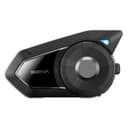
Best mesh value: Sena 30K. The previous-generation flagship, still auto-reconnecting mesh with Audio Multitasking and Advanced Noise Control, a claimed five-mile Open Mesh chain range and the longest talk time of the two at 17 hours. At our last check it was close enough to the 50S that the Harman Kardon audio is the deciding factor rather than the price.
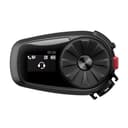
Budget pick: Sena 5S. HD two-way intercom, HD speakers, a backlit LCD and 18 hours of talk time, with a claimed 0.4 miles. It is Bluetooth only and it is pitched exactly right: solo and two-up riders who want music, calls and a pillion intercom and will never need a 24-rider mesh. It is also the only product on this page for which Sena publishes a water-resistance rating.
What we left off, and where Sena loses
The Sena Stryker is a good composite-shell helmet with a retractable sun visor, Harman Kardon speakers and LED taillights, and it is the top comms pick on our under-$500 helmet page. It is not a pick here because within Sena’s own catalogue the Outrush 2 offers a newer radio and more talk time for less, and the Phantom offers far more for more. The OutForce and Outrush R are the cheapest routes to built-in comms and both are Bluetooth-only; they are covered on our built-in Bluetooth and smart helmet pages.
Where Sena genuinely loses is the water rating it does not publish for the 50S or the 30K, and crash detection, which it does not offer at all in our registry. Our Sena alternatives page goes through the Cardo units that answer both, and our Cardo versus Sena page handles the ecosystem choice, which for most riders is decided by what the group already owns rather than by any spec.