How we ranked the band
Price gates this page; it does not rank it. Every pick had to carry a live price under $200 at the publish-day refresh. After that, the order came from the same three things every glove ranking on this site uses: the EN 13594 clause and KP mark the maker actually publishes, then the chassis — what the palm and backhand are made of, then how the waterproof membrane is built (bonded to the shell, hung as a Z-liner, or absent). After that we split the picks by job rather than by score, because “best glove” means something different in July than in November.
Every figure in the comparison table is read from the maker’s or a US retailer’s listing on a dated visit. Where a maker does not publish something, the table says “Not published” rather than guessing — and in gloves that happens more than it should. Two of the gloves we price under $200 publish no EN 13594 certification at all while still printing protective-sounding copy, which is why neither of them is a pick here.
The inversion: why the ceiling costs you almost nothing
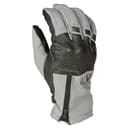
The best glove we rank is under $200. We did not set out to write that sentence. The Klim Vanguard GTX Short scores 9.1 on our rubric; the next glove down is 9.0 and costs more than twice as much. The reason is structural rather than lucky: the thing that makes the Vanguard good — GORE GRIP bonding, which laminates the membrane to the leather so the glove keeps bar feel while staying waterproof — is a construction choice, not an expensive material. Kangaroo leather and titanium sliders are expensive materials, and they buy track performance that does nothing for you on a commute.
So the real decision under $200 is climate, not budget. Four of these seven are waterproof and three are not, and that split matters far more than the $120 between the cheapest and most expensive pick. Our guide to choosing gloves walks through fit and cuff length; this page is about which of them to put in the basket.
Match the pick to the riding
One pair for most of the year: the Klim Vanguard GTX Short. Bonded GORE-TEX, EN 13594:2015 KP Level 1, 5 mm XRD impact foam in the palm and knuckle pads, and a short cuff that tucks under a jacket sleeve instead of fighting it. Klim builds it temperature-neutral on purpose, so it is not a winter glove — it is the glove you stop thinking about.
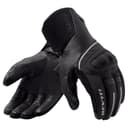
Riding in genuine cold: the REV’IT! Stratos 3 GTX, which publishes 3M Thinsulate G 300 g plus 80 g behind a GORE-TEX Z-liner — the most insulation printed on any glove we rank at this price. It is a bulkier glove than the Klim and REV’IT! calls its cuff “regular” (worn under the sleeve). Our winter glove ranking puts it against the heated options.
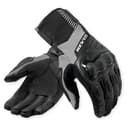
Maximum hardware without race money: the REV’IT! Sand 5 H2O. A TPU hard-shell knuckle, TPR finger knuckles, a TPU palm slider and a thumb protector, over a Hydratex Z-liner, with a visor wiper on the index finger. This is the glove on this page with the most separate protective components, and it is not the most expensive one.
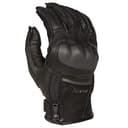
Hot weather: the Klim Induction — a mesh backhand with mapped perforations, a carbon-fiber hard knuckle and an aramid-reinforced Schoeller palm overlay, still CE Level 1 KP. It is not waterproof and does not pretend to be; the plan is to carry a second pair. See our summer glove ranking for the rest of the vented shelf.
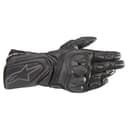
One leather glove for sport and street: the Alpinestars SP-8 V3, full-grain goat leather with a MotoGP-derived dual-density knuckle and a gauntlet cuff, certified to EN 13594:2015 KP Level 1, for around two-thirds of the ceiling.
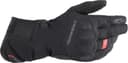
The cheapest certified waterproof gauntlet: the Alpinestars Tourer W-7 V2 Drystar. Certified, sealed and insulated for well under $150, with a ripstop upper and a conductive leather palm. It gives up leather on the backhand and the hard-shell knuckle the picks above it carry.
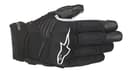
The budget pick: the Alpinestars Faster — the cheapest glove on this page and the cheapest we are willing to put in front of a street rider. A leather palm with a softshell backhand and a soft viscoelastic knuckle: enough for city riding, not enough for a highway slide. If that is the budget, read our sub-$100 page first.
Who we left off, and why
Two gloves under $200 publish no EN 13594 certification at all. The Scorpion SG3 MK III has a carbon-reinforced knuckle and a palm slider and we like the hardware, and the Cortech Scarab V3 is a waterproof insulated leather gauntlet with a four-year warranty. Neither maker prints a glove standard on the listing we read. On a page whose ranking is built on the certification clause, they cannot be picks — but they are both on our winter and race-glove pages with that caveat stated.
The Alpinestars Andes V3 Drystar and Corozal V3 Drystar are both certified, waterproof and under the ceiling, and both are genuinely good value. They are left off here only because the Tourer W-7 V2 does the same job for less and the Sand 5 H2O does it with far more armor. Our touring glove ranking covers all three head to head.
The gloves above the ceiling are deliberately absent rather than squeezed in. The Klim Badlands GTX Long, Alpinestars GP Plus R V3, GP Pro R4, REV’IT! Dominator 3 GTX and Jerez 4 are all excellent and all specialists. If your question is the best glove rather than the best glove under $200, start at our main glove ranking.