How we ranked them
Four mechanisms, in this order. Fog management first — is the shield Pinlock-ready, does an insert or a defogging shield come with the helmet, and is there a breath deflector or chin curtain. Then low-sun management — a drop-down internal sun visor or a photochromic shield, because winter demands tint and clear on the same ride. Then gloved operation — a flip front, a large shield tab, a sun-visor slider you can find without looking. Then the vents — whether they close completely, and whether the chin can be sealed.
Certification and shell construction break ties, and every spec in the comparison table is read from the maker’s or a US retailer’s listing on a dated visit. Where a maker publishes nothing, the table says “Not published” rather than guessing.
The thing winter changes about helmet shopping
In winter the accessory matters more than the shell. A $935 composite modular with no Pinlock insert fogs; a $150 polycarbonate helmet with one does not. That inverts the usual advice on this site, where shell construction and certification drive the ranking, and it is why the budget pick here is not a consolation prize. If you buy one thing after the helmet, buy the Pinlock insert for it.
The second thing is the sun, and almost nobody plans for it. Between November and February a commuter rides into direct low sun on the way home and then into the dark twenty minutes later. A dark shield is unusable; a clear shield means squinting through the glare. Five of these six solve it, four with a drop-down internal sun visor and one with a self-tinting shield. Our sun-visor ranking lists every helmet we rank that has one.
Match the pick to the riding
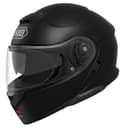
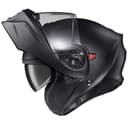
You ride through the whole winter: the Shoei Neotec 3. An AIM composite modular at a published 1,700 g with DOT and ECE 22.06, a CNS-3C Pinlock shield with a defogger, the QSV-2 drop-down sun visor, and the SRL3 comms channel built into the shell so there is nothing clamped on to catch the wind. It is the quietest modular we rank, which matters more in winter when a collar and a balaclava change the airflow at your ears. It is also the most expensive helmet on this page by a wide margin.
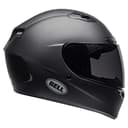
Your commute straddles sunset: the Bell Qualifier DLX MIPS. It is the cheapest helmet here after the budget pick and it is on this page for one feature: the ProTint photochromic shield, which tints itself in UV and clears when the light drops, so you are never stopping with cold hands to swap a shield. Bell adds MIPS, a rotational-impact system rarely found at this price. The caveats are real: DOT only, not Pinlock-ready, and a polycarbonate shell at 1,619 g.
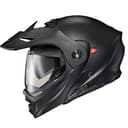
You want the newest certification without the Shoei money: the Scorpion EXO-AT960. DOT plus ECE 22.06, a flip-up modular chin bar, the SpeedView drop-down sun visor, and a removable ADV peak you can take off for road use. At a published 1,858 g it is the heaviest helmet on this page and it is advanced polycarbonate rather than composite — which is exactly what you would expect for roughly a third of the top pick’s price.
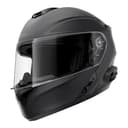
You do not want to take your gloves off: the Sena Outrush R. A flip-front with a drop-down sun visor and Bluetooth 5.1 comms built into the shell — four-way intercom, roughly 900 m, a quoted 18 hours of talk time — so calls, music and directions are handled by buttons designed to be found with a gauntlet on, rather than by a phone you would have to expose a hand for. It is polycarbonate ABS at 1,730 g, DOT only, and not Pinlock-ready, which is the trade.
You want one helmet for winter and summer: the Scorpion EXO-GT930 Transformer, whose chin bar comes off entirely rather than merely lifting — a sealed full-face in January and a genuine open-face in July. ECE 22.05 and DOT, the SpeedView sun visor, advanced polycarbonate at 1,814 g.
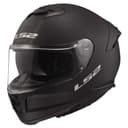
The budget pick: the LS2 Stream II at under $150, and it is not a compromise on the two things this page ranks on. A Pinlock-ready shield, a drop-down sun visor, AREM rotational-energy management and ECE 22.06 — the current standard, which only one other helmet on this page carries. Budget for the Pinlock insert on top and you have the winter essentials for less than the cost of a pair of heated gloves.
What to buy with it
Three things, in order of how much difference they make. A Pinlock insert for whichever helmet you choose — it is the single highest-value winter accessory and four of these six take one. A balaclava or neck tube, which seals the gap at the collar that lets cold air up into the helmet and also stops some breath reaching the shield. And gloves rated for the temperature you actually ride in, because cold hands end rides long before a cold head does — our winter glove ranking covers the certified and heated options.
For the rest of the kit, our cold-weather gear list takes it layer by layer, and how to stay warm on a motorcycle covers the technique that no amount of gear replaces. If fogging is the specific thing ruining your rides, start with how to stop a helmet fogging.
Who we left off, and why
The Schuberth S3 is arguably the best winter full-face we rank on fog management alone — it is the only helmet in our registry with a preinstalled Pinlock 120 — and it has a V-lock sun visor and in-shell speakers. It is left off here only because it is a fixed full-face, and on a page ranked partly on gloved operation and glasses, the flip-fronts win. It is the top full-face pick on our quietest helmet ranking.
The HJC RPHA 91 is a composite modular with a sun visor and a Pinlock-ready shield for $545, which on paper belongs here. Its US listing publishes DOT and no ECE rating at all, which costs it against the two ECE 22.06 picks above it. It is on our modular ranking.
Open-face and half helmets are deliberately absent. They are genuinely pleasant helmets and three of them are on our lists, but an open chin in freezing air is the one configuration no accessory fixes. Our open-face ranking covers them for the rest of the year.