The Lid Test

The Best Motorcycle Helmets Under $500

Eighteen of the thirty helmets we can price were under $500 at our last check, and the next one up is $545. At that same check the Snell-rated composite flagship landed exactly on the ceiling — so this page is gated on the live number, not on a list price.

By Stephen V.Last verified How we compare

The verdict

The Shoei RF-1400 is the pick for most riders, and for an unusual reason: it is the highest-scoring full-face we rank, and at our last price check it sat right on the $500 line rather than well above it. That is a hand-laid AIM+ composite shell with both DOT and Snell M2025 at the top of this band. If you want the newest certification rather than the best shell, the Scorpion EXO-AT960 is the cheapest ECE 22.06 helmet here with a sun visor. The open-face answer is the Shoei J-Cruise II, the comms answer is the Sena Stryker, and the budget pick — the cheapest current Snell rating we rank anywhere — is the Scorpion EXO-R430. Every price here was pulled live from Amazon and last checked November 22, 2026. Because this page is price-gated, check the button before you buy: the RF-1400 in particular moves across the line.

$500 is the most interesting ceiling in helmets, because it is the one where the answer changes from month to month. Below $200 the question is simple and we answer it on its own page. Above $600 you are buying a flagship and the badge decides most of it. In between sits a band where a composite shell, a current certification, a sun visor and built-in comms are all available — just never all four in the same helmet.

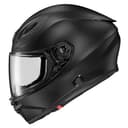
Here is the shape of the band at our last live check: eighteen of the thirty helmets we can price were under $500 (November 22, 2026), and the next helmet up is $545. The ceiling lands in a $45 gap, which is why this page can honestly claim to cover the whole band rather than an arbitrary slice of it.

And one specific thing happened at that check that is worth putting at the top. The Shoei RF-1400 — the helmet that tops our full-face ranking and the one most other helmets get measured against — came in at $499.99. Our own check a week earlier had it at $541.00. Every price on this page comes from a daily Amazon pull rather than from a list price, and it carries its own date on the button, so if that pick has drifted back over the ceiling you will see it there before you click. We would rather show you a moving number than pretend a helmet is permanently $499.

How this is funded: we earn a commission if you buy through our links, at no extra cost to you. It never changes which helmet we recommend, and we’ll tell you plainly when a cheaper or lighter one is the better buy. Full disclosure.

Quick picks

Ranked on our spec score — certification, weight, features and value. Select a row to jump to the full write-up. We have not tested these helmets; here is exactly how we compare them instead.

#HelmetBest forCertificationsWeightShellOur scorePrice
1
Shoei RF-1400

Shoei RF-1400

The full-face benchmark most riders are quietly measuring everything else against. Snell M2025 plus DOT, a hand-laid AIM+ composite shell, and Shoei's quietest, most refined shield system — it earns the price on the spec sheet, not the badge.

Best overall under $500DOT, Snell M20251651 gAIM+ multi-composite (interwoven fiberglass and organic fibers)9.3
$499.99 · View on Amazon

$549.999% off

Price as of November 22, 2026. #ad How we’re funded

2
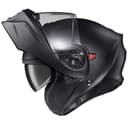
Scorpion EXO-AT960

Scorpion EXO-AT960

The Swiss-army ADV lid on a budget: it's modular AND adventure — flip-up chin bar, drop-down sun visor, removable peak — so it works as a touring modular or a dirt-road adventure helmet. DOT and ECE 22.06 for around $300.

Best certification for the moneyDOT, ECE 22.061858 gAdvanced LG polycarbonate8.0
$314.95 · View on Amazon

Price as of November 22, 2026. #ad How we’re funded

3
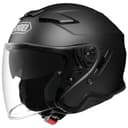
Shoei J-Cruise II

Shoei J-Cruise II

The open-face helmet built to full-face standards everywhere except the chin bar: AIM composite shell, a Pinlock-ready CJ-2 shield that is 10 mm longer than the one it replaced, a proper internal sun shield, and a shell tooled for Shoei's SRL headset. It is also the heaviest helmet on this page and carries DOT alone, which is the honest catch at this money.

Best open-faceDOT1615 gAIM (Advanced Integrated Matrix) multi-composite, four shell sizes8.6
$499.99 · View on Amazon

Price as of November 22, 2026. #ad How we’re funded

4
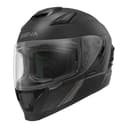
Sena Stryker

Sena Stryker

The previous-generation full-face, and the cheapest route to a composite shell with Harman Kardon audio, Mesh Intercom 3.0 and a retractable sun visor. The radio is a generation behind the Phantom's and the quoted mesh talk time is roughly a third of it — that is the trade you are making for the money.

Best with comms built inDOT1750 gComposite fiberglass shell8.0
$249.50 · View on Amazon

Price as of November 22, 2026. #ad How we’re funded

5
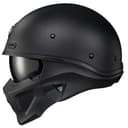
Scorpion Covert X

Scorpion Covert X

One helmet that converts between three shapes: pull the magnetic front mask and the ear covers and it goes from full coverage to three-quarter to a half shell. That is a real answer to the open-face problem — you keep the coverage for the highway and drop it for town — but the DOT approval covers the helmet, not a claim that a maskless configuration protects like a full-face.

Best for cruisersDOT1501 gUltra-TCT (fiberglass, aramid and poly-resin fibers) over dual-density EPS8.2
$339.95 · View on Amazon

Price as of November 22, 2026. #ad How we’re funded

6
Scorpion EXO-GT930 Transformer

Scorpion EXO-GT930 Transformer

The trick here is a genuinely removable chin bar — the GT930 runs as a full-face or, with the bar off, a proper open-face, which few modulars actually allow. Add a sun visor and a sub-$300 price and it's the value convertible.

Best modularDOT, ECE 22.051814 gAdvanced polycarbonate7.9
$279.95 · View on Amazon

Price as of November 22, 2026. #ad How we’re funded

7
Scorpion EXO-R430

Scorpion EXO-R430

The budget standout, because it carries the current Snell M2025 on top of DOT — a genuine top-tier impact rating for well under $200. It's also comm-ready with an EXO-COM port, so a Bluetooth setup is a clean add later.

Cheapest route to Snell M2025DOT, Snell M20251642 gAdvanced polycarbonate8.1
$184.95 · View on Amazon

Price as of November 22, 2026. #ad How we’re funded

Specs read from each manufacturer or retailer listing on the date shown in that helmet’s write-up below; “Not published” means the maker does not state that figure. Prices are pulled live from Amazon and were last checked November 22, 2026.

The picks in full

#1Best overall under $500Our score9.3

Shoei RF-1400

The full-face benchmark most riders are quietly measuring everything else against. Snell M2025 plus DOT, a hand-laid AIM+ composite shell, and Shoei's quietest, most refined shield system — it earns the price on the spec sheet, not the badge.

Strengths

  • Carries both DOT and Snell M2025 — the stricter Snell impact protocol on top of the US legal minimum
  • AIM+ multi-composite shell in multiple sizes keeps the fit true and the weight sensible for a fiberglass lid
  • CWR-F2 shield and vortex generators are aimed squarely at wind noise, the thing most riders complain about

Trade-offs

  • Premium money — you're paying for the shell and finish, not gadgets
  • No drop-down internal sun visor (Shoei's design choice; you swap to a tinted shield instead)
CertificationsDOT, Snell M2025
Weight1651 g
ShellAIM+ multi-composite (interwoven fiberglass and organic fibers)
Head shapeIntermediate oval
SizesXS-3XL
Internal sun visorNo
Pinlock-readyYes

Notable. CWR-F2 shield with vortex generators; 3D Max-Dry liner; emergency quick-release cheek pads

Specs read from the manufacturer / retailer listing, on July 19, 2026. “Not published” means the maker does not state that figure.

#2Best certification for the moneyOur score8.0

Scorpion EXO-AT960

The Swiss-army ADV lid on a budget: it's modular AND adventure — flip-up chin bar, drop-down sun visor, removable peak — so it works as a touring modular or a dirt-road adventure helmet. DOT and ECE 22.06 for around $300.

Strengths

  • Modular flip-up chin bar plus a removable ADV peak — two helmets in one
  • Drop-down SpeedView sun visor and an EverClear fog-free shield
  • DOT and ECE 22.06 at a budget price

Trade-offs

  • Polycarbonate shell is heavy (~1,858 g in M) — the heaviest lid here
  • Jack-of-all-trades design isn't as focused as a dedicated street or dirt helmet
CertificationsDOT, ECE 22.06
Weight1858 g
ShellAdvanced LG polycarbonate
Head shapeIntermediate oval
SizesXS-3XL
Internal sun visorYes
Pinlock-readyNo

Notable. Modular flip-up chin bar; SpeedView sun visor; removable ADV peak

Specs read from the manufacturer / retailer listing, on July 19, 2026. “Not published” means the maker does not state that figure.

#3Best open-faceOur score8.6

Shoei J-Cruise II

The open-face helmet built to full-face standards everywhere except the chin bar: AIM composite shell, a Pinlock-ready CJ-2 shield that is 10 mm longer than the one it replaced, a proper internal sun shield, and a shell tooled for Shoei's SRL headset. It is also the heaviest helmet on this page and carries DOT alone, which is the honest catch at this money.

Strengths

  • Pinlock-ready CJ-2 face shield with tool-less QRSA removal — an anti-fog capability almost no other open-face helmet offers
  • QSV-2 internal sun shield drops 5 mm lower than the previous generation, so low sun is handled without swapping shields
  • AIM multi-composite shell across four shell sizes, which is the same construction philosophy as Shoei's full-face lineup
  • The shell is tooled for the Shoei SRL/SRL2 headset by Sena, so comms sit flush instead of clamping to the outside

Trade-offs

  • The outgoing generation — Shoei now sells the J-Cruise 3 in the US above it, on a revised shell and reworked ventilation. The II is still widely stocked and distinctly cheaper, and the US listing for the 3 still states DOT alone, so the certification argument does not change
  • 3.56 lb (about 1,615 g) — heavier than several full-face helmets, because a big shield and a sun shield weigh what they weigh
  • Shoei's US distributor lists the standard as DOT FMVSS 218 only; no Snell and no ECE is claimed for the US version
  • Premium money for a helmet with no chin bar, which is a trade you have to want rather than tolerate
  • Pinlock insert is sold separately despite the shield being prepared for it
CertificationsDOT
Weight1615 g
ShellAIM (Advanced Integrated Matrix) multi-composite, four shell sizes
Head shapeIntermediate oval
SizesXS-2XL
Internal sun visorYes
Pinlock-readyYes

Notable. CJ-2 shield with QRSA tool-less removal; QSV-2 internal sun shield; 3D Max-Dry liner; upper vent redesigned for roughly 30% more intake air

Specs read from the manufacturer / retailer listing, on August 31, 2026. “Not published” means the maker does not state that figure.

#4Best with comms built inOur score8.0

Sena Stryker

The previous-generation full-face, and the cheapest route to a composite shell with Harman Kardon audio, Mesh Intercom 3.0 and a retractable sun visor. The radio is a generation behind the Phantom's and the quoted mesh talk time is roughly a third of it — that is the trade you are making for the money.

Strengths

  • Retractable sun visor — the cheapest route to one in Sena's smart-helmet range; Sena publishes no sun visor at all for the newer Phantom, and the Specter that does state one costs more
  • Composite fiberglass shell, the same construction family as the Phantom, at 1,750 ±50 g in a Medium
  • Mesh Intercom 3.0 with a quoted 2 km (1.2 mi) range and Group Mesh for 24 riders
  • Premium speakers and microphone with sound by Harman Kardon
  • Integrated LED taillights, so the helmet is lit from behind as well as connected

Trade-offs

  • Bluetooth 5.0, a generation behind the Phantom and the Specter
  • Sena quotes up to 13 hours on Mesh (20 hours on Bluetooth intercom) against 35 hours for the Phantom, and says LED use shortens both
  • The European version is ECE 22.05, the superseded standard; the US version is DOT only
  • The Pinlock anti-fog insert is an accessory, not something Sena includes
CertificationsDOT
Weight1750 g
ShellComposite fiberglass shell
SizesS-XXL
Internal sun visorYes
Pinlock-readyYes
IntercomMesh Intercom 3.0 + Bluetooth 5.0
Range (bike to bike)2 km (1.2 mi) in open terrain
Max riders (group)24
Talk time13 hours
SpeakersHarman Kardon

Notable. Retractable sun visor and integrated LED taillights; Mesh Intercom 3.0 with Harman Kardon speakers; Pinlock insert sold as an accessory

Specs read from the manufacturer / retailer listing, on September 24, 2026. “Not published” means the maker does not state that figure.

#5Best for cruisersOur score8.2

Scorpion Covert X

One helmet that converts between three shapes: pull the magnetic front mask and the ear covers and it goes from full coverage to three-quarter to a half shell. That is a real answer to the open-face problem — you keep the coverage for the highway and drop it for town — but the DOT approval covers the helmet, not a claim that a maskless configuration protects like a full-face.

Strengths

  • Full-coverage, three-quarter and half-shell configurations from one shell, with the front mask held on by neodymium magnets
  • Ultra-TCT shell layering fiberglass, aramid and poly-resin over a dual-density EPS liner — a composite, not polycarbonate
  • Dark smoke SpeedView internal sun visor with EverClear anti-fog installed, plus a clear visor supplied for night riding
  • Cold-weather ear covers with integrated Bluetooth speaker pockets are in the box

Trade-offs

  • 3.31 lb (about 1,501 g) — the heaviest way to arrive at a half helmet, because you carry the convertible hardware either way
  • DOT only; no ECE and no Snell is stated on the US listing
  • A removable magnetic front mask is a styling and wind-blast feature, not a certified chin bar — do not read it as full-face protection
  • The most expensive helmet here apart from the Shoei, and the parts you take off have to live somewhere
CertificationsDOT
Weight1501 g
ShellUltra-TCT (fiberglass, aramid and poly-resin fibers) over dual-density EPS
Head shapeIntermediate oval
SizesSM-2XL (55-64 cm)
Internal sun visorYes
Pinlock-readyNo

Notable. Magnetic removable front mask for full, three-quarter and half configurations; SpeedView internal sun visor; KwikWick 3 liner; ear covers with speaker pockets

Specs read from the manufacturer / retailer listing, on August 31, 2026. “Not published” means the maker does not state that figure.

#6Best modularOur score7.9

Scorpion EXO-GT930 Transformer

The trick here is a genuinely removable chin bar — the GT930 runs as a full-face or, with the bar off, a proper open-face, which few modulars actually allow. Add a sun visor and a sub-$300 price and it's the value convertible.

Strengths

  • Removable chin bar converts between full-face and open-face configurations
  • SpeedView drop-down internal sun visor and EXO-COM Bluetooth-ready pockets
  • DOT and ECE 22.05 certified at a budget price; includes a detachable peak

Trade-offs

  • Certified to the older ECE 22.05, not 22.06
  • Polycarbonate shell is heavy (~1,814 g) — one of the weightier lids here
CertificationsDOT, ECE 22.05
Weight1814 g
ShellAdvanced polycarbonate
Head shapeIntermediate oval
SizesXS-3XL
Internal sun visorYes
Pinlock-readyNo

Notable. Removable chin bar (full-face to open-face); SpeedView sun visor; EXO-COM-ready

Specs read from the manufacturer / retailer listing, on July 19, 2026. “Not published” means the maker does not state that figure.

#7Cheapest route to Snell M2025Our score8.1

Scorpion EXO-R430

The budget standout, because it carries the current Snell M2025 on top of DOT — a genuine top-tier impact rating for well under $200. It's also comm-ready with an EXO-COM port, so a Bluetooth setup is a clean add later.

Strengths

  • Carries DOT plus the current Snell M2025 — a real, up-to-date Snell rating at a budget price
  • EXO-COM comm-ready port and Bluetooth speaker pockets for an easy comms add
  • Ellip-Tec latching face shield with EverClear anti-fog coating

Trade-offs

  • Polycarbonate shell is heavier (~1,642 g) than a composite helmet
  • Stock shield is EverClear anti-fog, not Pinlock (a Pinlock-prepared shield is sold separately); no internal sun visor
CertificationsDOT, Snell M2025
Weight1642 g
ShellAdvanced polycarbonate
Head shapeIntermediate oval
SizesXS-4XL
Internal sun visorNo
Pinlock-readyNo

Notable. Snell M2025; Ellip-Tec latching shield with EverClear anti-fog; EXO-COM comm-ready

Specs read from the manufacturer / retailer listing, on July 19, 2026. “Not published” means the maker does not state that figure.

How we ranked the band

Price gates this page; it does not rank it. Every pick had to carry a live price under $500 at the publish-day refresh, and then the order came from the same three things every helmet ranking on this site uses: what the maker certifies, then what the shell is actually made of, then published weight. After that we separated the picks by job rather than by score, because this band is unusually wide in helmet types — a full-face, an open-face, a modular, a convertible, an adventure lid and a smart helmet all sit under $500, and a reader with a cruiser and a reader with a sport bike want different answers.

Every figure in the comparison table is read from the maker’s or a US retailer’s listing on a dated visit. Where a maker does not publish something — and in this band that happens a lot, because DOT-only listings often state nothing else — the table says “Not published” rather than guessing. One pattern worth noticing before you read further: of these seven, only two publish ECE 22.06 and only two publish Snell, and they are four different helmets.

The trade-off that defines this band

The best shell and the best certification are not the same helmet. This is the single most useful thing to understand about shopping at $500. The two composite Shoeis here publish DOT, and the RF-1400 adds Snell M2025; neither states ECE 22.06. The two helmets that do publish ECE 22.06 — the EXO-AT960 and, further down the price list, the LS2 Stream II — are both polycarbonate. So you are choosing which certification you want rather than collecting all of them, and the honest framing is that all three standards (DOT, ECE 22.06, Snell) are real impact protocols with different emphases. Our guide to helmet ratings explains what each one actually tests.

Weight is where the money shows up most. The lightest pick here is the EXO Covert X at a published 1,501 g, and it is also a composite — Scorpion’s Ultra-TCT fiberglass and aramid layup. The heaviest is the EXO-AT960 at 1,858 g, which is the price of a modular chin bar, a peak and a sun visor in a polycarbonate shell. That is a 357 g spread inside one price band, and it is the difference you feel at hour four, not at the checkout. Our lightweight ranking puts the whole registry in order on published grams.

The sun visor is nearly free down here, and nearly absent up there. Five of these seven publish a drop-down internal sun visor. Neither Shoei full-face does, because Shoei treats it as a design choice and sells a tinted shield instead. That inverts the usual assumption that features arrive with price — in helmets, the sun visor is a mid-market feature and the premium full-faces deliberately leave it out. The full pattern is on our sun-visor ranking.

Match the pick to the bike

Sport, sport-touring or one helmet for everything: the RF-1400, if the live price is still at the ceiling when you read this. It is the best shell, the strongest certification stack and the most refined shield system in the band, and the things it gives up — a sun visor and any electronics — are the things you can add or live without. If it has drifted over the line, the honest substitute at this certification level is the EXO-R430 at the bottom of the band, and the money you save buys the intercom.

Adventure, dual-sport, or you want the newest standard: the EXO-AT960. DOT plus ECE 22.06, a flip-up modular chin bar, a SpeedView drop-down sun visor and a removable peak, which is a lot of configurability for the money. It is the heaviest pick here at a published 1,858 g and it is polycarbonate rather than composite — both of which are exactly what you would expect for the price. Our adventure helmet ranking shows what the carbon ADV lids above it buy.

Cruiser, scooter or anything where you want your face out: the EXO Covert X for a three-quarter or half configuration — its front mask comes off magnetically, so one helmet covers three looks — or the J-Cruise II if you want Shoei’s AIM composite and four shell sizes in an open-face with a proper face shield and the QSV-2 internal sun shield. The Covert X is the lighter and cheaper of the two; the J-Cruise II is the better-built one and sits right at the ceiling. Both are DOT-only on the listings we read. See also our cruiser ranking and open-face ranking.

You want comms and you do not want a unit clamped on: the Sena Stryker. A composite fiberglass shell with Mesh Intercom 3.0, Harman Kardon speakers, a retractable sun visor and integrated LED taillights, at a published 1,750 ±50 g in a Medium. The honest caveats are all generational: Bluetooth 5.0 rather than the 5.3 in Sena’s newer helmets, a quoted 13 hours on mesh against 35 for the current flagship, DOT only on the US version, and the Pinlock insert is an accessory. Our smart helmet ranking covers the units above it.

You want to flip the front up at traffic lights: the EXO-GT930, which is the only true convertible in the band — the chin bar comes off entirely, so it runs as a full-face or a genuine open-face rather than a modular that merely lifts. It publishes ECE 22.05 rather than 22.06, and at 1,814 g it is the second-heaviest pick here. The other modular under the ceiling is the Sena Outrush R, which trades the convertibility for built-in Bluetooth; our modular ranking has both, plus the composite modulars that start just above this page.

Who we left off, and why

The HJC RPHA 91 is the first helmet above the ceiling at $545, and it is the cheapest composite-shell modular we rank — a P.I.M. EVO carbon, carbon-glass and linen layup with a sun visor. If your real question is the cheapest good modular rather than the best helmet under $500, it is worth the extra, and it is on our modular page.

The HJC RPHA 11 Pro is the awkward one, and we would rather say so than quietly omit it. It is a PIM+ carbon-blend composite full-face at a published ~1,417 g — the lightest shell anywhere near this band — and it has historically sold well under $500. But it carried no live price at our last refresh, and a price-gated page cannot include a helmet whose price we cannot verify today. Its review page has the full spec read and the live button, which is the right place to check it.

The sub-$200 shelf is deliberately represented by one pick rather than five. Seven more helmets we rank sit under $200 and they are all genuinely good for the money; putting them all here would turn a page about a $500 budget into a cheaper list wearing a bigger number. They have their own page: the best helmets under $200.
Frequently asked questions

Can you get a Snell-rated helmet for under $500?

Yes, at both ends of the band. At our last live check the Shoei RF-1400 carried DOT plus Snell M2025 at $499.99 — right on the ceiling — and the Scorpion EXO-R430 carries the same current Snell M2025 generation for well under $200. The difference between them is not the certification, it is the shell: the Shoei is a hand-laid AIM+ multi-composite in multiple shell sizes at a published 1,651 g, and the Scorpion is advanced polycarbonate at a published 1,642 g with a single shell family. Both passed the same Snell impact protocol.

Is there a composite-shell helmet under $500, or is it all polycarbonate?

There are several, and that is the main thing this band buys you over the sub-$200 shelf. Among our picks, the RF-1400 is hand-laid AIM+ multi-composite, the J-Cruise II is AIM multi-composite built in four shell sizes, the EXO Covert X is Scorpion's Ultra-TCT fiberglass-and-aramid layup at a published 1,501 g, and the Sena Stryker is a composite fiberglass shell. The two Scorpion picks with the strongest certifications — the EXO-AT960 and the EXO-R430 — are both polycarbonate, which is the trade-off the page keeps running into: in this band, the best shell and the best certification are usually not the same helmet.

What does $500 not buy you in a helmet?

Three things, consistently. It does not buy a flagship modular — the cheapest composite-shell modular we rank is $545 and the premium ones are well past $900. It does not buy the newest certification on the best shell: of the helmets under $500 at our check, the ones publishing ECE 22.06 are polycarbonate, and the composite ones publish DOT or DOT plus Snell. And it does not buy a carbon shell at all; the cheapest full carbon helmet we rank is a long way above this ceiling, and our carbon page explains why exactly one helmet we list publishes a genuine full-carbon layup.

Why is the RF-1400 on a page about helmets under $500 when it usually costs more?

Because this page is gated on the live price rather than on a list price, and at our last daily check that helmet was $499.99. We are not going to leave the best helmet in the band off the list to keep a tidy story, and we are not going to pretend the number is fixed either — our own check a week earlier had it at $541.00. Amazon prices on premium helmets move with colorway and size, sometimes by tens of dollars in a week. The button carries the current number and the date it was pulled; if it is over the ceiling when you read this, that is the honest answer and the rest of the list is still here.

Is a cheap helmet less safe than an expensive one?

Not in the way most people assume, and the certifications in this band are the proof. A helmet sold legally in the US meets DOT, and some of the cheapest helmets we rank carry a stricter rating on top of it — the EXO-R430 publishes Snell M2025 at well under $200, and the LS2 Stream II publishes ECE 22.06 at under $150. What money buys at the top of this band is shell construction, shell sizing, weight, finish, shield hardware and noise control, all of which affect whether you actually wear the helmet and how tired you are after four hours. Our page on whether cheap helmets are safe goes through what the standards do and do not test.

Should I spend the whole $500 or buy cheaper and add comms?

It depends which problem is annoying you. If you want music and rider-to-rider talk, buying a $280 helmet and a mid-range intercom usually gets you a better radio than a $500 helmet with the electronics built in — the Sena Stryker here publishes Mesh Intercom 3.0 on Bluetooth 5.0, a generation behind Sena's current units, and a quoted 13 hours on mesh. The case for the built-in helmet is that there is nothing clamped to your shell and nothing to forget. Our intercom ranking covers the separate-unit route, and our built-in comms page covers the other one.

Sources

Keep reading