How we picked the substitutes
Each pick had to replace a named, published Klim claim rather than a general impression of the brand, and it had to be the same kind of thing — a jacket for a jacket, a jean for a jean. We worked layer by layer down the body, which is how a Klim buyer actually shops, and inside each layer the criterion was whatever Klim publishes for its own product in that slot: the garment class for outerwear, the EN 13594 clause and the insulation weight for gloves, the armor level and coverage for the base layer, the certification stack for the helmet.
Every figure in the comparison table is read from the maker’s or a US retailer’s listing on a dated visit, and anything a maker does not publish renders “Not published”. That matters more here than on most pages, because the real distance between Klim and the rest of the market is partly a disclosure gap rather than a materials gap — and in two of the slots below, the cheaper product actually publishes more than the Klim does.
Layer by layer
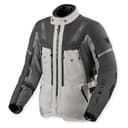
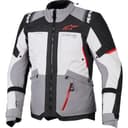
The jacket — REV’IT! Sand 5 H2O. The substitution that matters most, because the Carlsbad is the most expensive thing in our gear registry. The Sand 5 H2O matches it on the single hardest claim — Class AA certified to EN 17092-3:2020 — carries SEEFLEX CE Level 2 shoulder and elbow protectors certified to EN 1621-1:2012, and then adds range the Klim does not have: a detachable thermal liner that works as a jacket on its own, and a detachable hydratex 3L waterproof layer REV’IT! designed to be worn either inside the shell or over it. The honest cons: no back protector in the box (it is prepared for the SEESOFT Level 2 insert), three layers to manage instead of one, worn-underneath waterproofing that leaves the outer fabric free to soak, and thin Amazon stock on our last check. See it ranked against the Carlsbad directly on our all-season jacket ranking.
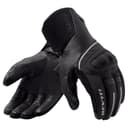
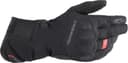
The cold-weather glove — REV’IT! Stratos 3 GTX. This is the slot where the cheaper product wins on the published numbers. Both are CE Level 1 KP to EN 13594; REV’IT! prints the year as well. Klim gives the Badlands GTX Long 60 g of Thinsulate on the backhand only; REV’IT! lists 3M Thinsulate G at 300 g and 80 g plus a high-loft fur liner. What Klim keeps is the construction: GORE-TEX bonded by GORE Grip rather than a Z-liner, a full gauntlet with a neoprene gasket rather than a regular cuff under the sleeve, and dual visor wipers. If you run heated grips, the Klim’s unlined palm is a feature rather than an omission. Both are on our winter glove ranking.
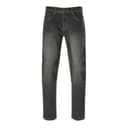
The riding jean — Scorpion EXO Covert Pro II. Same CE AA class to EN 17092-3:2020 as the K Fifty 2, with Rheon knee and hip armor included and — the part worth paying attention to — the CE level actually published as Level 1, with Level 2 offered as an upgrade. Klim names the K Fifty 2’s D3O Evo pads but does not state their EN 1621-1 level on that page. The Scorpion is also the more comfortable spec sheet: 13.5-14 oz high-stretch Nyco denim with a perforated Coolmax lining. Two real cons: one 32-inch inseam across every waist, where Klim runs genuine tall sizes, and no tailbone pad, where Klim includes a Poron XRD one. Both are on our riding pants ranking.
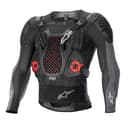
The armored base layer — Alpinestars Bionic Plus V2. Klim’s Tactical Pro is the only armored shirt we rank whose garment is certified as well as its pads, and it is a cooling shirt you can wear as your outer layer in August. The Bionic Plus V2 answers it on coverage instead: certified armor at four zones with every clause printed — EN 1621-1:2012 Level 1 elbows and shoulders, EN 1621-2:2014 Level 2 back, EN 1621-3:2018 Level 2 chest — which makes it the cheapest route here to a certified protector on four zones at once, and the only pick with certified elbow armor. The cons are the flip side: it is a protection jacket rather than a shirt, so there is no fabric and no garment class at all, and it is cut for off-road use so it is bulkier under a close road jacket. Both sit on our armored base layer ranking.
The cheapest waterproof route — Alpinestars Andes V4 Drystar jacket. Not a Carlsbad substitute on certification, and the page should not pretend otherwise: it is Class A to EN 17092-4:2020, one class below, with Nucleon Flex Plus CE Level 1 shoulder and elbow armor and empty back and chest compartments. What it is, is the cheapest jacket we rank that does the two jobs a Klim buyer actually wants done: a Drystar membrane for genuine waterproofing, and a removable full-sleeve thermal liner (Alpinestars publishes 100 g in the body and 80 g in the sleeves) that the Carlsbad does not include at all. It is also Tech-Air Ready. If the Klim price is simply out of range rather than marginally out of range, start here.
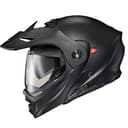
The helmet — Scorpion EXO-AT960. The Krios Pro is a hand-laid full carbon shell at a published 1,450 g in Large with DOT plus ECE 22.06, Koroyd structure, four ride modes and a photochromic shield, and nothing on this page matches that construction. What the EXO-AT960 matches is the certification: DOT plus ECE 22.06, the standard that adds rotational and multi-point impact testing, for roughly half the money at our last check, with a flip-up modular chin bar, a SpeedView drop-down sun visor and a removable peak. It pays for that in weight — a published 1,858 g against the Krios Pro’s 1,450 g, which is over 400 g you carry all day — and in shell material, because it is advanced LG polycarbonate rather than carbon. Our Krios Pro vs XD-5 comparison covers the premium end of that decision, and the adventure helmet ranking has all five ADV lids we rank.
The three-season glove — Alpinestars Tourer W-7 V2 Drystar. Klim’s Vanguard GTX Short is the highest- scoring glove in our entire registry: bonded GORE-TEX and GORE Grip, a goat leather palm, and deliberately neither venting nor insulation so it covers a wide temperature band instead of a narrow one. The Tourer W-7 V2 is the cheapest glove we rank that prints the same clause in full — “CE Certified Category II EN 13594:2015 LEVEL 1 KP” — behind a Drystar membrane Alpinestars rates at 5,000 mm / 5,000 g/m², with a long touring cuff that goes over the sleeve rather than under it. The caveats: a textile upper with a leather palm rather than leather throughout, and Alpinestars prints two different insulation figures for it without reconciling them. Both are on our touring glove ranking.
What none of these replaces
Bonded waterproofing. GORE Grip and a GORE-TEX Performance Shell are structural choices, and no pick here reproduces them. A Z-liner, a detachable layer and an unspecified membrane will all keep rain out of a new garment. Where they differ from a bonded build is over time and under load, when a free-floating liner can start to move against the shell — which in a glove is the difference between feeling the bars and feeling the lining.
Armor already in the box at three points. The Carlsbad ships Rogue CE Level 2 pads at shoulders, elbows and back. Of the two AA jackets here, the REV’IT! is prepared for a back protector rather than supplied with one, and the Alpinestars has empty back and chest compartments. Add the cost of the missing insert before you compare prices, because a Level 2 back protector is not a trivial line item — our CE Level 2 ranking is built entirely around which makers fill the pocket for you.
The size run. Klim runs genuine tall inseams on the K Fifty 2 (32, 34, 36 and 38) where the Scorpion jean ships a single 32-inch inseam at every waist. If you are tall, that is not a detail — it is the whole decision, and it is the one place on this page where the cheaper option may simply not fit you.
If you still want the Klim
Then buy the piece where its four claims stack up hardest, which is the Carlsbad: a GORE-TEX Performance Shell, CE AA to EN 17092-3, and Rogue CE Level 2 armor at shoulders, elbows and back with nothing left to purchase. Budget for a thermal mid-layer, because Klim lists no thermal liner for it. If the jacket is out of reach but you want the brand’s construction somewhere, the Vanguard GTX Short glove is the cheapest Klim we rank that still carries bonded GORE-TEX and a printed EN 13594 clause. Our Klim brand page lists all seven products we rank with live prices, and is honest about the four things Klim consistently does not publish.