The yardstick: what Alpinestars publishes
Four things, consistently, and they are the reason this brand ranks well on a site that scores on published facts. The EN clause with its year — not “CE approved” but “EN 1621-1:2012 Level 1”. The garment class — EN 17092-3 Class AA on the leather, EN 17092-4 Class A on the mesh, printed rather than implied. The zone each protector covers, separately, so you can tell a shoulder claim from a back claim. And the airbag standard — EN 1621-4:2013 with a level, which most of the airbag market does not print at all.
Three places it goes quiet. Weight is published for the Tech-Air 5 Plasma (1,530 g) and almost nothing else in the range. Leather thickness is given for the GP Plus R V4 Rideknit (1.3 mm) and the Missile V3 Airflow (1.3 mm) but described only as “premium bovine race leather” on the Missile V3 jacket. And on the Tourer W-7 V2 Drystar glove, Alpinestars’ own page prints two different insulation figures for the same product — our winter glove page shows both rather than picking one.
The system, not the garment
Tech-Air is the reason the range looks like this. Alpinestars sells an airbag and then sells you somewhere to put it, and once you notice that, the catalogue makes sense: the SMX Air is a mesh jacket built around a Tech-Air 5 Plasma, the T-GP Plus R V4 is a cheaper mesh jacket that is Tech-Air ready, the GP Plus R V4 Rideknit takes a Tech-Air 5 or 3, and the Missile V3 Leather takes the Tech-Air 7x. No other brand in our registry has that spine.
It changes the buying advice in a specific way. If you think you will own an airbag eventually, buy the jacket that takes the one you want — because the vest outlives the jacket and the compatibility is not retrofittable. If you know you will not, you are paying a few percent for a feature you will never use, and REV’IT! or Scorpion will often give you the same class for less. Our airbag vest ranking goes through what each system actually certifies.
The picks, layer by layer
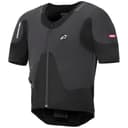
The airbag: Tech-Air 5 Plasma. 1,530 g, eight sizes from XS to 4XL, chest, rib, back and shoulder coverage, EN 1621-4:2013 Level 1 for the full back plus a passive EN 1621-2:2014 Level 1 back protector, and an EN 17092-6:2020 Class C undergarment rating for the vest itself. Electronic self-contained sensors arm it when the zip closes, the inflator is user-replaceable, and there is no subscription. It scores 9.2 on our rubric, level with the GP Pro R4 and above every jacket here.
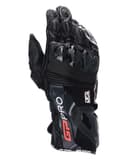
The gloves: GP Pro R4. Bovine and goat backhand with a kangaroo palm and fingers, inner-seam palm construction, Category II EN 13594:2015 Level 1 KP, dual-density DFS Race knuckle, palm and finger sliders, aramid reinforcement, and a finger bridge between the third and fourth fingers. Sizes S to 3XL. It is the second-highest-scoring glove we rank anywhere.
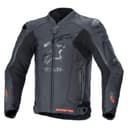
The jacket: GP Plus R V4 Rideknit Leather. 1.3 mm race-grade cowhide, CE AA to EN 17092-3, A-CS Plus composite stretch and Rideknit inner-arm panels, dual-density DFS external shoulder sliders, Tech-Air 5 and Tech-Air 3 ready. EU 48 to 60. The back and chest pockets ship empty.
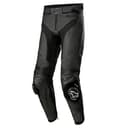
The pants: Missile V3 Airflow. 1.3 mm bovine leather with perforated thigh panels and accordion stretch zones, garment CE AA to EN 17092, GP-R Lite internal knee protection with replaceable sliders, a jacket waist connection zip and Tech-Air 10 compatibility. Bioflex hip protectors are sold separately, which the table states.
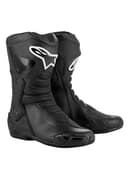
The boots: SMX-6 V3. Microfiber upper with 3D-mesh flex zones, certified to EN 13634:2017, with a TPU ankle brace, a dual-density ankle, a shin plate, replaceable toe sliders and front-flex and back-flexion zones. It is the better of the two boots we rank and it is still walkable.
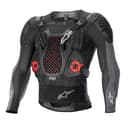
The armor layer: Bionic Plus V2. The most completely certified single garment in our registry: EN 1621-1:2012 Level 1 elbows and shoulders, EN 1621-2:2014 Level 2 back, EN 1621-3:2018 Level 2 chest, on a padded chassis with Perforated Cell Technology protectors and elastic quick-release closures, S to 2XL. It is the only pick on our base-layer page with certified elbow armor as well as chest, back and shoulder. Note what it is not: an armored base layer carries no abrasion protection, and is worn under a jacket, not instead of one.
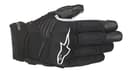
The budget pick: Faster gloves. A leather palm with a softshell windbreaker backhand, CE Level 1 with a soft viscoelastic knuckle and touchscreen fingertips, for well under $50. It is an urban and commuter glove and we say so plainly — it is the cheapest Alpinestars product we are willing to recommend, not the cheapest Alpinestars product.
Where to buy something else instead
Three honest gaps. Waterproofing: Drystar is a real membrane and the Andes V4 Drystar jacket and pant are good value, but Alpinestars publishes a water column figure for only one product we list (the Andes V3 Drystar glove, at 5,000 mm). If you want a published, bonded membrane, Klim’s GORE-TEX construction is the clearer claim — see our Klim brand page. Garment class in textile: Alpinestars’ textile jackets we list are Class A; REV’IT! certifies a ventilated textile jacket to Class AA. And helmets: Alpinestars makes them and we do not list one, so for a maker whose helmets and gear we both cover, start at Scorpion or Klim.
None of that undercuts the top of this page. On published certification clauses across a full kit, Alpinestars is the most complete brand we track, and the Tech-Air 5 Plasma is the single highest-scoring piece of protective equipment in the registry.